


























Views
Downloads
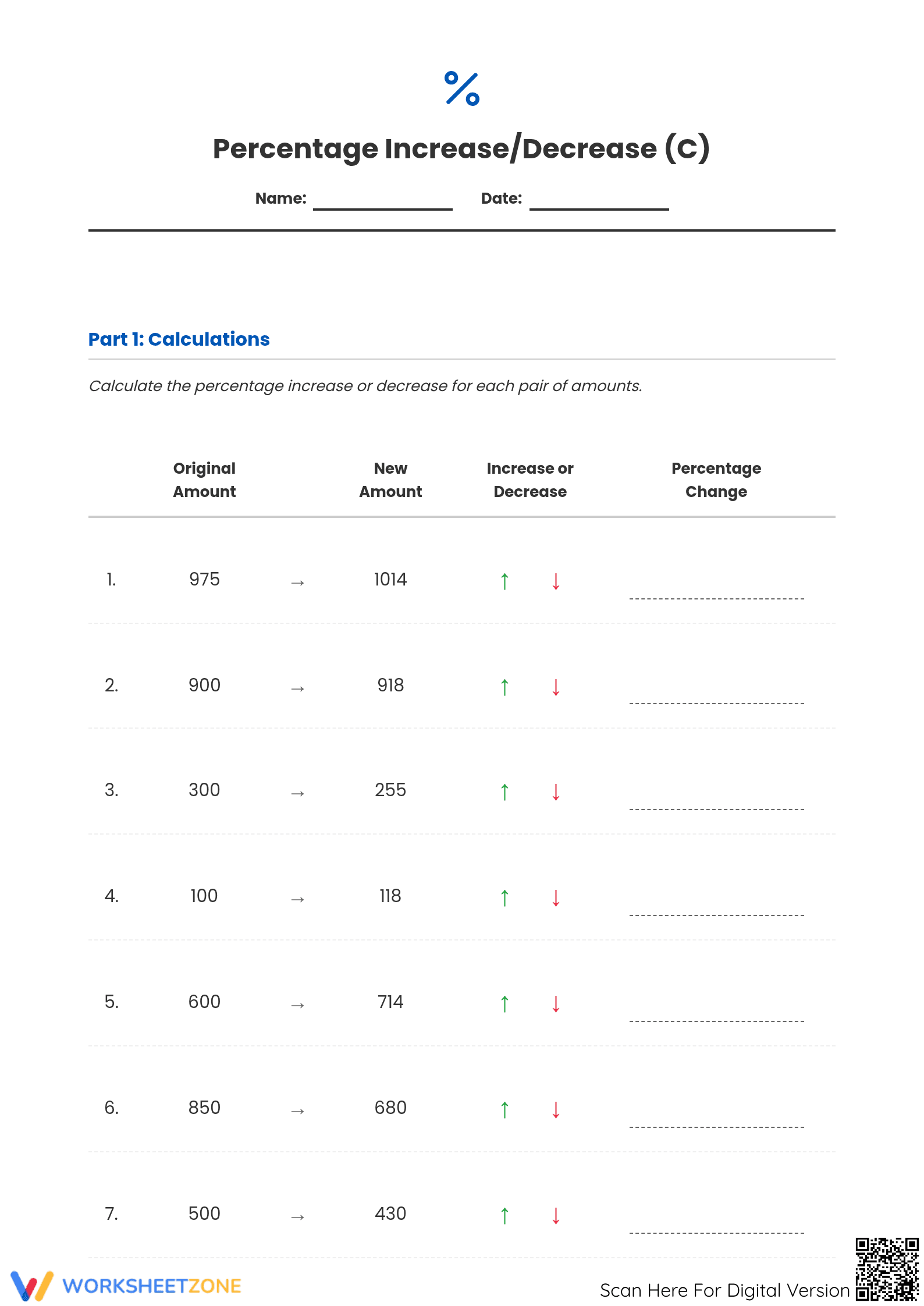


Essential Percent Increase/Decrease Worksheet | Grade 7 Math
Paste this activity's link or code into your existing LMS (Google Classroom, Canvas, Teams, Schoology, Moodle, etc.).
Students can open and work on the activity right away, with no student login required.
You'll still be able to track student progress and results from your teacher account.
This worksheet provides a focused environment for students to master the calculation of percentage increase and decrease. By comparing original and new values, learners develop a deep understanding of proportional relationships and real-world mathematical changes. This resource ensures students can confidently determine percentage shifts across various contexts, from abstract numbers to practical word problems.
At a Glance
- Grade: 7 · Subject: Math
- Standard:
CCSS.MATH.CONTENT.7.RP.A.3— Use proportional relationships to solve multistep ratio and percent problems- Skill Focus: Percent Increase and Decrease
- Format: 2 pages · 13 problems · Answer key included · PDF
- Best For: Middle school ratio and proportion practice
- Time: 25–35 minutes
The two-page PDF includes a comprehensive set of 13 exercises designed to build calculation fluency. Part 1 features a structured table with 10 problems where students identify the direction of change (increase or decrease) and calculate the exact percentage. Part 2 transitions to 3 real-world word problems involving markups, population changes, and test score improvements. A complete answer key is provided for immediate feedback and grading.
Skill Progression
- Guided Practice: The initial table problems provide a clear structure, helping students focus on the formula without the distraction of complex text.
- Supported Practice: Mid-table problems increase in numerical complexity, requiring careful division while maintaining the same familiar format.
- Independent Practice: The word problems require students to extract values and determine relationships independently before applying the formula.
This resource utilizes a gradual-release model, moving from structured table calculations to situational application.
Standards Alignment
The primary focus is `CCSS.MATH.CONTENT.7.RP.A.3`, which requires students to use proportional relationships to solve multistep ratio and percent problems, specifically mentioning percent increase and decrease. This worksheet directly addresses the core requirements of the Ratio and Proportional Relationships domain. This standard code can be copied directly into lesson plans, IEP goals, or district curriculum mapping tools.
How to Use It
This worksheet is ideal for use after a direct instruction lesson on ratios and percentages. Teachers can assign the table portion as guided practice during class to check for procedural understanding. The word problems can serve as a formative assessment to see if students can apply the concept to real-world scenarios. Expect students to complete both pages within 30 minutes, allowing for a quick review at the end of the period.
Who It's For
This resource is tailored for 7th-grade math students but is also appropriate for 6th-grade acceleration or 8th-grade review. It supports diverse learners by providing a visual table layout for the first 10 problems. It pairs naturally with a percent change anchor chart or a short introductory video on the difference between original and new amounts.
Calculating percentage change is a fundamental skill that bridges basic arithmetic and higher-level algebraic reasoning. According to EdReports 2024, high-quality instructional materials must prioritize the application of proportional relationships in diverse settings to ensure long-term mastery. This worksheet aligns with these findings by providing both isolated procedural practice and contextual application. Students who master `CCSS.MATH.CONTENT.7.RP.A.3` develop a stronger quantitative literacy, enabling them to interpret economic data, scientific results, and personal financial changes more effectively. Research from Fisher & Frey (2014) emphasizes the importance of scaffolding, which this resource provides through its transition from table-based calculations to complex word problems. By focusing on the "original amount" as the denominator, the worksheet reinforces a common area of student confusion, ensuring a solid foundation for more advanced mathematical concepts in subsequent grade levels. This intentional design facilitates deeper cognitive engagement and mathematical fluency.


