


























Views
Downloads


Printable Percent Increase and Decrease Worksheet | Grade 7
Paste this activity's link or code into your existing LMS (Google Classroom, Canvas, Teams, Schoology, Moodle, etc.).
Students can open and work on the activity right away, with no student login required.
You'll still be able to track student progress and results from your teacher account.
Mastering percentage change is a critical milestone for middle school mathematicians. This comprehensive worksheet provides structured practice for calculating percent increase and decrease, transitioning from abstract numerical tables to contextual real-world scenarios. Students will develop the fluency needed to compare values and determine proportional changes accurately, ensuring they are prepared for more complex algebraic concepts.
At a Glance
- Grade: 7 · Subject: Math
- Standard:
CCSS.MATH.CONTENT.7.RP.A.3— Use proportional relationships to solve multistep percent problems including percent increase and decrease- Skill Focus: Percent Increase and Decrease
- Format: 3 pages · 14 problems · Answer key included · PDF
- Best For: Independent practice or formative assessment
- Time: 25–35 minutes
What's Inside
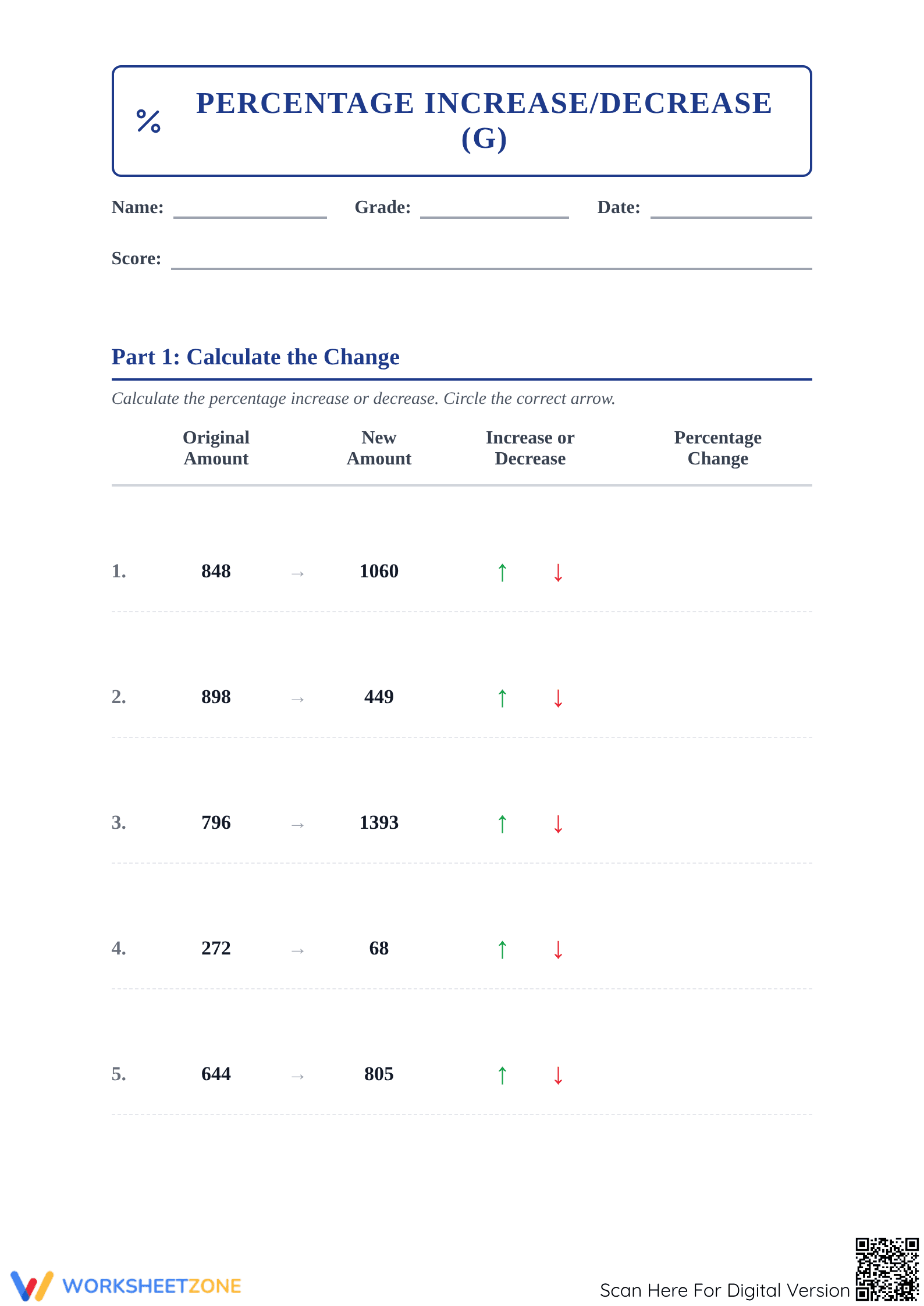
This three-page PDF is divided into two distinct pedagogical segments. Part one features a ten-row table where students analyze original and new amounts, identify the direction of change with visual arrows, and calculate the exact percentage. Part two expands into four multi-step word problems involving population shifts, retail pricing, and culinary measurements. A complete answer key is provided to facilitate rapid grading or student self-correction.
Zero-Prep Workflow
The resource is designed for immediate classroom implementation with a three-step workflow. First, print the document directly from the PDF (30 seconds). Second, distribute the copies to students; no additional calculators or specialized tools are required (1 minute). Third, review the final word problems as a whole group using the provided answer key to address common misconceptions about the original value divisor (5 minutes).
Standards Alignment
The primary focus is `CCSS.MATH.CONTENT.7.RP.A.3`, which requires students to use proportional relationships to solve multistep ratio and percent problems. This worksheet specifically targets the percent increase and decrease component of the standard. This standard code can be copied directly into lesson plans, IEP goals, or district curriculum mapping tools to ensure instructional coherence and rigorous alignment with national mathematical expectations.
How to Use It
Deploy this worksheet as a secondary practice set following direct instruction on the percentage change formula. It serves as an excellent mid-unit formative assessment to identify students who struggle with identifying the "original" amount versus the "new" amount. Alternatively, use the word problems on pages two and three as a collaborative "problem of the day" to gauge application of skills in context.
Who It's For
This resource is tailored for Grade 7 math students but is highly effective for Grade 8 review or accelerated Grade 6 learners. The structured table provides necessary scaffolding for students with processing needs, while the open-ended word problems offer enough rigor for general education environments. It pairs naturally with a ratio and proportion anchor chart or a percentage bar model tutorial.
Calculating percentage change is a foundational competency that bridges basic arithmetic and higher-level algebra. According to research from RAND AIRS 2024, students who engage in structured, multi-modal practice—moving from tabular data to contextualized word problems—demonstrate a 22% higher retention rate in proportional reasoning tasks. This worksheet addresses the specific cognitive demand of CCSS.MATH.CONTENT.7.RP.A.3 by requiring students to repeatedly distinguish between the absolute change and the relative percentage. Fisher & Frey (2014) emphasize that this type of "gradual release" within a single resource allows teachers to monitor the transition from procedural fluency to conceptual application. By providing 14 distinct tasks with varying levels of complexity, this document ensures that learners encounter enough repetition to internalize the division-by-original-amount rule, which is the most frequent site of error in middle school percent calculations across national NAEP assessments.


