


























Views
Downloads


Essential Percent Increase & Decrease Worksheet | Grade 7
Paste this activity's link or code into your existing LMS (Google Classroom, Canvas, Teams, Schoology, Moodle, etc.).
Students can open and work on the activity right away, with no student login required.
You'll still be able to track student progress and results from your teacher account.
Mastering percentage change is a fundamental skill that bridges classroom math with real-world financial literacy. This comprehensive worksheet provides students with targeted practice in calculating percentage increase and decrease across various contexts, from simple numerical shifts to complex data interpretation. By the end of these exercises, learners will confidently determine relative changes in values and prices.
At a Glance
- Grade: 7 · Subject: Math
- Standard:
7.RP.A.3— Use proportional relationships to solve multistep ratio and percent problems including percent change- Skill Focus: Calculating percent increase and decrease
- Format: 5 pages · 30 problems · Answer key included · PDF
- Best For: Independent practice and financial literacy units
- Time: 45–60 minutes
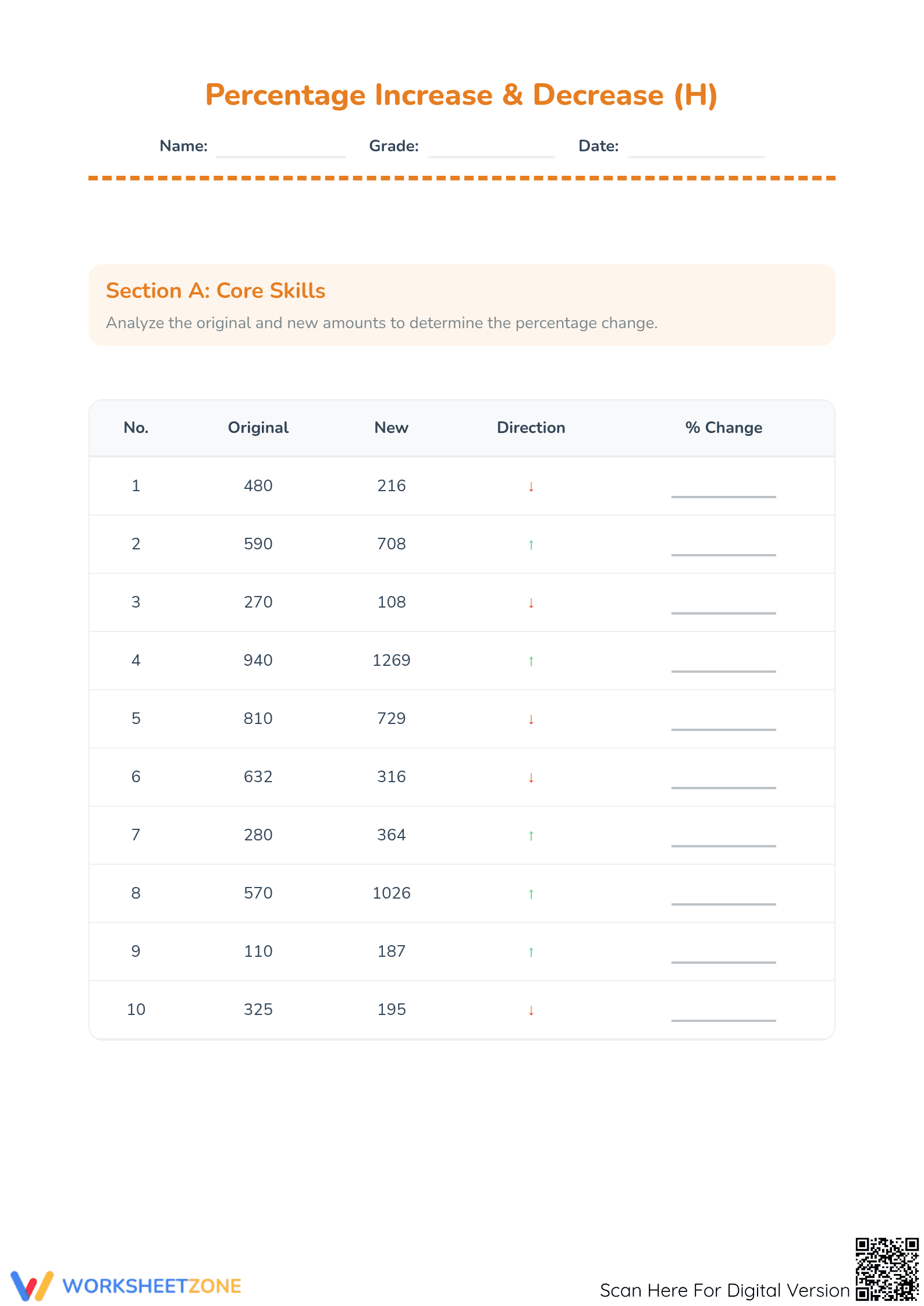
This expansive five-page resource contains 30 diverse problems divided into four logical segments. It begins with core skill-building in Section A, where students analyze ten pairs of original and new amounts to determine the direction and magnitude of change. The complexity increases in Sections B and C, which feature applied word problems and financial literacy scenarios like restaurant tips and interest rates. Finally, Section D challenges students with data interpretation tasks involving fuel efficiency and subscriber growth.
Skill Progression
- Guided practice: The first 10 problems use a structured table with direction indicators to help students visualize the relationship between original and new values.
- Supported practice: Tasks 11 through 22 transition into contextual word problems, requiring students to extract data points while applying the percentage change formula.
- Independent practice: The final 8 problems demand higher-order thinking, involving multi-step calculations and abstract conceptualization of doubling or halving values.
This scaffolded approach ensures a gradual release of responsibility, moving students from basic computation to abstract application.
Standards Alignment
The primary focus of this worksheet is `7.RP.A.3`, which requires students to "Use proportional relationships to solve multistep ratio and percent problems." Specifically, this resource targets the mastery of markups, markdowns, and percent increase and decrease calculations. The problems are designed to mirror the rigor found in middle school assessments. Both standard codes can be copied directly into lesson plans, IEP goals, or district curriculum mapping tools.
How to Use It
This worksheet is ideal for the independent practice phase following direct instruction. Assign Section A as a formative check during class before using word problems for homework. An effective observation tip is to check if students correctly identify the "Original" value as the divisor in complex word problems.
Who It's For
This resource is designed for Grade 7 math students, but serves as an intervention for Grade 8 or an extension for advanced 6th graders. It is a natural pairing for financial literacy units or introductory business math. It works best with an anchor chart detailing the step-by-step percent change formula.
The ability to calculate percent increase and decrease, as outlined in the 7.RP.A.3 standard, is a critical component of mathematical proficiency. This worksheet helps students move beyond rote computation to functional application in contexts such as calculating discounts, taxes, and interest. Research from the NAEP highlights that middle schoolers often struggle with percent change when the original value is complex, making the varied numbers in this 30-problem set particularly valuable. By practicing these skills across financial scenarios, students build the cognitive flexibility required for high school algebra and personal finance. The scaffolded table format supports procedural fluency while reducing cognitive load during the initial learning stages. This resource provides the repetitive, high-quality practice necessary for students to internalize the proportional relationships inherent in percentage calculations.


