


























Views
Downloads



Essential Percent Increase & Decrease Worksheet | Grade 7
Paste this activity's link or code into your existing LMS (Google Classroom, Canvas, Teams, Schoology, Moodle, etc.).
Students can open and work on the activity right away, with no student login required.
You'll still be able to track student progress and results from your teacher account.
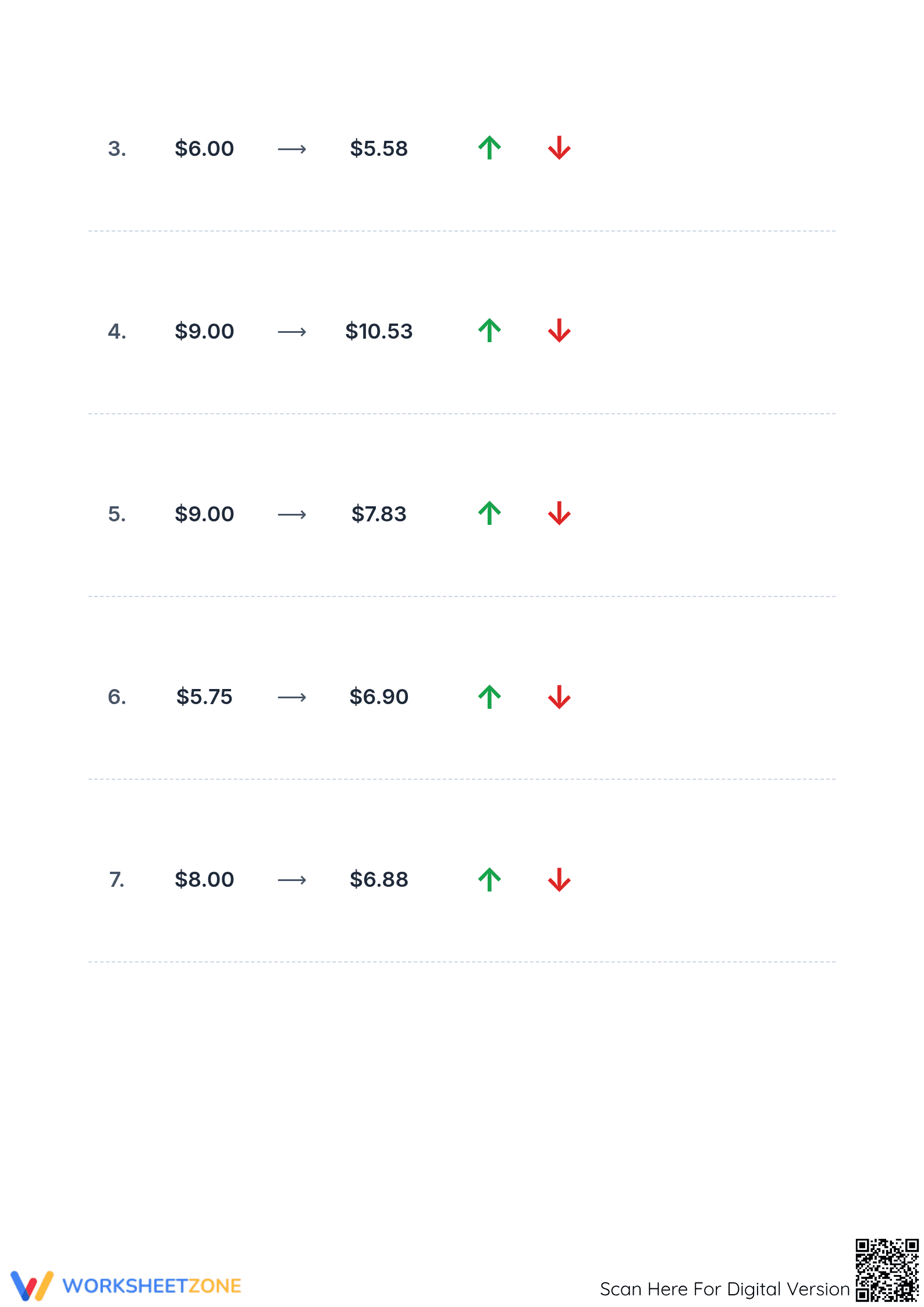
Developing a strong grasp of proportional relationships is essential for middle school success. This percentage increase and decrease worksheet provides students with fifteen targeted problems to master the calculation of relative change. Students compare original and new amounts to determine the direction of change before calculating the final percentage. This focused resource ensures mastery of foundational financial literacy.
At a Glance
- Grade: 7 · Subject: Math
- Standard:
CCSS.MATH.CONTENT.7.RP.A.3— Use proportional relationships to solve multistep ratio and percent problems accurately- Skill Focus: Calculating percentage increase and decrease in financial contexts
- Format: 4 pages · 15 problems · Answer key included · Printable PDF
- Best For: Independent skill practice, homework, or sub plans
- Time: 35–45 minutes
This four-page instructional resource is meticulously organized to support student success. Inside, you will find fifteen distinct problems presented in a clear tabular format. Each item provides an original amount and a new amount, accompanied by visual arrow cues to help students identify whether the value has increased or decreased. The inclusion of a dedicated "Bonus Section" for extra practice ensures that students have ample opportunity to reinforce their skills before moving on to more complex algebraic concepts. A comprehensive answer key is provided for rapid grading and self-assessment.
Skill Progression and Mastery
The worksheet uses a systematic approach for skill progression. Guided Practice (Items 1-5) focuses on straightforward dollar amounts. Supported Practice (Items 6-10) increases difficulty with non-integers and varied amounts. An Independent Practice (Bonus Section) challenges students with five additional problems, reinforcing increase/decrease identification. This gradual-release model moves from teacher-supported to student-led mastery.
Standards Alignment
This worksheet is strictly aligned to CCSS.MATH.CONTENT.7.RP.A.3: "Use proportional relationships to solve multistep ratio and percent problems. Examples: simple interest, tax, markups and markdowns, gratuities and commissions, fees, percent increase and decrease, percent error." By focusing specifically on percent change, it provides the depth required for seventh-grade mastery. This standard code can be copied directly into lesson plans, IEP goals, or district curriculum mapping tools.
How to Use It
This resource is ideal for use during the "independent practice" phase of a lesson on proportional reasoning. After direct instruction on the percent change formula [(New - Old) / Old], assign the first ten problems as a class activity. The bonus section serves as an excellent exit ticket or extension for early finishers. Teachers should observe students as they select the increase or decrease arrows to ensure they understand the directional shift before they begin the division process. Expect a completion time of 35 to 45 minutes.
Who It's For
This worksheet is designed for Grade 7 math students but is highly effective for Grade 8 review or for Grade 6 students ready for advanced proportional challenges. It is particularly useful for students who benefit from structured layouts and visual cues. Pair this resource with a real-world shopping catalog or a bank statement analysis to provide additional context for financial literacy lessons.
Proportional reasoning, particularly calculating percent change, is a critical skill for middle school students. This worksheet directly addresses this by targeting CCSS.MATH.CONTENT.7.RP.A.3, helping students distinguish between absolute and relative percentage change. Research suggests that structured practice, especially in financial contexts like those presented here, significantly improves retention of the percent change formula. The fifteen distinct scenarios encourage conceptual understanding over rote memorization, building mathematical stamina for higher-order financial literacy and data interpretation. This resource offers rigorous, standards-aligned practice essential for seventh-grade learners.


