


























Views
Downloads

Printable Percent Increase & Decrease Worksheet - Grade 7 Math
Paste this activity's link or code into your existing LMS (Google Classroom, Canvas, Teams, Schoology, Moodle, etc.).
Students can open and work on the activity right away, with no student login required.
You'll still be able to track student progress and results from your teacher account.
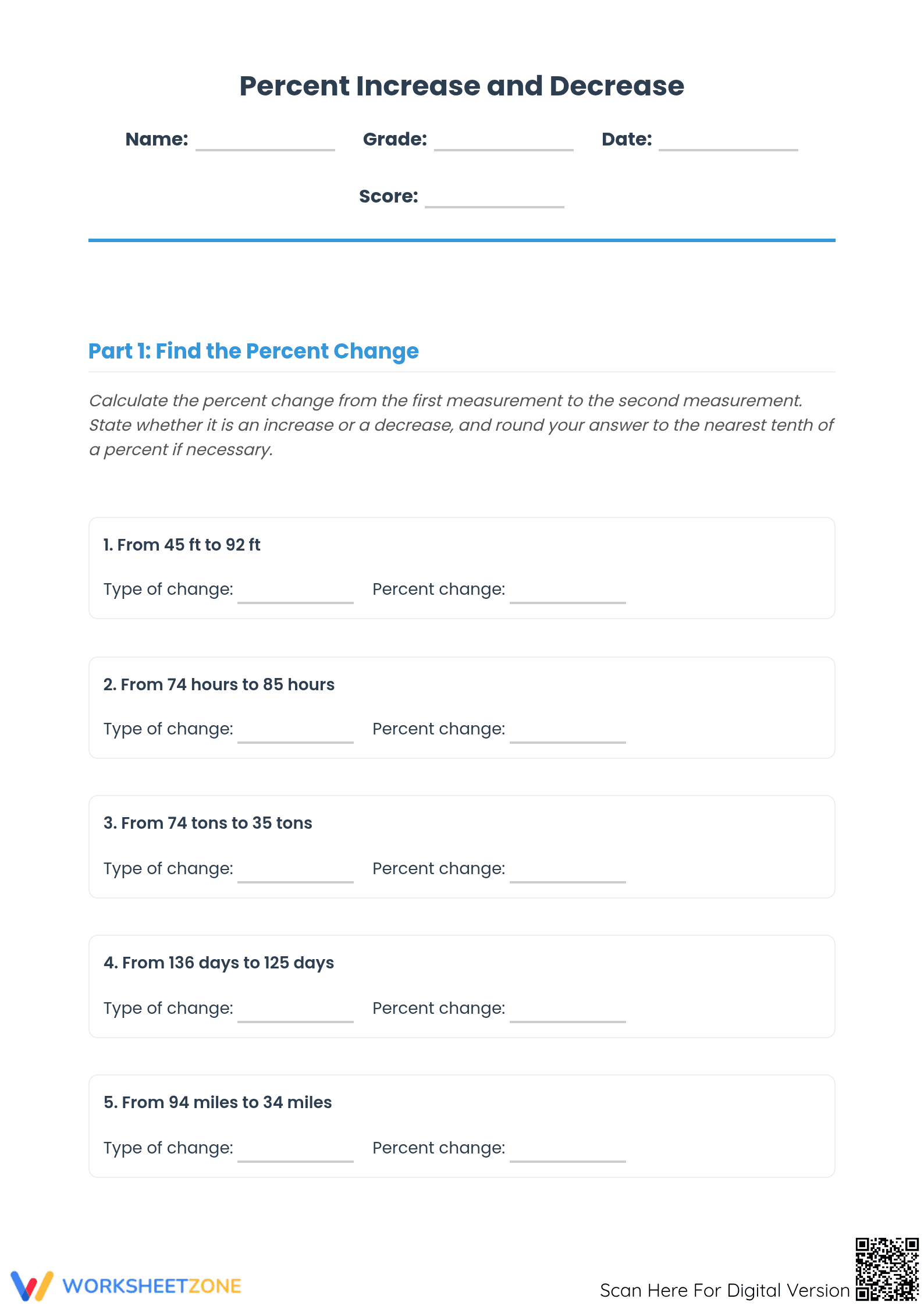
This Percent Increase and Decrease worksheet provides students with focused practice in calculating change. By working through various real-world units, learners develop a deep understanding of comparing initial and final values. This resource ensures students can confidently identify the direction of change and compute precise percentages.
At a Glance
- Grade: 7 · Subject: Math
- Standard:
7.RP.A.3— Use proportional relationships to solve multistep percent problems including percent increase and decrease- Skill Focus: Calculating percentage change
- Format: 4 pages · 24 problems · Answer key included · PDF
- Best For: Independent practice and homework assignments
- Time: 30–45 minutes
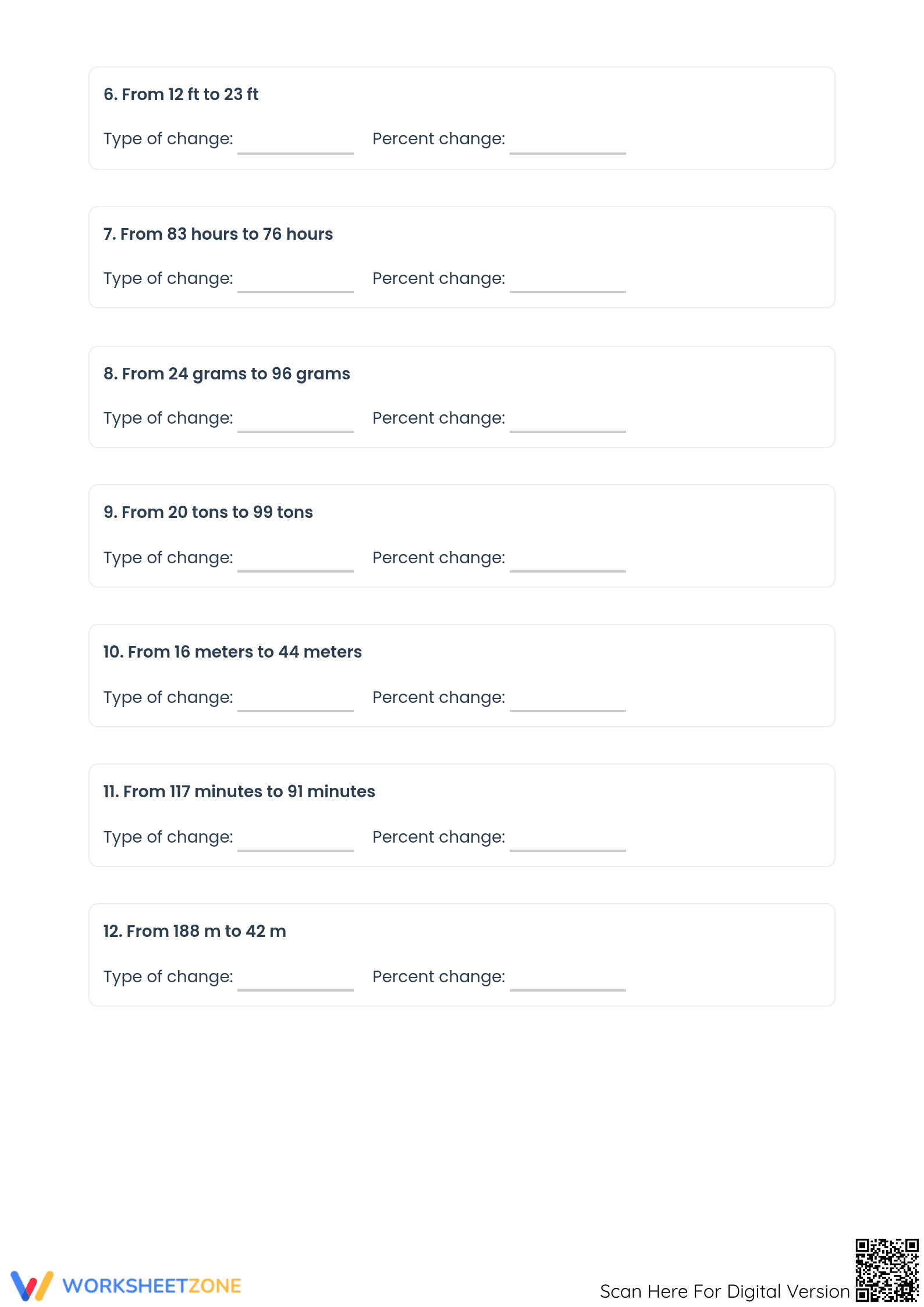
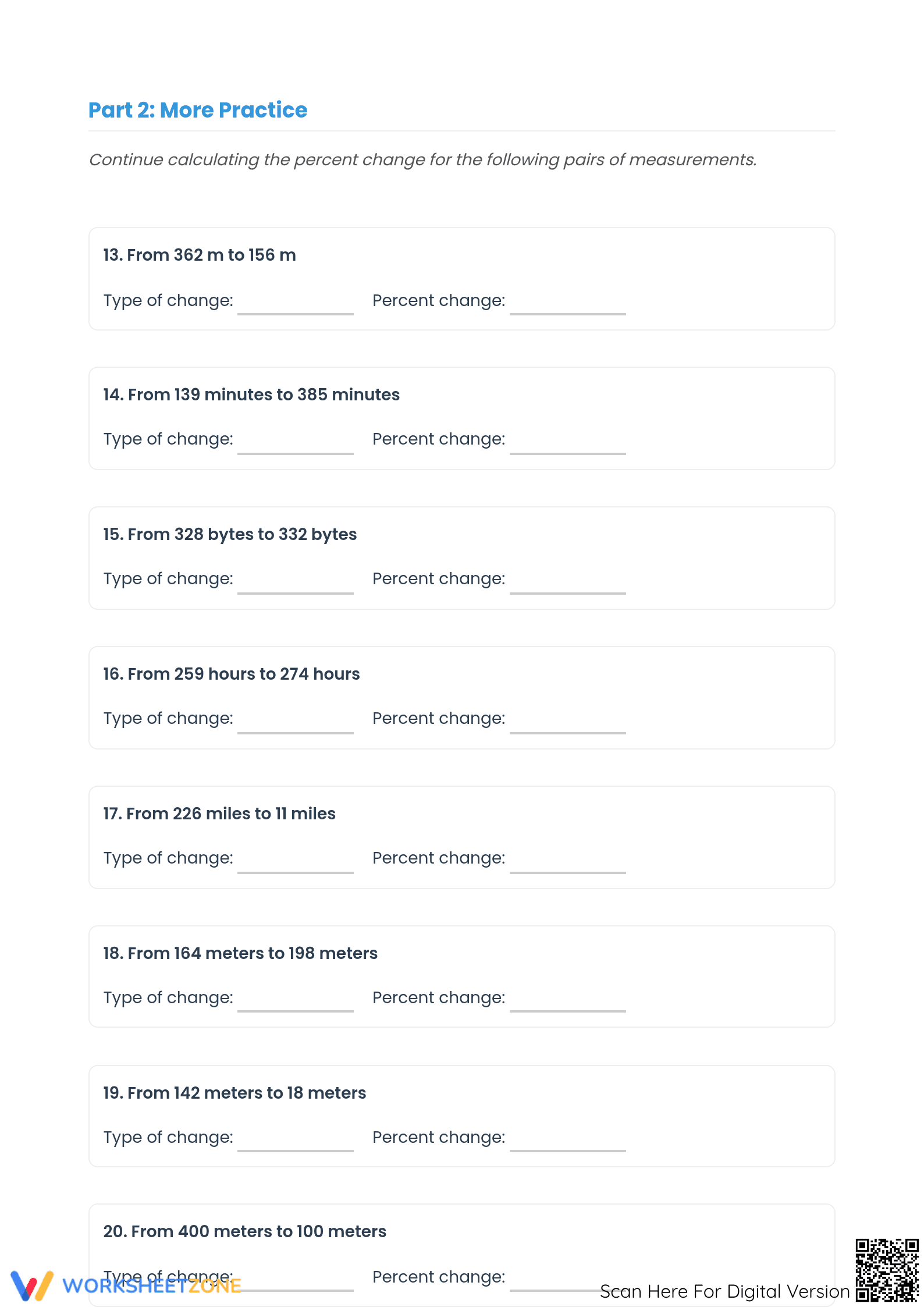
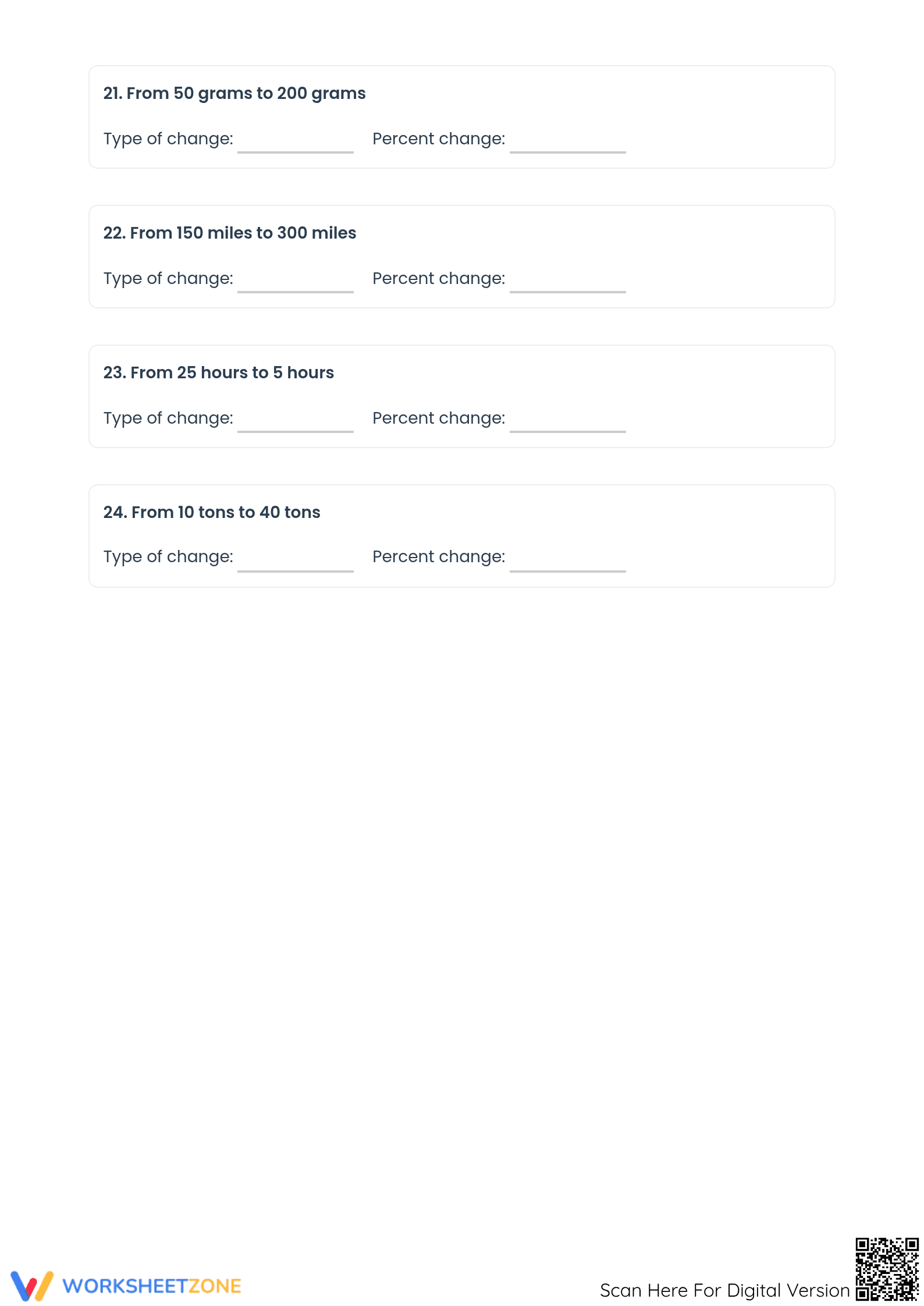
This 4-page PDF contains 24 structured problems divided into two sections. Part 1 introduces the concept with 12 foundational exercises, while Part 2 offers 12 additional practice opportunities. Each problem provides space for students to state the type of change and calculate the percentage. A full answer key is included for quick grading or student self-correction.
- Guided Practice: The first section uses familiar units like feet and hours to help students establish a consistent calculation routine.
- Supported Practice: As students move through the problems, the numbers become more varied, requiring precise rounding to the nearest tenth.
- Independent Practice: The final set challenges students to apply skills across diverse contexts like bytes and grams, ensuring formula mastery.
This structure follows a gradual-release model, moving from initial concept introduction to fluid application of the percentage change formula.
Standards Alignment
This resource is directly aligned to `7.RP.A.3`, which requires students to use proportional relationships to solve multistep percent problems. Specifically, it targets the ability to determine the percent increase or decrease between two quantities. This standard code can be copied directly into lesson plans, IEP goals, or district curriculum mapping tools.
How to Use It
Use this worksheet as a primary practice set immediately following your direct instruction on the percent change formula. It works well as a formative assessment tool; observe if students are correctly identifying the original amount during the first five problems. Expect completion within 45 minutes for most middle school learners.
Who It's For
This resource is designed for seventh-grade students mastering ratios and proportions. It is also suitable for eighth-grade review or for advanced sixth-grade learners. Use it alongside a graphic organizer that defines the "change over original" formula for maximum classroom support.
Research conducted by Fisher & Frey (2014) highlights that mathematical fluency in proportional reasoning is significantly improved through repeated, structured practice across varied contexts. This worksheet provides 24 targeted opportunities for students to apply the percent change algorithm, which is a critical gateway skill for higher-level algebra and financial literacy. By requiring students to first identify the "Type of Change" before calculating the "Percent Change," the resource scaffolds the conceptual understanding that an increase represents a positive shift while a decrease represents a negative one. This dual-step process prevents the common error of rote calculation without situational context. According to NAEP performance data, students who master these multi-step percent problems demonstrate higher proficiency in applying math to real-world scenarios, such as interest rates and discounts. This material serves as a rigorous, standards-aligned tool for building the persistent problem-solving habits necessary for college and career readiness in STEM fields.


