


























Views
Downloads

Grade 7 Percent Increase and Decrease — Printable Ready
Paste this activity's link or code into your existing LMS (Google Classroom, Canvas, Teams, Schoology, Moodle, etc.).
Students can open and work on the activity right away, with no student login required.
You'll still be able to track student progress and results from your teacher account.
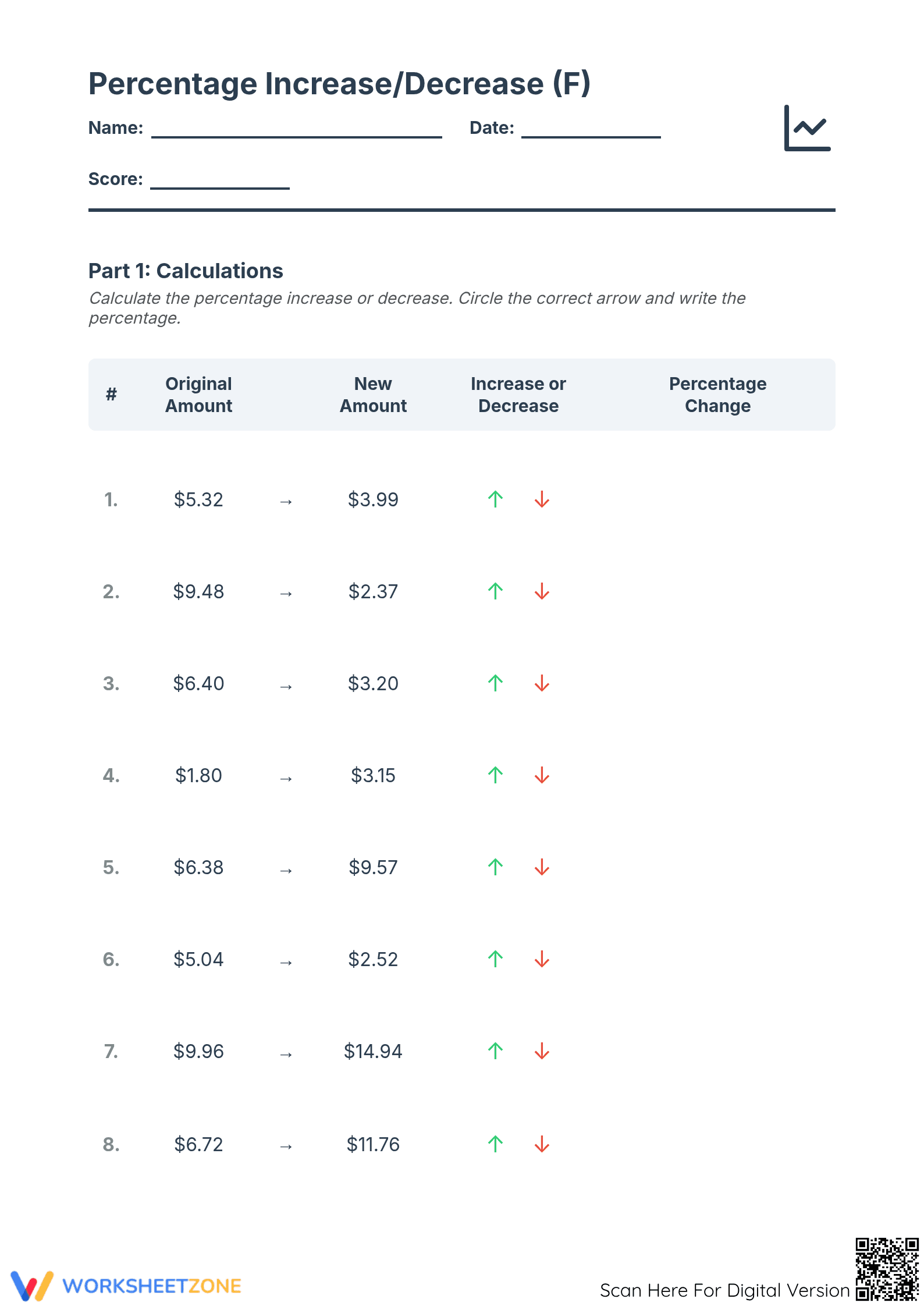
Students master the critical shift between original and new values with this comprehensive worksheet. By calculating the exact percentage change across 24 varied problems, learners build the fluency required for real-world financial literacy. This resource focuses on the mathematical mechanics of change, ensuring students can identify and solve proportional relationships with confidence and precision.
At a Glance
- Grade: 7 · Subject: Math
- Standard:
CCSS.MATH.CONTENT.7.RP.A.3— Use proportional relationships to solve multistep ratio and percent problems like percent increase.- Skill Focus: Percent Increase and Decrease
- Format: 3 pages · 24 problems · Answer key included · PDF
- Best For: Middle school ratio and proportion practice
- Time: 35–45 minutes
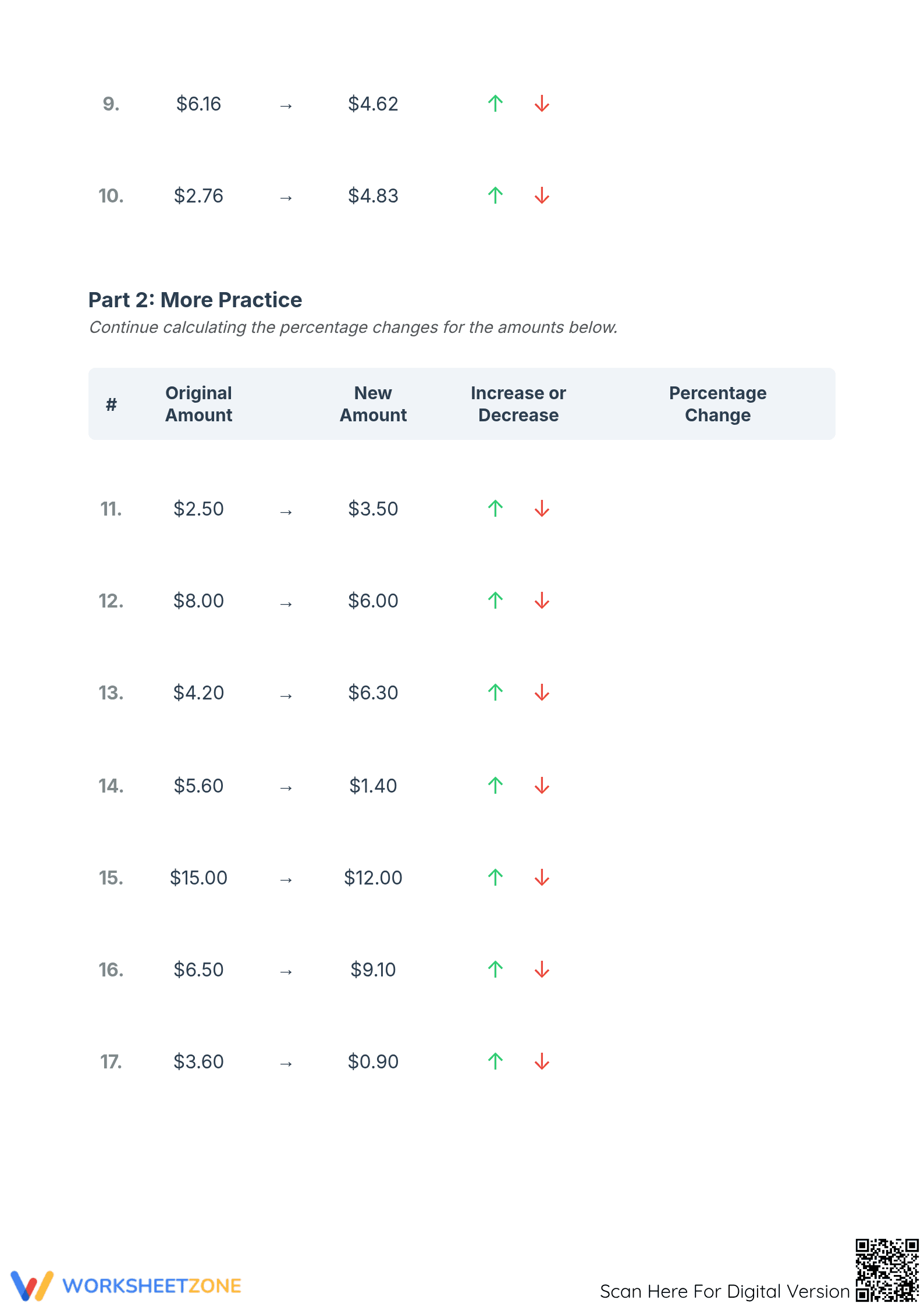
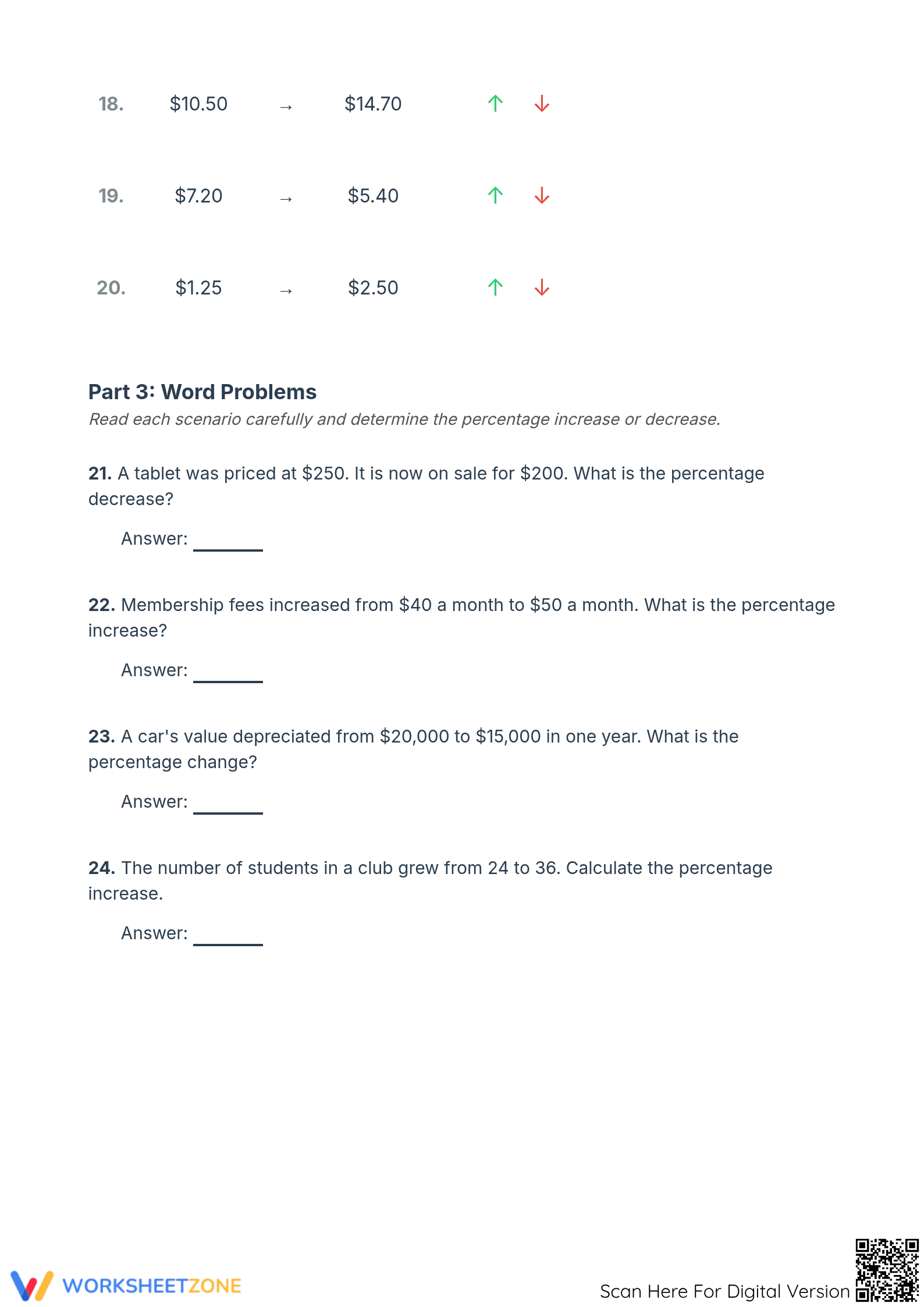
This three-page PDF is structured into three distinct parts to support learner success. Part 1 and Part 2 feature a tabular format with 20 calculation problems using currency values, where students must circle an arrow for directionality before calculating the rate. Part 3 introduces 4 contextual word problems involving sale prices, depreciation, and membership growth to bridge the gap between abstract math and application.
The zero-prep workflow allows teachers to integrate this into a lesson in under two minutes. First, print the three-page set (30 seconds). Second, distribute to students for immediate independent work (1 minute). Third, review student progress using the provided answer key. This streamlined process makes it a reliable resource for substitute plans or emergency enrichment sessions when instructional time is at a premium.
The worksheet is strictly aligned to the primary standard `CCSS.MATH.CONTENT.7.RP.A.3`, which mandates that students solve multistep ratio and percent problems. This includes specific mastery of markups, markdowns, and general percentage change. This standard code can be copied directly into lesson plans, IEP goals, or district curriculum mapping tools to ensure vertical alignment across the middle school math sequence.
Use this resource as a bridge between direct instruction and independent mastery. For a formative check, observe students during Part 1 to see if they correctly identify the direction of change before performing division; this early step often prevents common computation errors. Most students will complete the full 24-problem set within 45 minutes of active, focused mathematical work.
This resource is designed for seventh-grade math students but serves as a vital extension for sixth graders or a remediation tool for eighth graders. It pairs naturally with an anchor chart on the percentage change formula or a short instructional passage on consumer math. The clear layout supports students with executive functioning needs by providing a predictable workspace for each calculation.
According to NAEP data, proportional reasoning remains one of the most significant predictors of success in high school algebra and beyond. This worksheet targets `CCSS.MATH.CONTENT.7.RP.A.3` by requiring students to calculate percent increase and decrease through a structured gradual release of responsibility. Research from NAEP highlights that students who struggle with these concepts often lack sufficient practice with directionality and original-base identification. By providing 24 targeted tasks that progress from basic table calculations to applied word problems, this resource builds the cognitive stamina required for multi-step mathematical operations. The inclusion of currency-based problems further reinforces financial literacy, a key component of the current educational focus on career and college readiness. Educational leaders frequently cite the transition from additive to multiplicative thinking as a bottleneck in middle school; this tool provides the repetitive, high-quality practice necessary to move students past this hurdle toward mastery.


