


























Views
Downloads
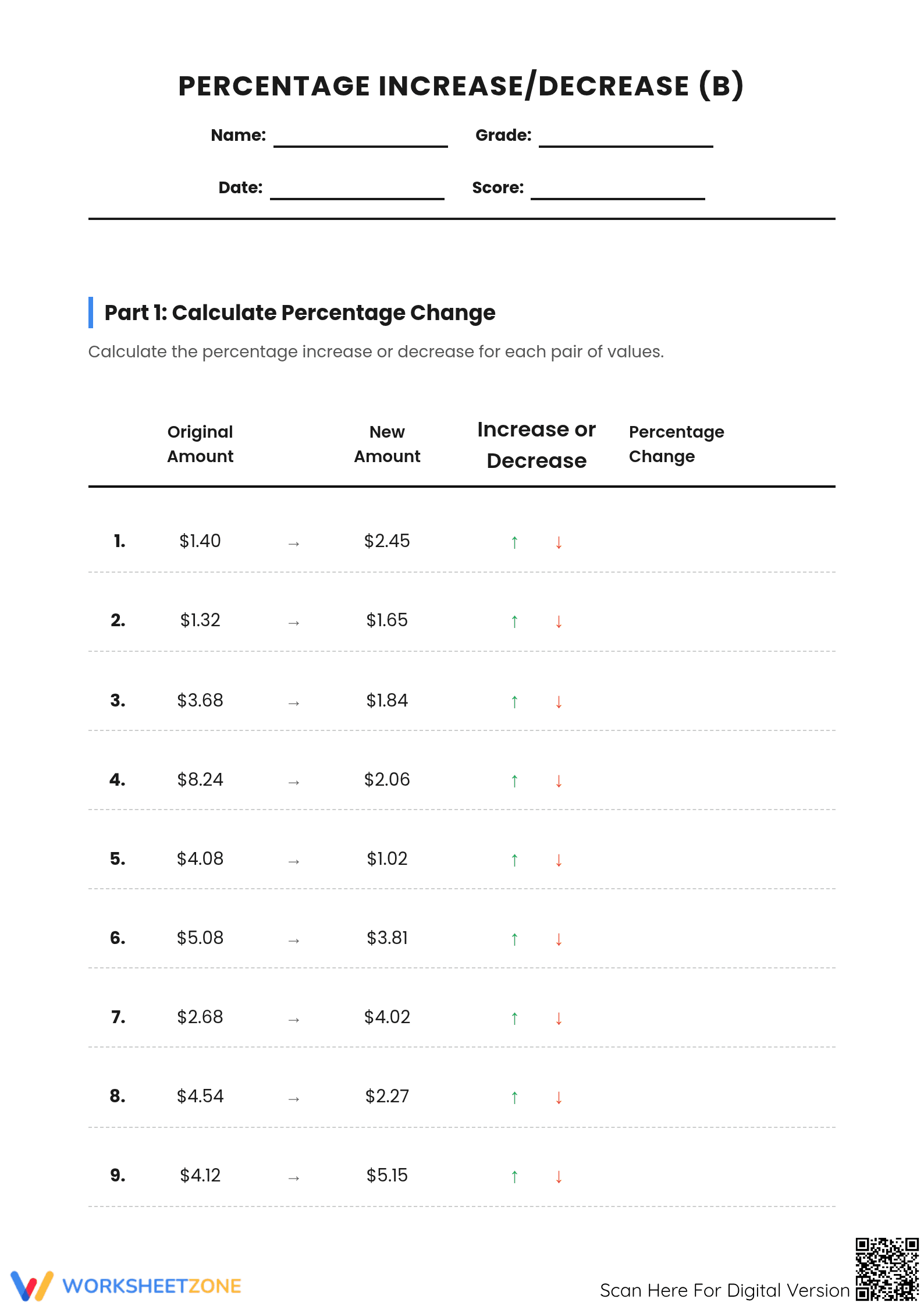


Printable Percent Increase and Decrease Worksheet | Grade 7
Paste this activity's link or code into your existing LMS (Google Classroom, Canvas, Teams, Schoology, Moodle, etc.).
Students can open and work on the activity right away, with no student login required.
You'll still be able to track student progress and results from your teacher account.
This comprehensive Grade 7 Math worksheet empowers students to calculate percentage changes with accuracy and speed. By bridging the gap between abstract calculations and real-world word problems, learners develop a deep understanding of proportional relationships. Students will analyze original and new values to determine the direction and magnitude of change in various contexts.
At a Glance
- Grade: 7 · Subject: Math
- Standard:
7.RP.A.3— Use proportional relationships to solve multi-step ratio and percent problems like percentage changes.- Skill Focus: Percent Increase and Decrease
- Format: 3 pages · 24 problems · Answer key included · PDF
- Best For: Independent practice or formative assessment
- Time: 25–35 minutes
The 3-page PDF features 24 structured tasks designed for incremental mastery. The first two pages present a 20-problem drill table where students identify the direction of change (increase or decrease) and compute the exact percentage. Page 3 challenges students with four authentic word problems involving concert tickets, retail discounts, and asset depreciation. A full answer key is included for immediate feedback.
Skill Progression
- Guided practice: Problems 1-8 provide low-complexity decimal and currency values to establish the basic formulaic routine of comparing new versus original amounts with clear visual prompts.
- Supported practice: Problems 9-20 increase in numerical complexity, requiring careful calculation of ratios and conversion to percentages within the familiar table structure.
- Independent practice: The final 4 word problems require students to extract data from text and apply the percentage change formula autonomously in diverse real-world contexts.
This sequence follows a gradual-release model, moving from basic computational drills to high-level application.
Standards Alignment
This resource aligns with 7.RP.A.3: "Use proportional relationships to solve multistep ratio and percent problems. Examples: simple interest, tax, markups and markdowns, gratuities and commissions, fees, percent increase and decrease, percent error." This standard code can be copied directly into lesson plans, IEP goals, or district curriculum mapping tools.
How to Use It
Use this worksheet as a summative assessment after a unit on ratios or as a targeted intervention for students struggling with proportional reasoning. Teachers can observe student work during the table portion to identify common errors in decimal placement or fraction-to-percent conversion. Expected completion time is 25 to 35 minutes depending on student fluency.
Who It's For
This resource is ideal for Grade 7 general education classrooms, middle school Math resource rooms, or home school environments. It pairs naturally with a lesson on unit rates or a retail-themed math project. The inclusion of an answer key makes it suitable for self-directed learning or sub plans.
Research by Fisher & Frey (2014) emphasizes the importance of structured drills followed by application tasks to solidify mathematical fluency. This worksheet aligns with those findings by providing 24 opportunities for students to engage with 7.RP.A.3, specifically focusing on percent increase and decrease. The dual-format approach—table drills and word problems—ensures that students move beyond rote memorization toward conceptual understanding. By practicing with real-world scenarios like ticket prices and car depreciation, students see the immediate relevance of proportional reasoning. Standardized testing often focuses on these multi-step percent problems, making this focused practice essential for exam readiness and long-term retention. This resource provides a reliable bridge between classroom instruction and independent mastery of complex ratio concepts, making it a valuable addition to any Grade 7 mathematics curriculum.


