


























Views
Downloads
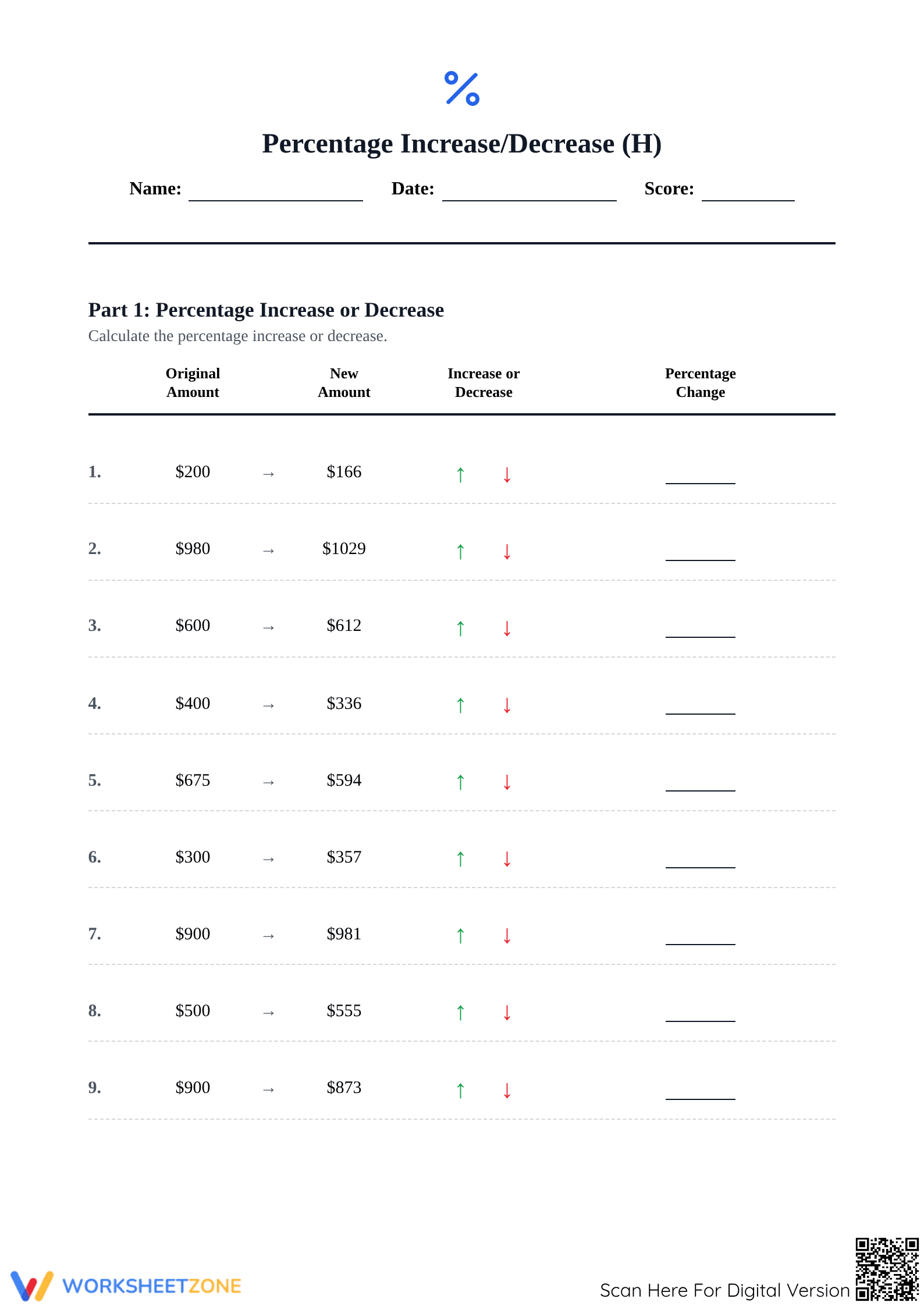


Essential Percent Increase and Decrease Worksheet | Grade 7
Paste this activity's link or code into your existing LMS (Google Classroom, Canvas, Teams, Schoology, Moodle, etc.).
Students can open and work on the activity right away, with no student login required.
You'll still be able to track student progress and results from your teacher account.
Master the complexities of percentage change with this comprehensive three-page practice packet. Students will transition from basic table-based calculations to real-world word problems and missing value applications. This resource ensures learners can confidently determine whether a value has increased or decreased and calculate the exact percentage of that shift.
At a Glance
- Grade: 7 · Subject: Math
- Standard:
CCSS.MATH.CONTENT.7.RP.A.3— Use proportional relationships to solve multistep ratio and percent problems including percent increase and decrease- Skill Focus: Percent Increase and Decrease
- Format: 3 pages · 18 problems · Answer key included · PDF
- Best For: Independent practice and formative assessment
- Time: 30–45 minutes
This 18-problem worksheet is divided into three logical segments across three pages. Part 1 features a 10-item table requiring students to identify the direction of change and calculate the percentage. Part 2 provides 4 realistic word problems involving retail, population, and time. Part 3 challenges students with 4 "Missing Value" scenarios where they must calculate the final amount. A full answer key is included.
Zero-Prep Workflow
- Print (30 seconds): Simply select the three-page PDF and print enough copies for your class.
- Distribute (1 minute): Hand out the worksheets during independent practice or as a transition activity.
- Review (10 minutes): Use the included answer key to quickly grade or have students self-correct their work.
Total teacher preparation time is under 2 minutes, making this an ideal sub plan or emergency lesson filler.
Standards Alignment
This resource is strictly aligned to CCSS.MATH.CONTENT.7.RP.A.3, which requires students to use proportional relationships to solve multistep ratio and percent problems. The tasks specifically target the "percent increase and decrease" component of the standard. This standard code can be copied directly into lesson plans, IEP goals, or district curriculum mapping tools.
How to Use It
Assign this worksheet as a follow-up to a direct instruction lesson on ratios and proportions. It serves as an excellent "You Do" component of a gradual release model. For a formative assessment tip, observe students during Part 2; if they struggle with the phrasing of "price dropped," offer a quick scaffold on identifying the original versus the new amount before they proceed.
Who It's For
This worksheet is designed for 7th-grade students mastering the Ratios and Proportional Relationships domain. It is also suitable for 6th-grade extension or 8th-grade review. Naturally pair this with a percentage change anchor chart or a digital graphing tool to visualize the numerical shifts described in the word problems.
Calculating percentage change is a foundational skill in the middle school mathematics curriculum, directly supporting the development of proportional reasoning. According to a RAND AIRS 2024 analysis, students who engage in mixed-format practice—combining procedural tables with contextual word problems—demonstrate higher retention rates compared to those using isolated drill sheets. This worksheet provides that essential balance, requiring learners to first master the arithmetic of CCSS.MATH.CONTENT.7.RP.A.3 before applying it to life-like scenarios such as bakery sales and library acquisitions. By asking students to identify the direction of change before calculating the magnitude, the resource encourages conceptual understanding over rote memorization. This deliberate scaffolding aligns with NAEP recommendations for improving algebraic thinking. Teachers can utilize this printable resource to provide rigorous, standard-aligned practice that bridges the gap between basic percentages and complex financial literacy applications.


