


























Views
Downloads



Printable Percent Increase and Decrease Worksheet | Grade 7
Paste this activity's link or code into your existing LMS (Google Classroom, Canvas, Teams, Schoology, Moodle, etc.).
Students can open and work on the activity right away, with no student login required.
You'll still be able to track student progress and results from your teacher account.
Mastering percent change is a vital milestone for middle school mathematicians. This worksheet provides a direct, effective way for students to calculate percentage increase and decrease through structured table practice and realistic word problems. Students will learn to compare original and new amounts, identifying the direction of change before calculating the precise percentage.
At a Glance
- Grade: 7 · Subject: Math
- Standard:
CCSS.MATH.CONTENT.7.RP.A.3— Use proportional relationships to solve multistep ratio and percent increase or decrease problems- Skill Focus: Percent Increase and Decrease
- Format: 3 pages · 15 problems · Answer key included · PDF
- Best For: Independent practice or sub plans
- Time: 30–45 minutes
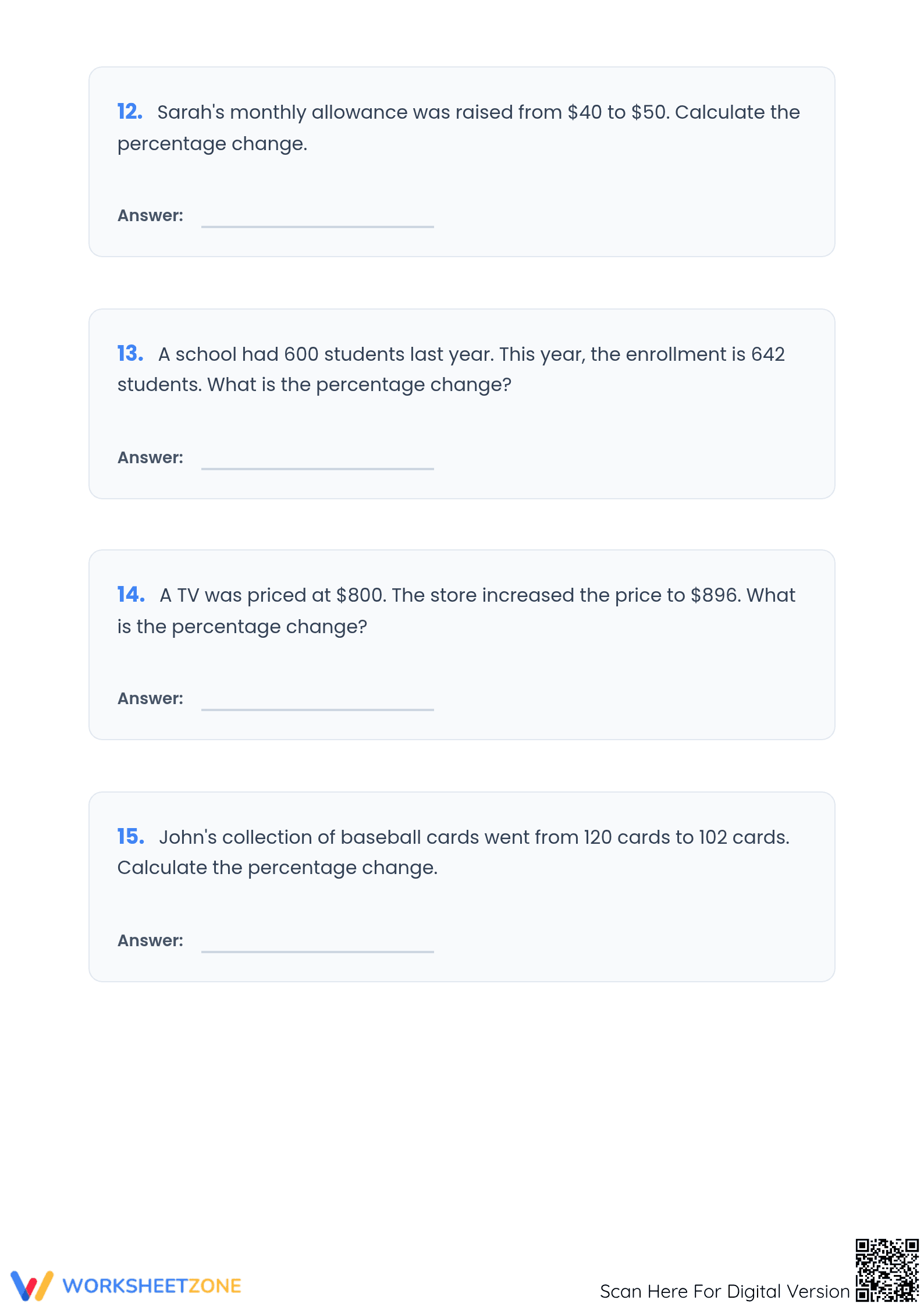
This three-page PDF features a comprehensive set of 15 problems designed for immediate classroom use. The first ten problems are organized in a clear table format, requiring students to identify whether a value increased or decreased before calculating the change. The final five tasks are multi-sentence word problems involving retail sales, enrollment figures, and collection tracking. A complete answer key is provided for rapid grading.
The "Print-and-Go" design ensures this resource is ready in under two minutes. Step 1: Print the three-page packet for each student. Step 2: Distribute the worksheets as a warm-up or independent practice session. Step 3: Use the included answer key to review the most challenging word problems as a whole class or for self-correction. Its clear structure makes it an ideal choice for emergency sub plans or quick formative assessments.
This resource is meticulously aligned to CCSS.MATH.CONTENT.7.RP.A.3. This standard requires students to "Use proportional relationships to solve multistep ratio and percent problems," specifically including percent increase and decrease. The worksheet bridges the gap between basic percentage calculation and more complex multi-step applications. Both standard codes can be copied directly into lesson plans, IEP goals, or district curriculum mapping tools.
Deploy this worksheet after a direct instruction lesson on the percent change formula. It serves as an excellent "You Do" component of a gradual release model. For formative assessment, observe students as they complete the first four table entries; if they struggle to determine the direction of change, offer a quick scaffold on value comparison. Most students will finish the full 15-problem set within 35 minutes, making it a perfect single-period activity.
This worksheet is primarily designed for 7th-grade students mastering the Ratios and Proportional Relationships domain. It is equally effective for 8th-grade review or accelerated 6th-grade students. The structured table provides natural differentiation for learners who benefit from visual organization, while the word problems challenge higher-order thinkers. Pair this with a real-world shopping catalog or an anchor chart for maximum impact.
Calculating percent increase and decrease is a foundational skill in the Grade 7 CCSS.MATH.CONTENT.7.RP.A.3 standard, which anchors much of the middle school Ratios and Proportional Relationships domain. This worksheet targets the specific cognitive shift required for students to move from simple part-to-whole calculations to analyzing dynamic changes in value. Research from Fisher & Frey (2014) emphasizes the importance of providing both structured scaffolding—such as the table format used here—and applied word problems to ensure long-term skill retention and transfer. By requiring students to first determine the direction of change before calculating the magnitude, the resource reinforces the conceptual understanding of increase and decrease beyond mere arithmetic. This dual-layered approach ensures that students can accurately quote mathematical evidence when justifying their answers in multi-step scenarios. This resource serves as a high-quality instructional tool for teachers looking to provide rigorous, standards-aligned practice that is both accessible and challenging for diverse learner populations.


