


























Views
Downloads



Percent Increase and Decrease Worksheet | Printable Math
Paste this activity's link or code into your existing LMS (Google Classroom, Canvas, Teams, Schoology, Moodle, etc.).
Students can open and work on the activity right away, with no student login required.
You'll still be able to track student progress and results from your teacher account.
This comprehensive percent increase and decrease worksheet empowers Grade 7 students to master proportional relationships through 20 targeted problems. By calculating the shift between original and new values, learners build a vital bridge from basic arithmetic to algebraic reasoning. This resource ensures students can accurately determine percentage changes in diverse, real-world contexts.
At a Glance
- Grade: 7 · Subject: Math
- Standard:
7.RP.A.3— Use proportional relationships to solve multistep ratio and percent problems- Skill Focus: Percent Increase and Decrease
- Format: 4 pages · 20 problems · Answer key included · PDF
- Best For: Middle school ratio and proportion practice
- Time: 35–45 minutes
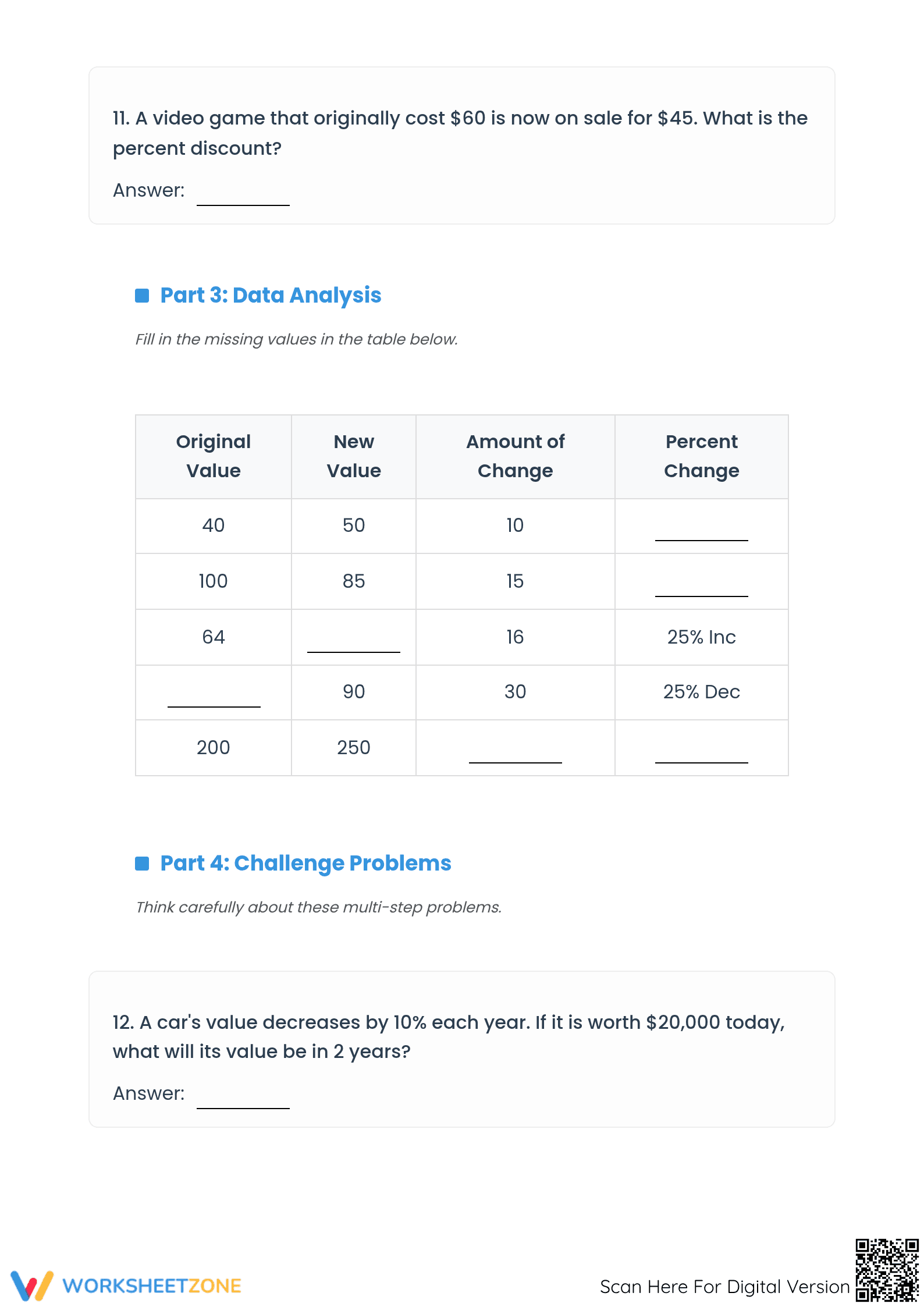
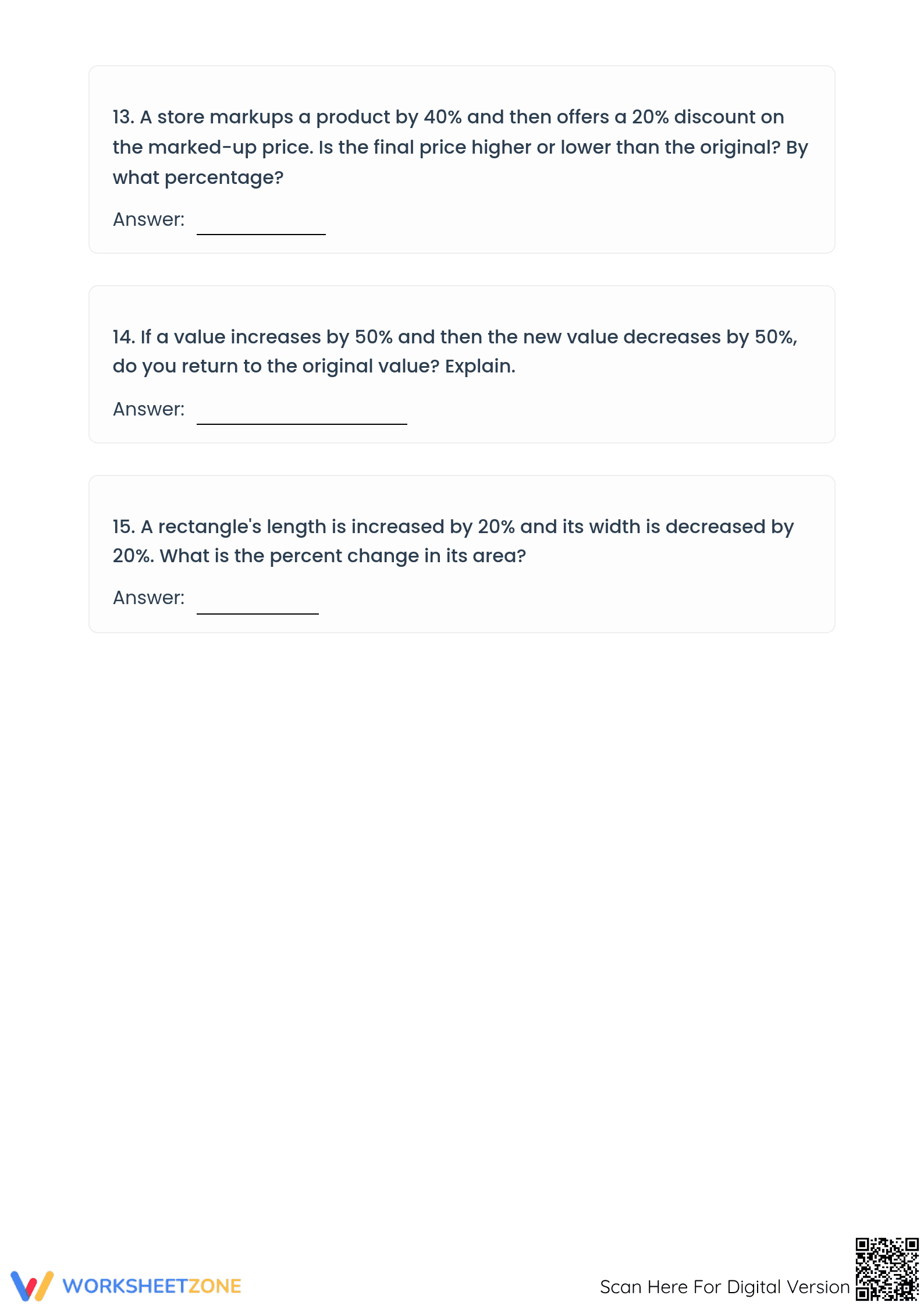
This four-page instructional packet is logically organized into four distinct parts to support varied learning needs. It includes six basic calculation drills, five real-world scenarios involving currency and weights, a data analysis table for missing values, and four complex multi-step challenge problems. A full answer key is provided for immediate feedback and grading efficiency.
- Guided Practice: The initial six problems focus on procedural fluency, asking students to calculate the "result" from pairs of simple integers.
- Supported Practice: Five word problems translate abstract math into concrete scenarios like shoe store markups and wage increases, using labels to scaffold setup.
- Independent Practice: The final challenge section demands higher-order thinking, requiring students to solve multi-step problems involving compounded percentages and area changes.
This gradual release of responsibility model ensures students build confidence before tackling the more rigorous algebraic applications found in high-stakes testing.
Standards Alignment
The primary alignment is CCSS.MATH.CONTENT.7.RP.A.3: "Use proportional relationships to solve multistep ratio and percent problems." This worksheet specifically targets the application of percentages to markups, markdowns, and situational changes. Both standard codes can be copied directly into lesson plans, IEP goals, or district curriculum mapping tools.
How to Use It
Use this as a summative assessment after a unit on ratios to gauge student mastery of percentage shifts. During instruction, have students "circle the original value" in the word problems to prevent common calculation errors. This activity typically takes 40 minutes and serves as an excellent formative observation tool for identifying students who struggle with decimal placement.
Who It's For
Designed for Grade 7 general education math classes, this resource also supports Grade 8 students requiring remedial review or Grade 6 advanced learners. It pairs naturally with an anchor chart on the "Change over Original" formula and works well following a direct instruction lesson on simple interest or unit rates.
Effective instruction in proportional reasoning requires moving beyond rote memorization of formulas toward an understanding of multiplicative relationships. As emphasized by Fisher & Frey (2014), the gradual release of responsibility—moving from simple procedural calculations to complex multi-step word problems—is essential for developing mathematical persistence. This Grade 7 worksheet adheres to this pedagogical model by providing 20 problems that transition from basic "Percent Change" drills to rigorous "Challenge Problems" involving compounded decreases and geometric area shifts. Aligned with CCSS.MATH.CONTENT.7.RP.A.3, the resource focuses on the plain-English skill of using proportional relationships to solve multistep percent problems in real-world contexts like finance and population growth. Such structured practice is critical for meeting the cognitive demands of middle-school standards and preparing students for the abstraction of algebra. The inclusion of a data analysis table and a comprehensive answer key further supports formative assessment strategies recommended for diverse classroom environments.


