


























Views
Downloads


Printable Percent Increase and Decrease Worksheet | Grade 7
Paste this activity's link or code into your existing LMS (Google Classroom, Canvas, Teams, Schoology, Moodle, etc.).
Students can open and work on the activity right away, with no student login required.
You'll still be able to track student progress and results from your teacher account.
This Grade 7 Math worksheet provides a comprehensive pathway for students to master the calculation of percentage changes. By working through direct calculations and complex story problems, learners build the fluency needed to compare results with original amounts accurately. This resource ensures students can confidently determine if a value has increased or decreased and quantify that change.
At a Glance
- Grade: 7 · Subject: Math
- Standard:
CCSS.MATH.CONTENT.7.RP.A.3— Solve multi-step ratio and percent problems including percent increase and decrease- Skill Focus: Percent Increase and Decrease
- Format: 4 pages · 27 problems · Answer key included · PDF
- Best For: Middle school ratio and proportion practice
- Time: 45–60 minutes
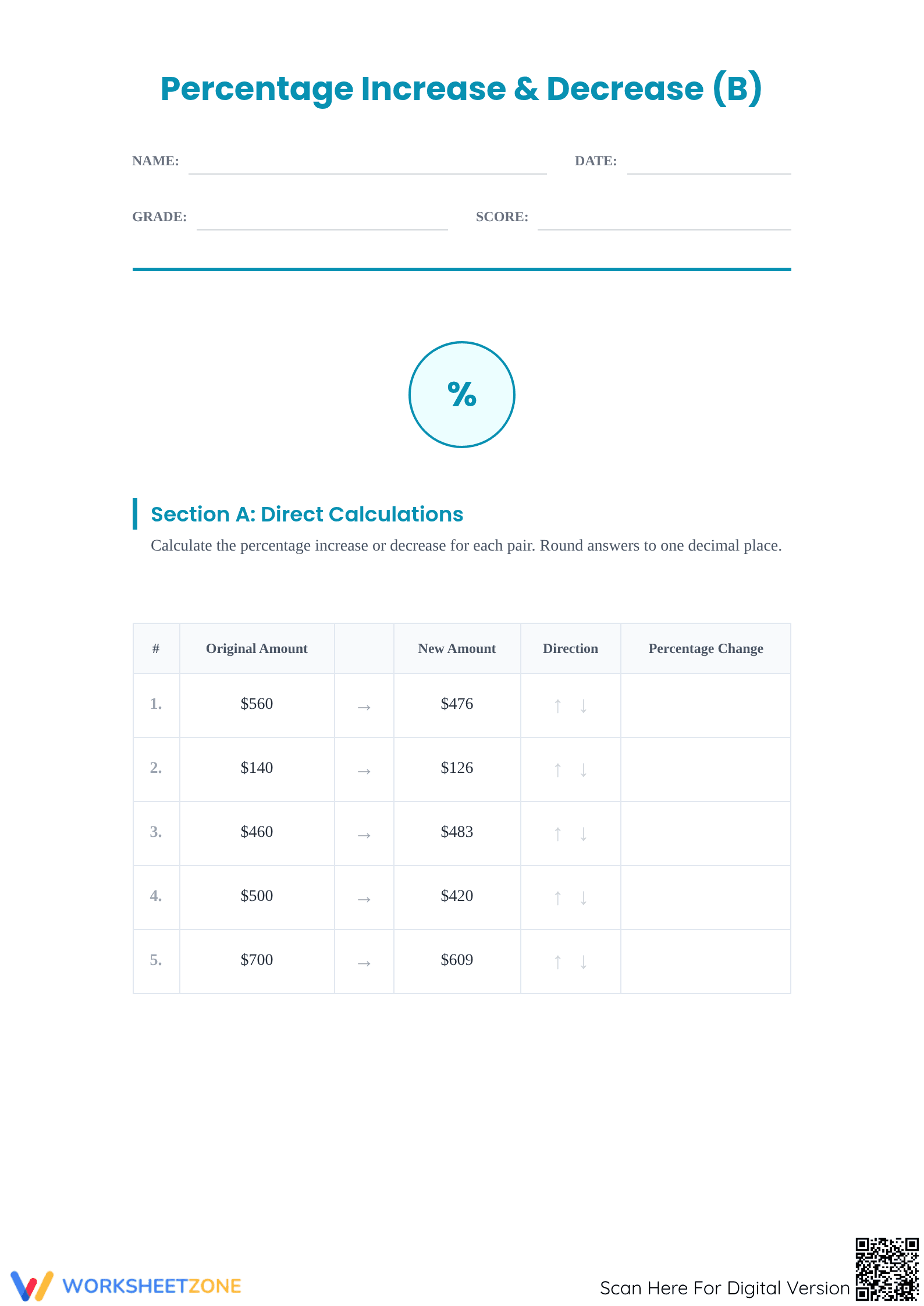
This four-page PDF resource contains 27 structured problems designed for deep engagement. It begins with ten direct calculation pairs in Section A, moves to five intermediate missing-value tasks in Section B, and provides five realistic story problems in Section C. The set concludes with a high-level Mastery Challenge featuring multi-step financial and retail scenarios. A complete answer key is provided for immediate feedback.
Skill Progression
- Guided Practice: The first 10 items use a table format with clear arrows to help students identify the direction of change before calculating the precise percentage, rounding to one decimal place.
- Supported Practice: Section B removes the visual aids, requiring students to find missing "new" or "original" values based on a given percentage, bridging the gap toward independent application.
- Independent Practice: The final sections provide story problems and a Mastery Challenge where students apply logic to subscribers, stock prices, and coupons without any scaffolding.
This progression follows the gradual-release model to move students from basic computation to abstract problem-solving.
Standards Alignment
This worksheet is strictly aligned to CCSS.MATH.CONTENT.7.RP.A.3, which requires students to use proportional relationships to solve multi-step ratio and percent problems, specifically focusing on percent increase and decrease. The resource also supports mastery of the mathematical practice of modeling with mathematics (MP.4). Both standard codes can be copied directly into lesson plans, IEP goals, or district curriculum mapping tools.
How to Use It
Use this worksheet during the middle of a unit on ratios and proportions as a primary practice activity. It serves as an excellent formative assessment; as students work through the story problems, observe if they correctly identify the "original amount" versus the "new amount" in the denominator. Expected completion time is roughly one class period, or it can be split over two days for differentiated homework.
Who It's For
This resource is designed for seventh-grade students but is equally effective for sixth-grade acceleration or eighth-grade review. It pairs naturally with a direct instruction lesson on decimal-to-percent conversion or an interactive anchor chart showing the percent change formula. The variety of difficulty levels allows teachers to assign specific sections based on current student data.
Effective instruction in proportional reasoning requires moving beyond rote memorization to contextual application. According to Fisher & Frey (2014), the gradual release of responsibility—moving from the highly structured tables in Section A to the open-ended Mastery Challenge—is essential for ensuring students internalize mathematical concepts rather than just following steps. Research indicates that when students struggle with percent change, the root cause is often a failure to correctly identify the base or original value. By providing 27 diverse problems, this worksheet addresses that hurdle through repetitive, varied exposure. This design supports the CCSS.MATH.CONTENT.7.RP.A.3 requirement for multi-step problem solving, ensuring students can handle real-world fluctuations in data, finance, and measurement. The inclusion of an answer key further supports self-correction, a key component of mathematical fluency and student agency in middle school settings.


