


























Views
Downloads
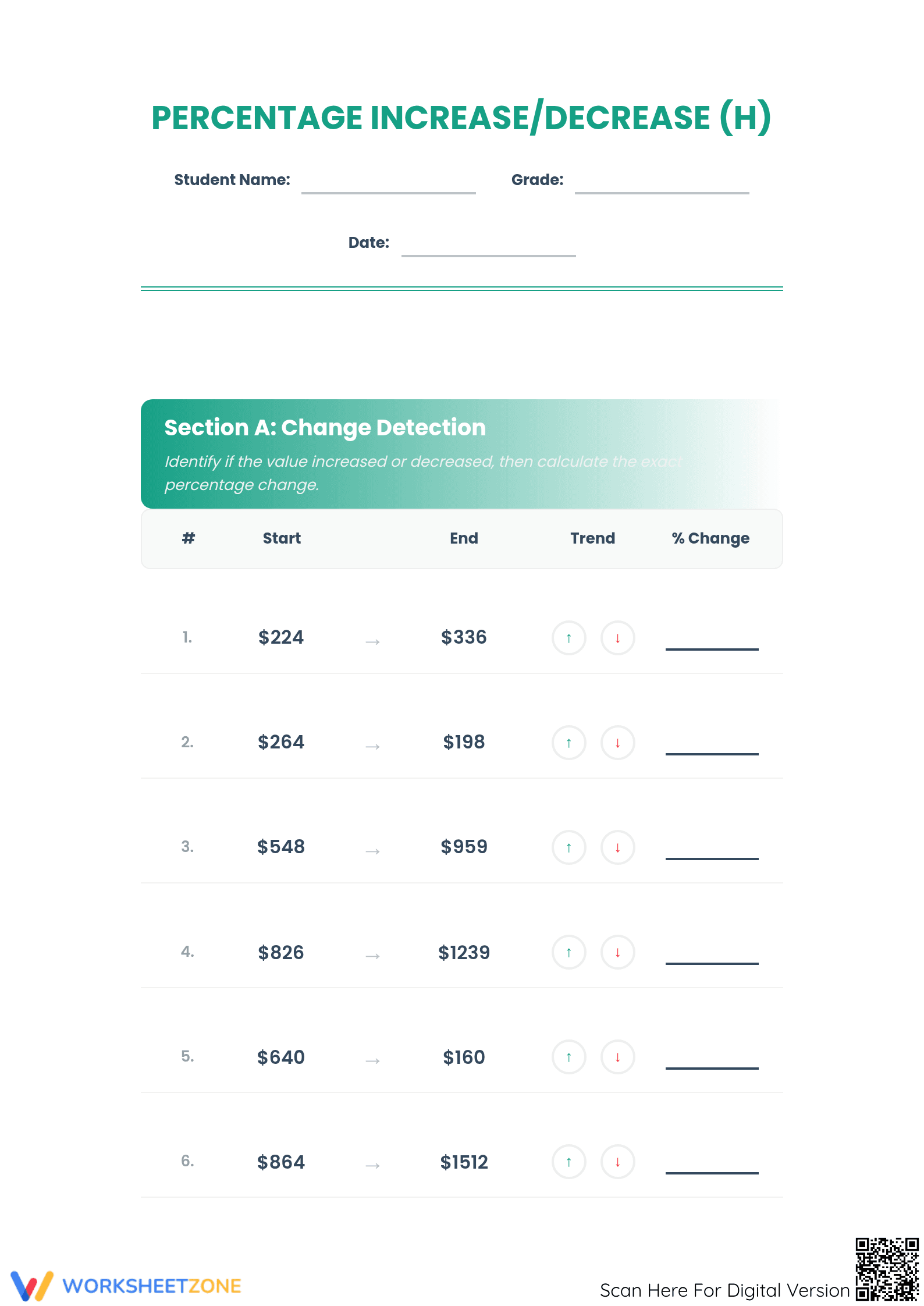


Essential Percent Increase and Decrease Worksheet | Grade 7
Paste this activity's link or code into your existing LMS (Google Classroom, Canvas, Teams, Schoology, Moodle, etc.).
Students can open and work on the activity right away, with no student login required.
You'll still be able to track student progress and results from your teacher account.
This comprehensive percent increase and decrease worksheet helps students master the calculation of proportional changes in both abstract and real-world scenarios. Students will learn to identify trends and apply formulas to find the exact percentage of change. By completing these exercises, learners develop the essential financial literacy and mathematical reasoning skills required for high school success.
At a Glance
- Grade: 7 · Subject: Math
- Standard:
7.RP.A.3— Use proportional relationships to solve multistep percent problems including percent increase and decrease- Skill Focus: Percent Increase and Decrease Calculation
- Format: 4 pages · 25 problems · Answer key included · PDF
- Best For: Homework, Quiz Prep, or Independent Practice
- Time: 45–60 minutes
What's Inside
This four-page instructional packet contains 25 rigorous problems divided into three distinct sections. Page one and two initiate the "Change Detection" phase with 10 problems focused on dollar values. Page two and three introduce "Applied Logic" word problems involving consumer goods and performance metrics. The final section, "Final Challenge," presents complex multi-step scenarios including consecutive changes and abstract logic. A full answer key is included.
Skill Progression
- Guided Practice: The first 10 problems provide a structured table where students must first identify the trend (increase or decrease) before calculating the numerical percentage, reinforcing the conceptual shift before calculation.
- Supported Practice: Five intermediate word problems (11–15) provide specific "Work" hints and formulas, helping students translate real-world text into solvable mathematical equations without getting lost in the phrasing.
- Independent Practice: The final 10 problems remove all scaffolding, requiring them to handle multi-step discounts, markups, and population changes independently to demonstrate total mastery of the standard.
This gradual-release approach ensures students move confidently from guided examples to independent problem-solving within a single session.
Standards Alignment
The primary alignment is to 7.RP.A.3, which requires students to "Use proportional relationships to solve multistep ratio and percent problems." This worksheet specifically targets the percent increase and decrease component of the standard. Students must compare a result to an original amount and derive a ratio expressed as a percentage. This standard code can be copied directly into lesson plans, IEP goals, or district curriculum mapping tools.
How to Use It
Use this worksheet as a summative assessment after a unit on ratios and proportions. It serves as an excellent resource where the teacher can model the first section and then allow students to work through the logic problems in pairs. Teachers should observe if students are correctly identifying the "original" value versus the "new" value, which is a common point of confusion. Expected completion time is 45 to 60 minutes.
Who It's For
This resource is designed for Grade 7 math students but is also highly effective for Grade 8 review or high school remediation. It is particularly useful for students who struggle with the reading comprehension aspect of word problems, as the scaffolded hints on pages two and four provide necessary support. Pair this with a lesson on consumer math or financial literacy for maximum engagement.


