


























Views
Downloads



Essential Percent Increase and Decrease Practice — Grade 7
Paste this activity's link or code into your existing LMS (Google Classroom, Canvas, Teams, Schoology, Moodle, etc.).
Students can open and work on the activity right away, with no student login required.
You'll still be able to track student progress and results from your teacher account.
This Grade 7 math worksheet provides a rigorous practice set for mastering percent of change. Students will learn to identify the direction of change, calculate percentage increases or decreases, and apply concepts to real-world financial scenarios.
At a Glance
- Grade: 7 · Subject: Math
- Standard:
CCSS.MATH.CONTENT.7.RP.A.3— Use proportional relationships to solve multi-step ratio and percent problems- Skill Focus: Percent Increase and Decrease
- Format: 5 pages · 25 problems · Answer key included · PDF
- Best For: Independent practice and formal formative assessment
- Time: 45–60 minutes
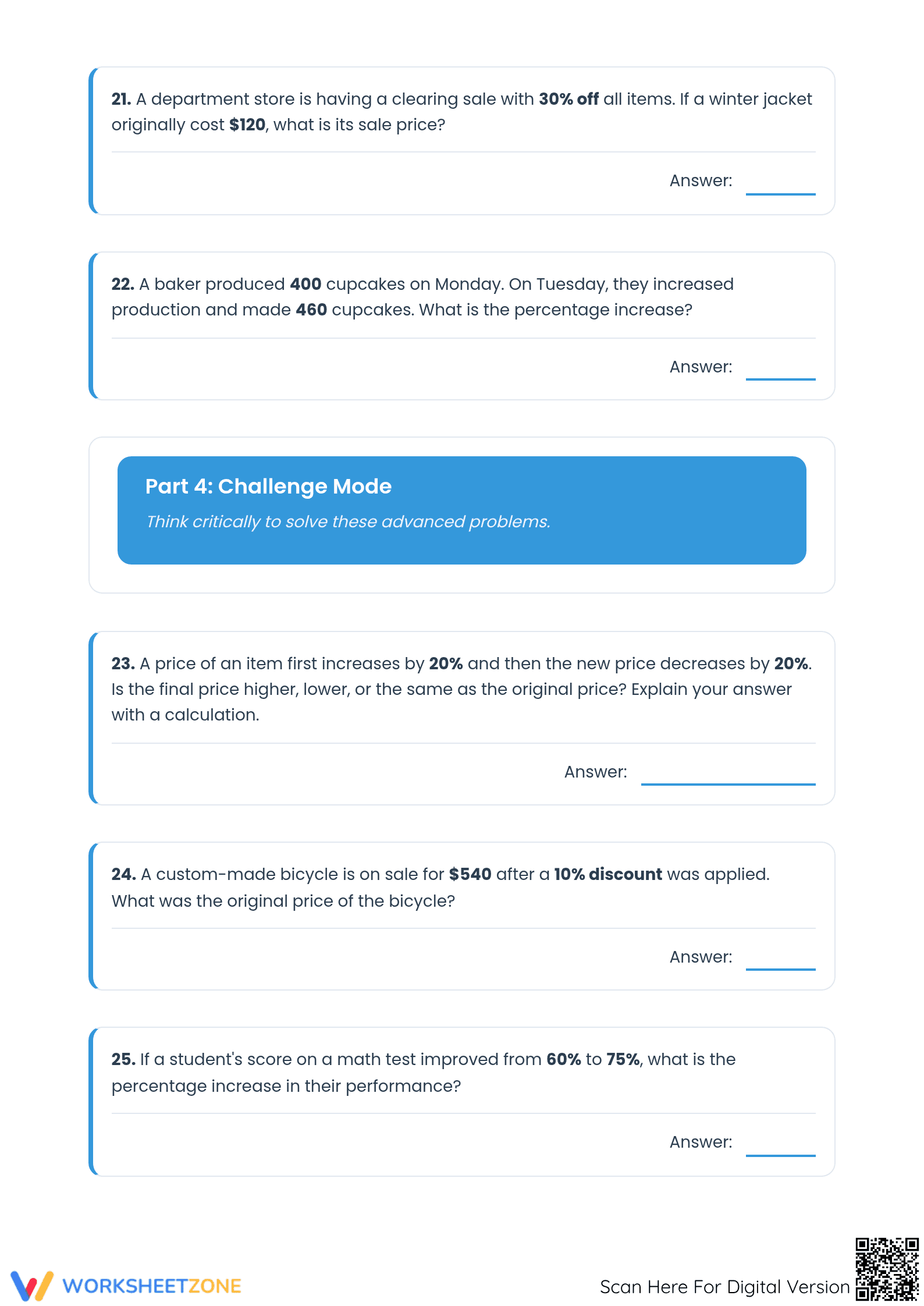
What's Inside: This 5-page resource includes 25 problems organized into four distinct parts. It covers 16 direct calculation items, 6 real-world word problems involving population and retail data, and a 3-question "Challenge Mode" for advanced application. A full answer key is provided, making this ideal for independent practice, homework, or formal formative assessment.
Skill Progression and Scaffolding
- Guided Practice: Problems 1-10 use a table format to help students identify the direction of change before calculating percentages, preventing common conceptual errors.
- Supported Practice: Items 11-16 remove the table, requiring students to extract original and new values independently while focusing on mathematical relationships.
- Independent Mastery: The final sections feature word problems and challenge tasks where students apply their knowledge to complex contexts like markups and discounts.
This resource utilizes a gradual-release model, moving from high-support computation to independent application in varied contexts.
Standards Alignment
This resource focuses on CCSS.MATH.CONTENT.7.RP.A.3, which requires students to use proportional relationships for multi-step percent problems. It directly addresses percent increase and decrease through varied contexts. This standard code can be copied directly into lesson plans, IEP goals, or district curriculum mapping tools to ensure instructional alignment and student mastery of middle school math foundations.
Effective Classroom Implementation
This worksheet is ideal for the "You Do" phase of instruction. Assign the first page as a quick check for understanding following a lesson on proportional reasoning. The word problems are excellent for building financial literacy or as a middle school math center activity. We recommend observing student progress after Part 1 to ensure they are correctly identifying the "original" value as the divisor in their calculations.
Who It's For
While designed for Grade 7, this is also effective for Grade 8 remediation or high school consumer math. The "Challenge Mode" provides natural extension for advanced learners. This resource pairs well with lessons on markups, discounts, or anchor charts detailing the percent change formula for students who benefit from visual aids.
According to NAEP mathematics assessment data, students who demonstrate proficiency in calculating percent change are better prepared for high school algebra and financial literacy. Research from EdReports (2024) emphasizes that quality materials must balance procedural fluency with conceptual understanding and real-world application. This worksheet achieves that balance by transitioning from basic arithmetic to contextualized word problems that mirror standardized testing complexity. By completing these 25 problems, students develop the proportional reasoning necessary to evaluate economic shifts and statistical trends. The consistent terminology aligns with best practices in mathematical literacy, ensuring learners understand the relationship between values rather than just memorizing a formula. This comprehensive set provides the practice required to move these skills into long-term memory, supporting future mathematical success across diverse disciplines. The inclusion of inverse percentage problems in the challenge section further solidifies deep conceptual mastery.


