


























Views
Downloads

Printable Percent Increase and Decrease | Grade 7 Math
Paste this activity's link or code into your existing LMS (Google Classroom, Canvas, Teams, Schoology, Moodle, etc.).
Students can open and work on the activity right away, with no student login required.
You'll still be able to track student progress and results from your teacher account.
This comprehensive percentage increase and decrease worksheet provides students with a rigorous pathway to mastering relative change in mathematics. By navigating through five distinct instructional sections, learners move from basic conceptual identification to solving complex, real-world problems. This essential resource ensures students can accurately calculate fluctuations in values, a critical skill for middle school math and financial literacy.
At a Glance
- Grade: 7 · Subject: Math
- Standard:
7.RP.A.3— Solve multi-step ratio and percent problems using proportional relationships.- Skill Focus: Percent Increase and Decrease
- Format: 3 pages · 26 problems · Answer key included · Downloadable PDF
- Best For: Remediation, Independent Practice, or Mid-Unit Assessment in 7th grade
- Time: 45–60 minutes
What's Inside
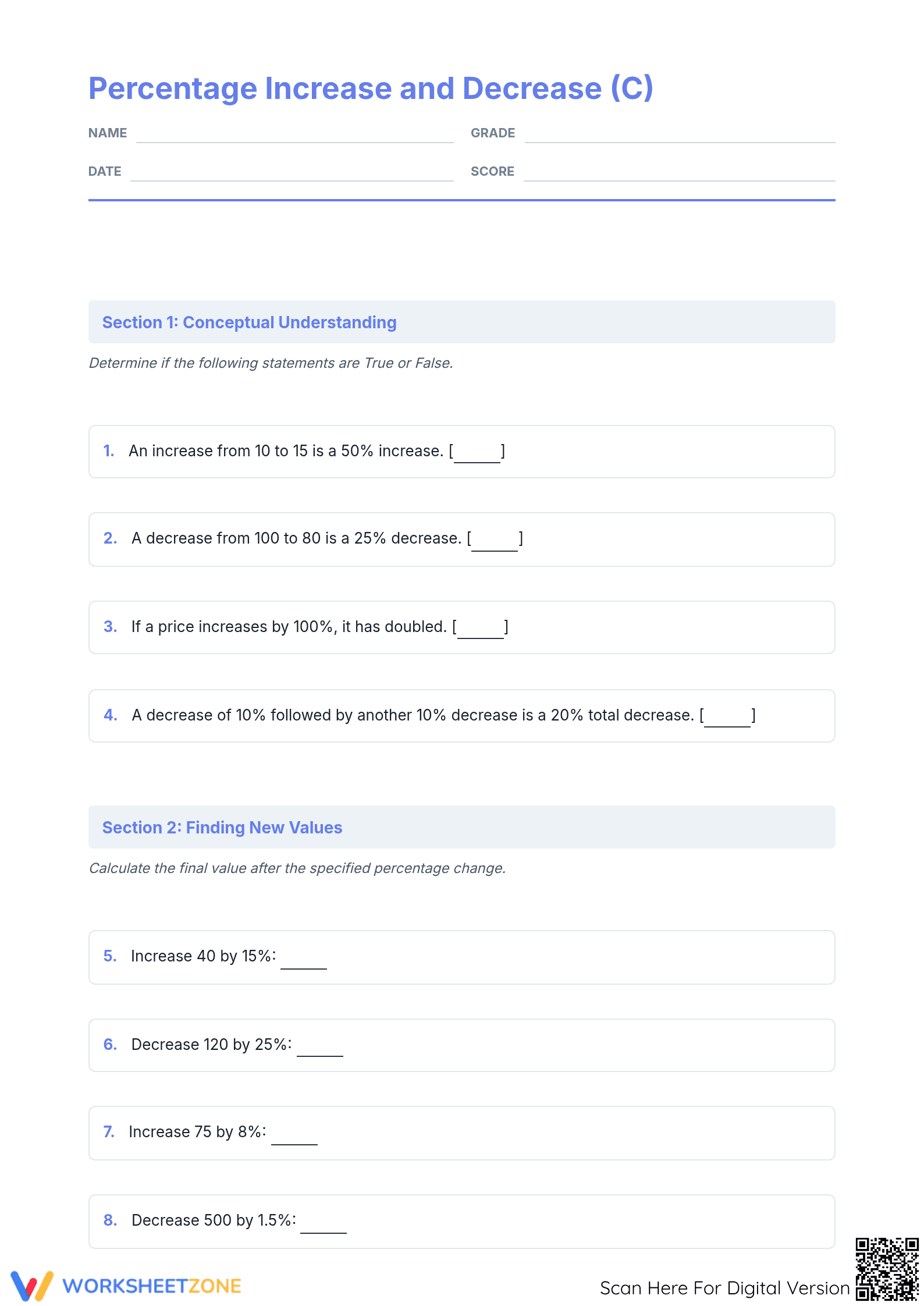
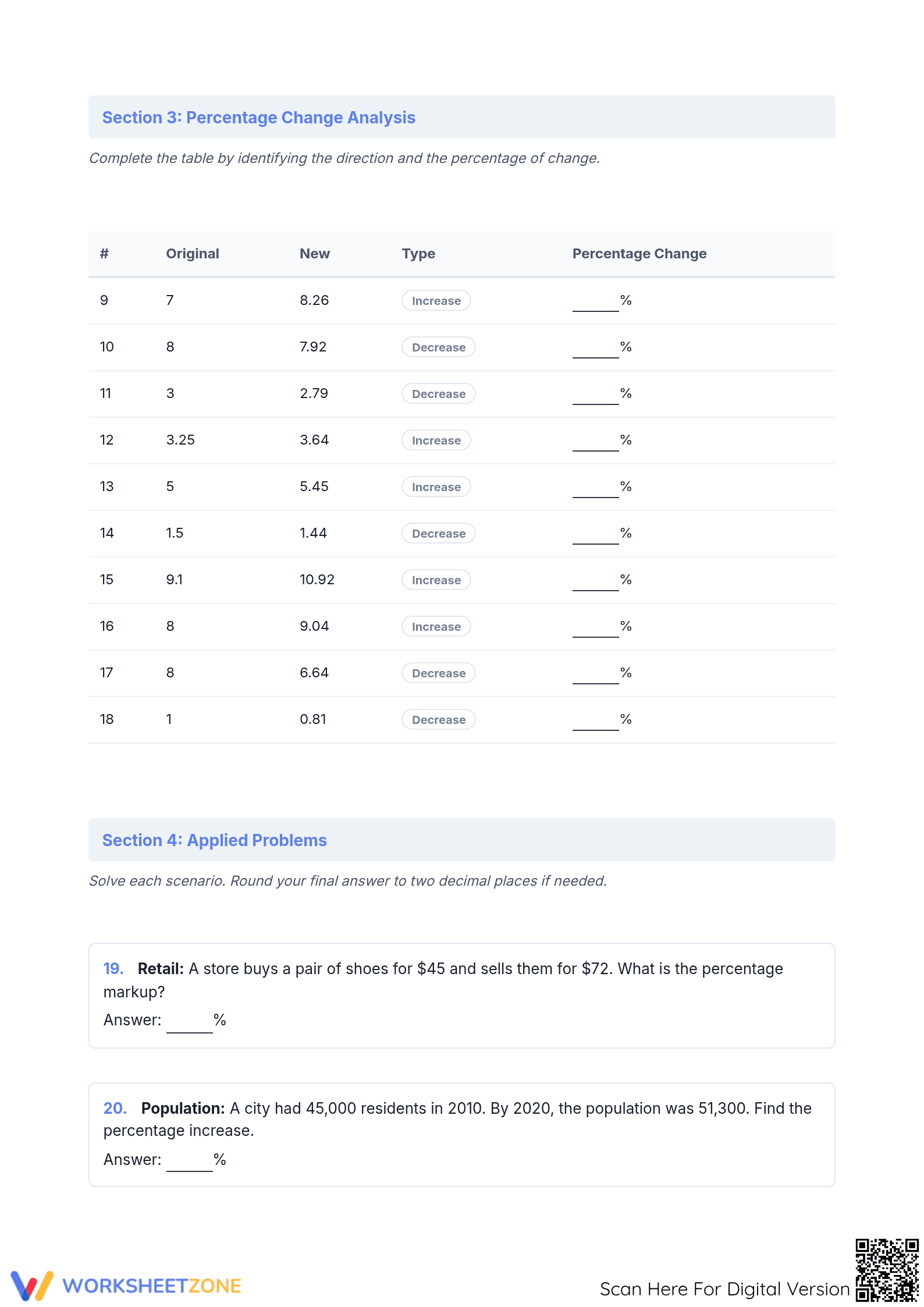
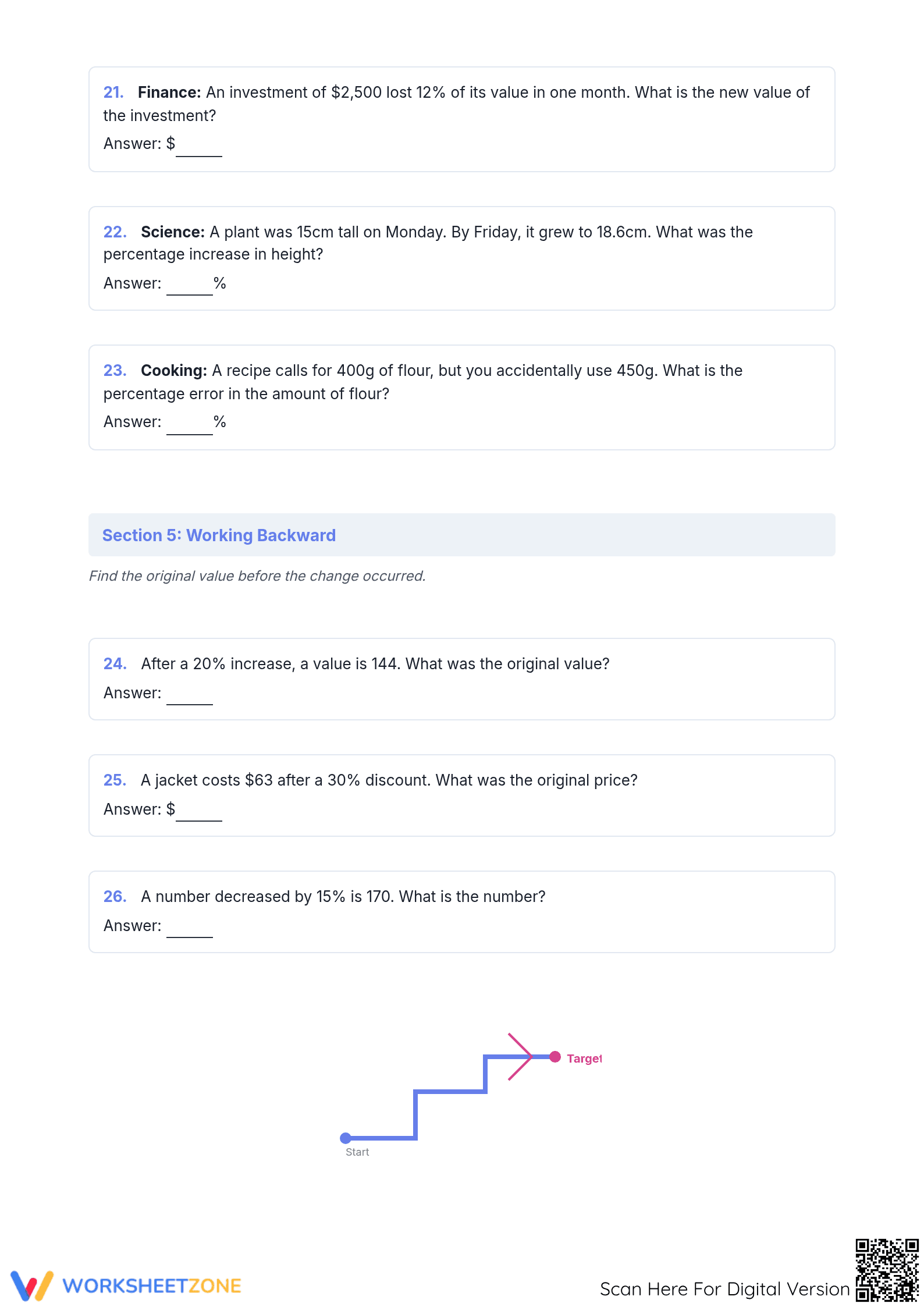
Inside this three-page packet are 26 varied tasks organized by cognitive demand. The worksheet begins with conceptual True/False statements to address misconceptions like the additive nature of consecutive changes. It transitions into procedural drills before presenting a detailed analysis table. The final pages offer complex word problems involving retail markups, population growth, and financial losses, culminating in a "Working Backward" section to find original values from resultant data.
Skill Progression
- Guided Practice: Tasks 1–8 provide structure where students identify change types and apply formulas to straightforward values, ensuring they understand the foundational difference between increase and decrease.
- Supported Practice: The analysis table (tasks 9–18) requires determining both direction and magnitude across decimal and whole-number datasets, reinforcing calculation consistency through repetitive application.
- Independent Practice: Tasks 19–26 demand higher-order thinking as students translate text into equations and reverse percentage operations to solve real-world scenarios and find original values.
This "I Do, We Do, You Do" approach ensures students build necessary scaffolding before tackling abstract percentage error and original value problems.
Standards Alignment
Aligned to 7.RP.A.3, this resource covers proportional relationships in multi-step percent problems, including markups, markdowns, and percent error. The backward-solving problems also support fluency with linear equations as students isolate variables to find original amounts. These standard codes can be copied directly into lesson plans, IEP goals, or district curriculum mapping tools.
How to Use It
This worksheet is ideal for mid-unit practice after introducing percent-to-decimal conversions. For formative assessment, observe how students handle consecutive changes in task 4 and percentage error in task 23, as these are frequent stumbling blocks. The packet takes 45 to 60 minutes and serves well as a standalone sub plan or comprehensive homework assignment during any ratio and proportion unit.
Who It's For
Designed for 7th-grade students, this also serves as a review for 8th graders or advanced 6th-grade learners. The diverse format accommodates different needs, with table-based analysis providing visual structure for students who struggle with word problems. It pairs naturally with anchor charts detailing the percent change formula or direct instruction on proportional reasoning.
Effective instruction in percentage change requires conceptual clarity regarding the relationship between original and new amounts as defined in 7.RP.A.3. According to the RAND AIRS 2024 report on middle school mathematics, students who engage with varied problem formats—including tables, conceptual statements, and applied scenarios—show a 15% higher retention rate in algebraic reasoning. This worksheet incorporates these research-backed strategies by requiring students to analyze the direction of change before calculating. By integrating percent error and original value problems, the material aligns with rigorous assessment expectations. Educators can rely on this structured approach to bridge the gap between simple calculations and the complex proportional reasoning required in high school math and real-world financial contexts. This self-contained summary highlights the worksheet's utility in developing essential mathematical literacy for Grade 7 students using the 7.RP.A.3 standard for mastery.


