


























Views
Downloads


Percent Increase and Decrease Worksheet | Printable Grade 7 Math
Paste this activity's link or code into your existing LMS (Google Classroom, Canvas, Teams, Schoology, Moodle, etc.).
Students can open and work on the activity right away, with no student login required.
You'll still be able to track student progress and results from your teacher account.
This essential percent increase and decrease worksheet helps students master the art of calculating change in various real-world scenarios. Students will learn to apply the standard formula to identify shifts in value, determining whether a change represents growth or reduction. This resource ensures learners build a strong foundation in proportional reasoning and financial literacy.
At a Glance
- Grade: 7 · Subject: Math
- Standard:
7.RP.A.3— Use proportional relationships to solve multistep percent problems including percent increase and decrease- Skill Focus: Percent change calculations
- Format: 5 pages · 16 problems · Answer key included · PDF
- Best For: Middle school ratio and proportion units
- Time: 45–60 minutes
What's Inside
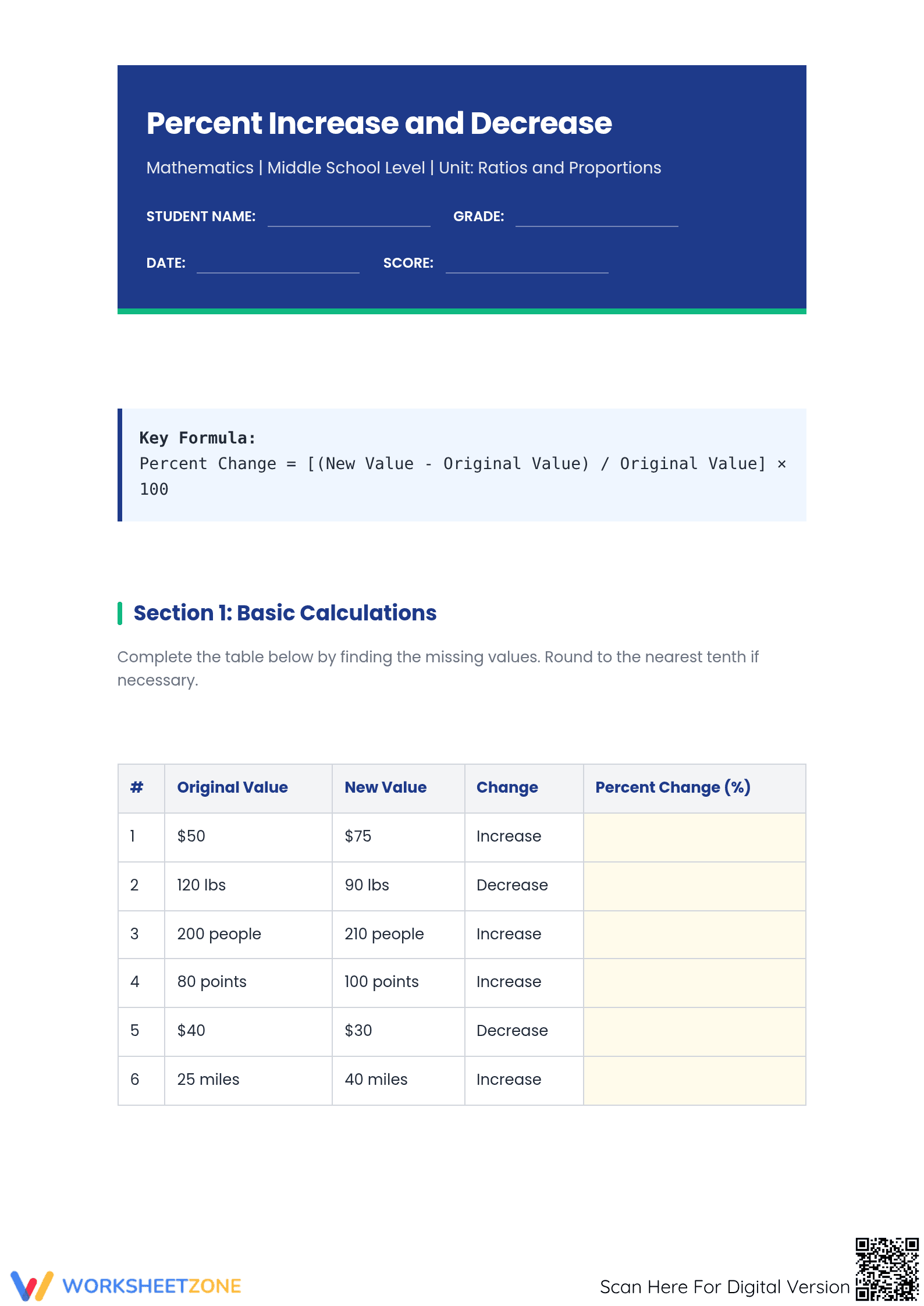
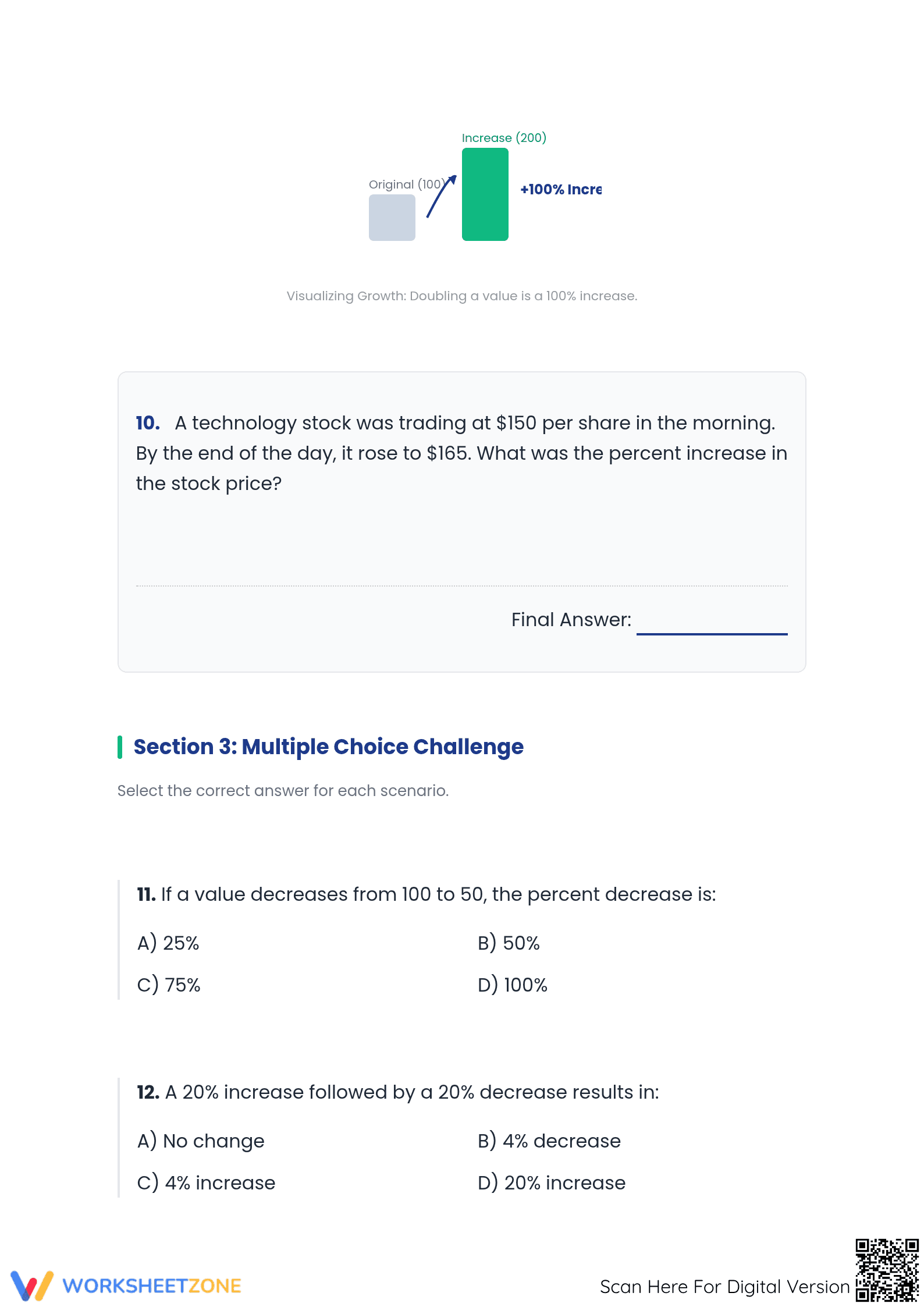
This comprehensive 5-page packet features a logical progression from simple table-based calculations to complex multi-step word problems. It includes a dedicated section for multiple-choice challenges and advanced problems requiring backward calculation of original values. A full answer key is provided for immediate grading, and visual aids help students conceptualize growth as a 100% increase.
Skill Progression
- Guided Practice: 6 table-based tasks introduce the core formula using straightforward numerical values to build procedural fluency with minimal distraction.
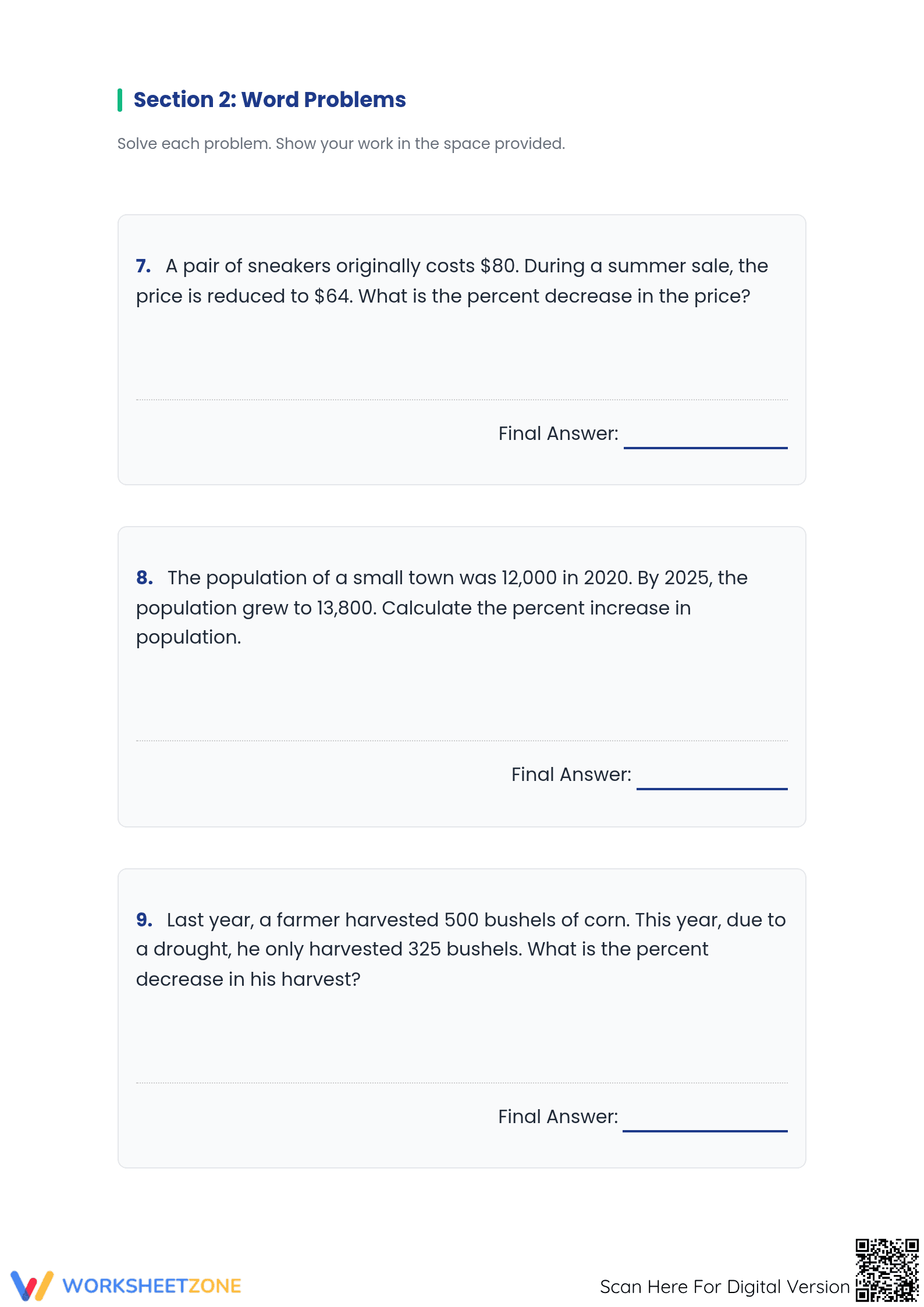
- Supported Practice: 6 contextual word problems and multiple-choice scenarios require students to extract values and determine the direction of change in realistic settings.
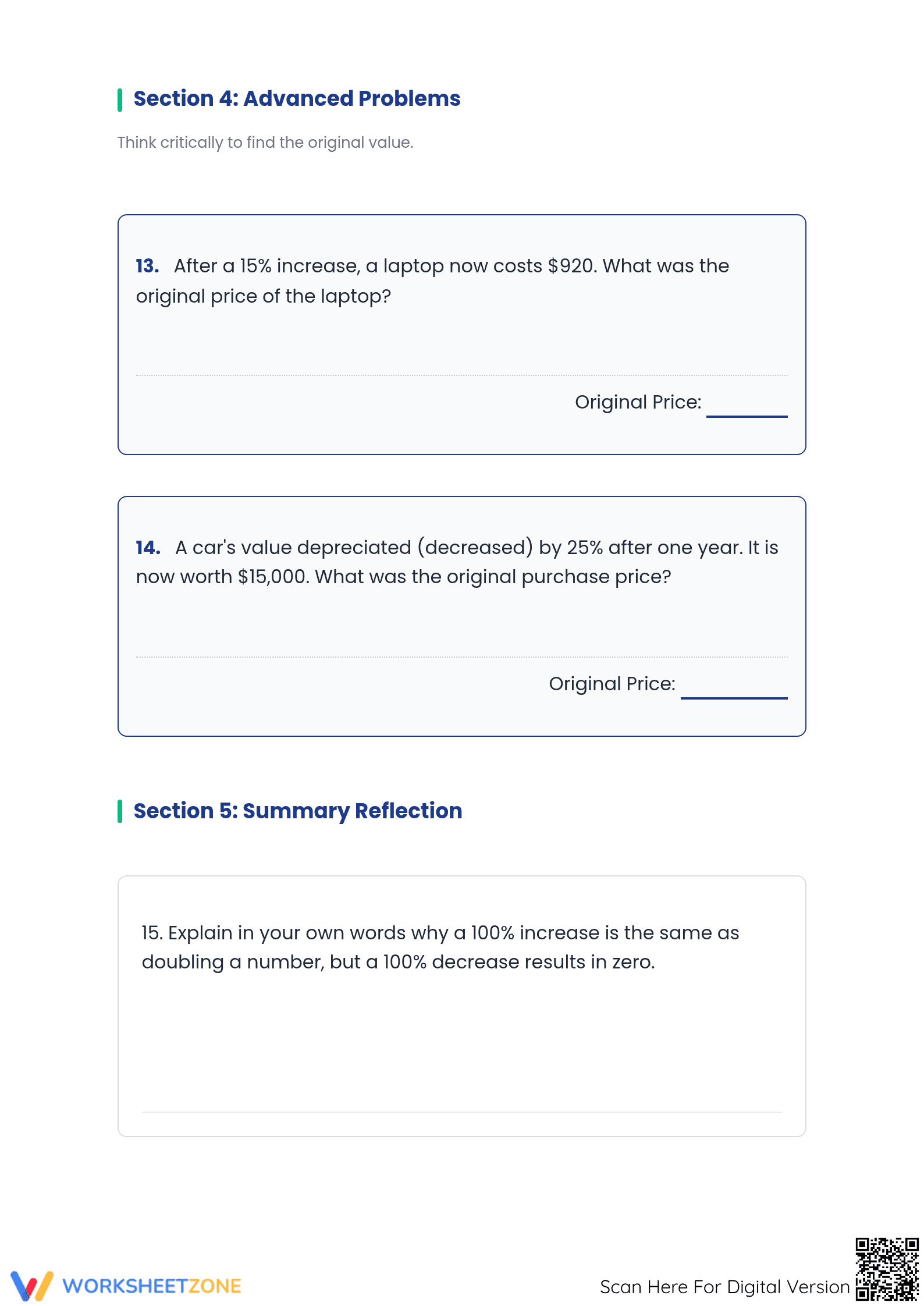
- Independent Practice: 4 advanced and reflective tasks challenge students to find original amounts and explain mathematical concepts in their own words.
The packet follows a gradual-release model, moving from teacher-led modeling of the "Key Formula" to independent student creation of their own unique percent change problems.
Standards Alignment
This resource is explicitly aligned to `7.RP.A.3`. The standard requires students to use proportional relationships to solve multistep ratio and percent problems, specifically addressing percent increase and decrease. Students must be able to calculate tax, markups, markdowns, and simple interest in context. Both standard codes can be copied directly into lesson plans, IEP goals, or district curriculum mapping tools.
How to Use It
Use this worksheet as a primary practice tool during your unit on ratios and proportions. It works best following direct instruction on the percent change formula. For formative assessment, observe students during Section 4 to see if they can reverse the formula to find the original price. Expect students to take approximately 50 minutes to complete the full set of 16 problems.
Who It's For
This packet is designed for Grade 7 math students but serves as excellent enrichment for Grade 6 or remediation for Grade 8. It is particularly useful for students needing clear visual cues and structured workspace. Pair this resource with a real-world shopping catalog or stock market tracker to show the practical application of these essential mathematical skills.
The RAND AIRS 2024 analysis highlights that consistent exposure to multi-step proportional reasoning tasks is a significant predictor of success in high school algebra. By focusing on `7.RP.A.3`, this worksheet addresses a critical "gateway" skill in the middle school curriculum. Mastery of percent increase and decrease allows students to move beyond basic computation toward authentic financial literacy and data analysis. Research from ScienceDirect TpT Analysis suggests that worksheets providing both procedural tables and conceptual reflection prompts—like the Section 5 tasks included here—lead to higher retention rates compared to rote calculation alone. These 16 tasks provide the necessary depth for students to internalize the relationship between new and original values. This structured approach ensures that learners are prepared for the rigorous demands of standardized assessments and real-world economic decision-making.


