


























Views
Downloads


Essential Patterns Worksheet: ABC & AAB — Kindergarten Math
Paste this activity's link or code into your existing LMS (Google Classroom, Canvas, Teams, Schoology, Moodle, etc.).
Students can open and work on the activity right away, with no student login required.
You'll still be able to track student progress and results from your teacher account.
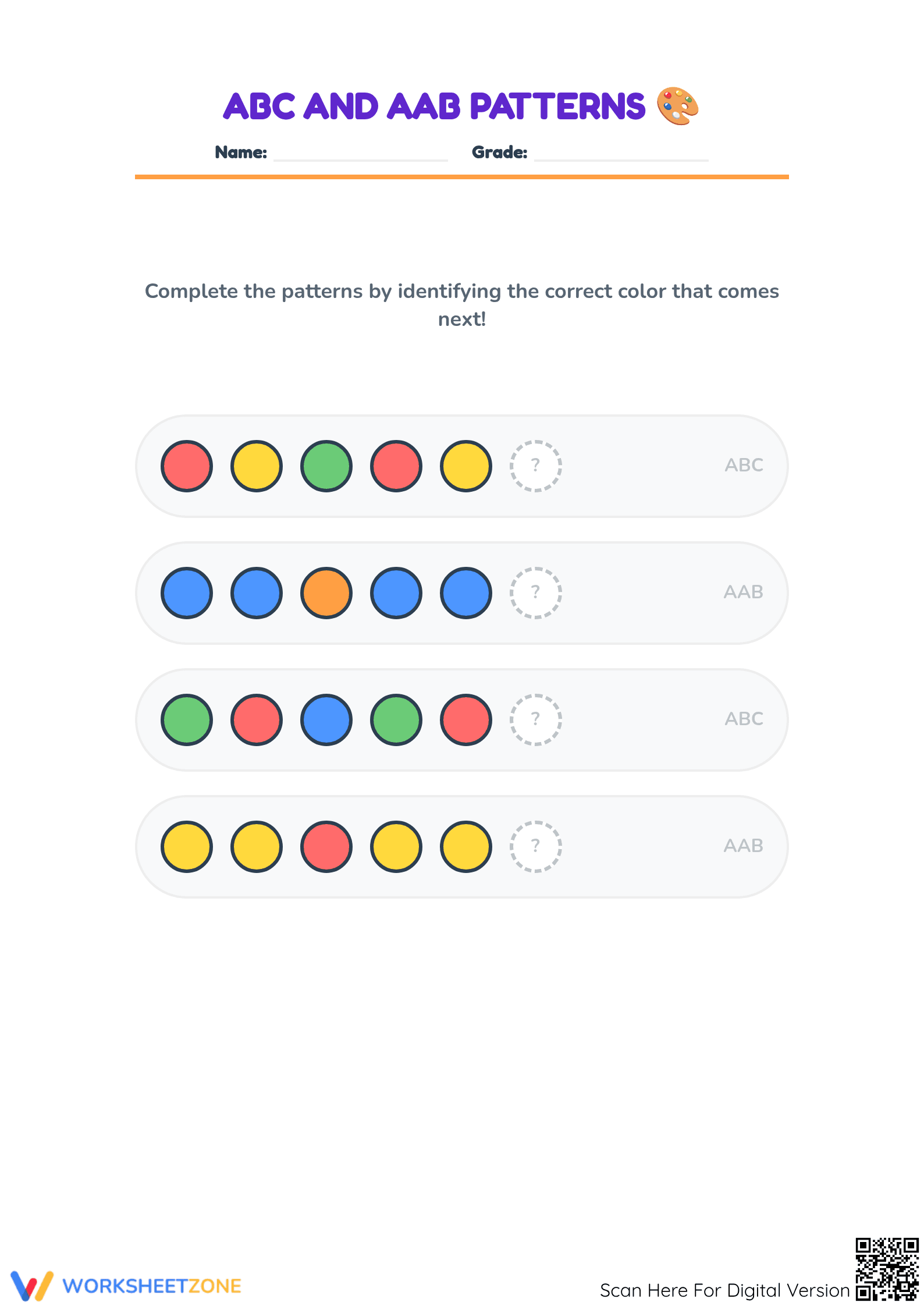
This printable Kindergarten patterns worksheet helps young learners master the fundamentals of algebraic thinking through color-based sequence identification. Students engage with ABC and AAB patterns, sharpening their visual discrimination and logical reasoning skills. By completing existing sequences and creating their own, children build the essential foundation required for advanced mathematical relationships and algebraic operations in later grades.
At a Glance
- Grade: Kindergarten · Subject: Math
- Standard:
CCSS.MATH.CONTENT.K.OA.A.1— Represent relationships and patterns to build early algebraic thinking skills- Skill Focus: Pattern identification and creation (ABC, AAB)
- Format: 2 pages · 5 problems · Answer key included · PDF
- Best For: Early finishers and morning work
- Time: 10–15 minutes
This 2-page resource features five distinct learning tasks designed for early learners. The first page presents four color-coded sequences where students must identify the next color in ABC and AAB arrangements. The second page encourages higher-order thinking with an open-ended "create your own" pattern task. The document includes a full-color answer key and high-contrast visuals to ensure clarity during printing or digital display.
Zero-Prep Workflow
The zero-prep design of this worksheet ensures a smooth classroom transition with minimal teacher oversight. Simply print the two pages (1 minute), distribute them to your students (30 seconds), and let them work independently while you manage other classroom needs. Reviewing the finished work takes less than 30 seconds using the provided visual answer key, bringing total teacher prep and management time to under 2 minutes. This makes it an ideal solution for emergency sub plans or unexpected schedule shifts.
Standards Alignment
The primary alignment for this activity is CCSS.MATH.CONTENT.K.OA.A.1, which focuses on representing relationships and understanding the building blocks of operations. Identifying repeating patterns is a critical prerequisite for understanding mathematical cycles and algebraic expressions. This standard code can be copied directly into lesson plans, IEP goals, or district curriculum mapping tools to ensure documented adherence to rigorous educational frameworks.
How to Use It
Use this worksheet as a formative assessment during a unit on classification and sequences. For best results, introduce the concept with physical manipulatives first, then use this printable to transition students toward representational thinking. Teachers can observe students as they color the creation task on page two to identify who understands the rule of the pattern versus those who are simply choosing colors randomly. This provides immediate data for small-group intervention.
Who It's For
This resource is tailored for Kindergarten students, though it serves as excellent remediation for first graders or a challenge for advanced Pre-K learners. It is particularly effective for English Language Learners (ELLs) as the instructions are visual and the tasks rely on color recognition rather than heavy text. Pair this with a pattern anchor chart or a pattern-focused picture book for a comprehensive cross-curricular lesson.
According to NAEP research on early childhood mathematics, the ability to recognize and extend repeating patterns is a significant predictor of later success in algebraic reasoning and functional thinking. This Kindergarten patterns worksheet bridges the gap between concrete manipulation and symbolic representation. By targeting CCSS.MATH.CONTENT.K.OA.A.1, the activity ensures that students develop the mental models necessary for identifying structures within the base-ten system. Fisher & Frey (2014) emphasize that such focused practice, when coupled with immediate feedback, accelerates the acquisition of foundational logic. This resource provides five scaffolded tasks that move students from passive identification to active creation, fulfilling the requirements for high-quality math instructional materials. The inclusion of ABC and AAB sequences specifically addresses the cognitive load requirements for five-year-olds, making it an essential tool for any early childhood classroom.


