




























Views
Downloads

Essential Grade 3 Patterns of Motion Science Worksheet

Paste this activity's link or code into your existing LMS (Google Classroom, Canvas, Teams, Schoology, Moodle, etc.).
Students can open and work on the activity right away, with no student login required.
You'll still be able to track student progress and results from your teacher account.
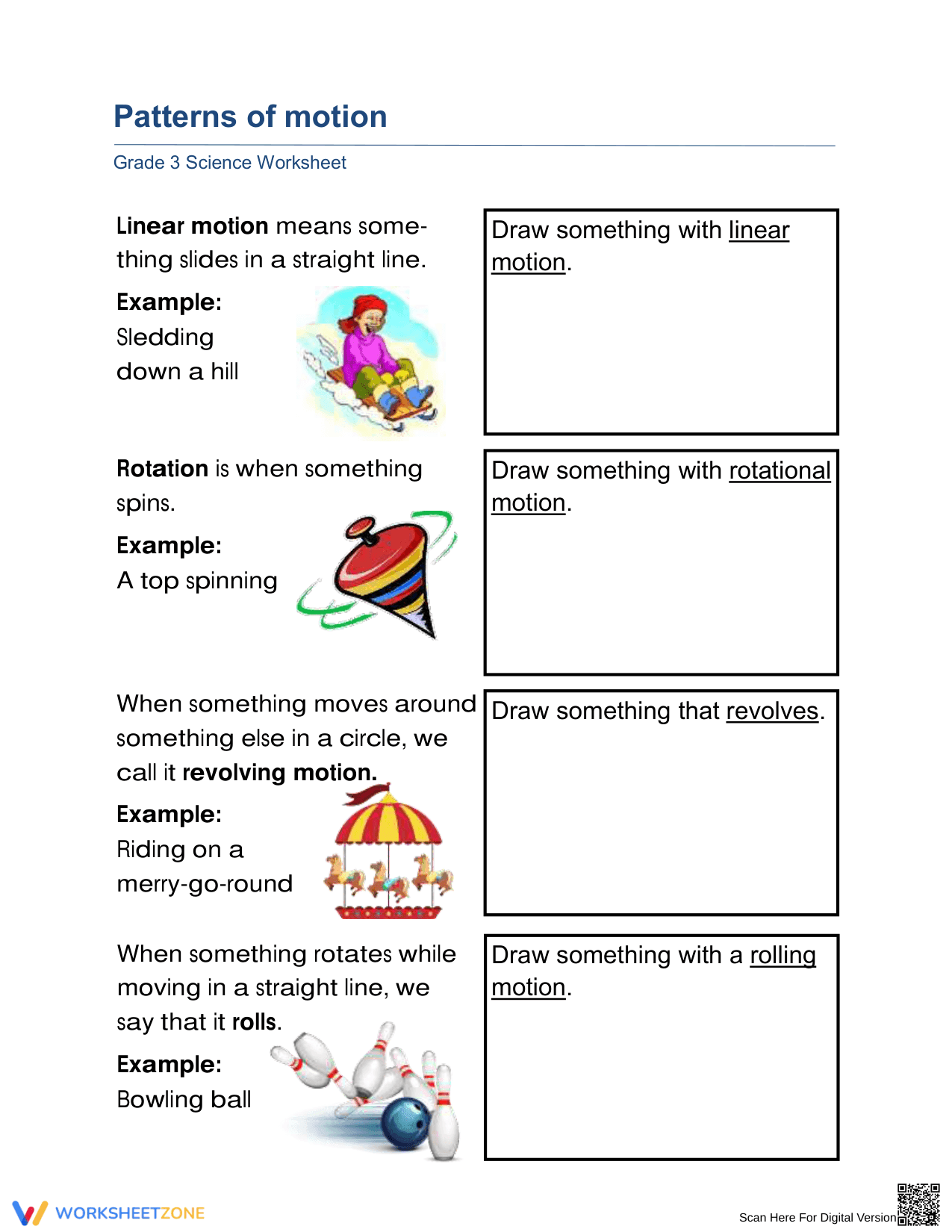
This Grade 3 science worksheet introduces students to four distinct patterns of motion: linear, rotation, revolving, and rolling. Students move beyond simple observation by defining these physical phenomena and then applying their understanding through creative drawing tasks. It is designed to build a concrete visual foundation for predicting object motion in physical science units.
At a Glance
- Grade: 3 · Subject: Science
- Standard:
3-PS2-2— Observe and use motion patterns to provide evidence for predicting future motion- Skill Focus: Identifying and illustrating physical motion patterns
- Format: 1 page · 4 problems · Answer key included · PDF
- Best For: Introduction to forces and motion units
- Time: 15–20 minutes
Inside this single-page PDF, you will find four clear, illustrated definitions that explain linear motion, rotational spinning, revolving paths, and rolling combinations. Each concept is paired with a real-world example, such as a sledding hill or a bowling ball, followed by a dedicated workspace for students to illustrate their own unique example of that motion pattern.
Zero-Prep Workflow
- Print (30 seconds): Simply select the page and print enough copies for your class or small group.
- Distribute (1 minute): Hand out the worksheets alongside colored pencils or crayons to encourage detailed student illustrations.
- Review (5 minutes): Use the provided answer key or the included visual examples to conduct a quick whole-class check for understanding.
This streamlined process requires less than two minutes of total teacher preparation, making it an ideal choice for emergency sub plans or quick lesson transitions.
Standards Alignment: This activity is directly aligned with `3-PS2-2`. Students must make observations of an object’s motion to provide evidence that a pattern can be used to predict future motion. By mastering the vocabulary and visual representation of these four patterns, students develop the analytical skills needed for more complex kinetic investigations. This standard code can be copied directly into lesson plans, IEP goals, or district curriculum mapping tools.
How to Use It: Assign this worksheet during the "Exploration" phase of a 5E science lesson. It serves as a perfect bridge between a hands-on lab with toy cars and the formal assessment of motion prediction. For a quick formative-assessment observation tip, watch for students who struggle to differentiate between revolving and rotation; this common misconception can be addressed immediately by referring back to the merry-go-round versus the spinning top examples.
Who It's For: This resource is tailored for third-grade general education classrooms, but it is also highly effective for ESL/ELL students who benefit from the strong visual-to-text pairing. It naturally pairs with a short reading passage about basic physics or an anchor chart displaying these motion types in the classroom environment.
The RAND AIRS 2024 report on elementary science instruction emphasizes that visualizing abstract physical concepts through sketching significantly improves long-term retention of NGSS 3-PS2-2 requirements. This worksheet facilitates that exact cognitive process by requiring students to translate the plain-English skill of identifying motion patterns into original drawings. By engaging both the linguistic and spatial centers of the brain, the activity ensures that learners can accurately predict the future path of an object based on observed patterns. This resource provides the necessary scaffolding to move from basic identification to the high-level evidence-based reasoning required by modern state and national science frameworks. Teachers can rely on this assessment-ready tool to provide measurable proof of student mastery regarding linear, rotational, revolving, and rolling motions within any elementary physical science curriculum.


