


























Views
Downloads

Past Perfect Progressive Worksheet | Grade 5-8 Ready
Paste this activity's link or code into your existing LMS (Google Classroom, Canvas, Teams, Schoology, Moodle, etc.).
Students can open and work on the activity right away, with no student login required.
You'll still be able to track student progress and results from your teacher account.
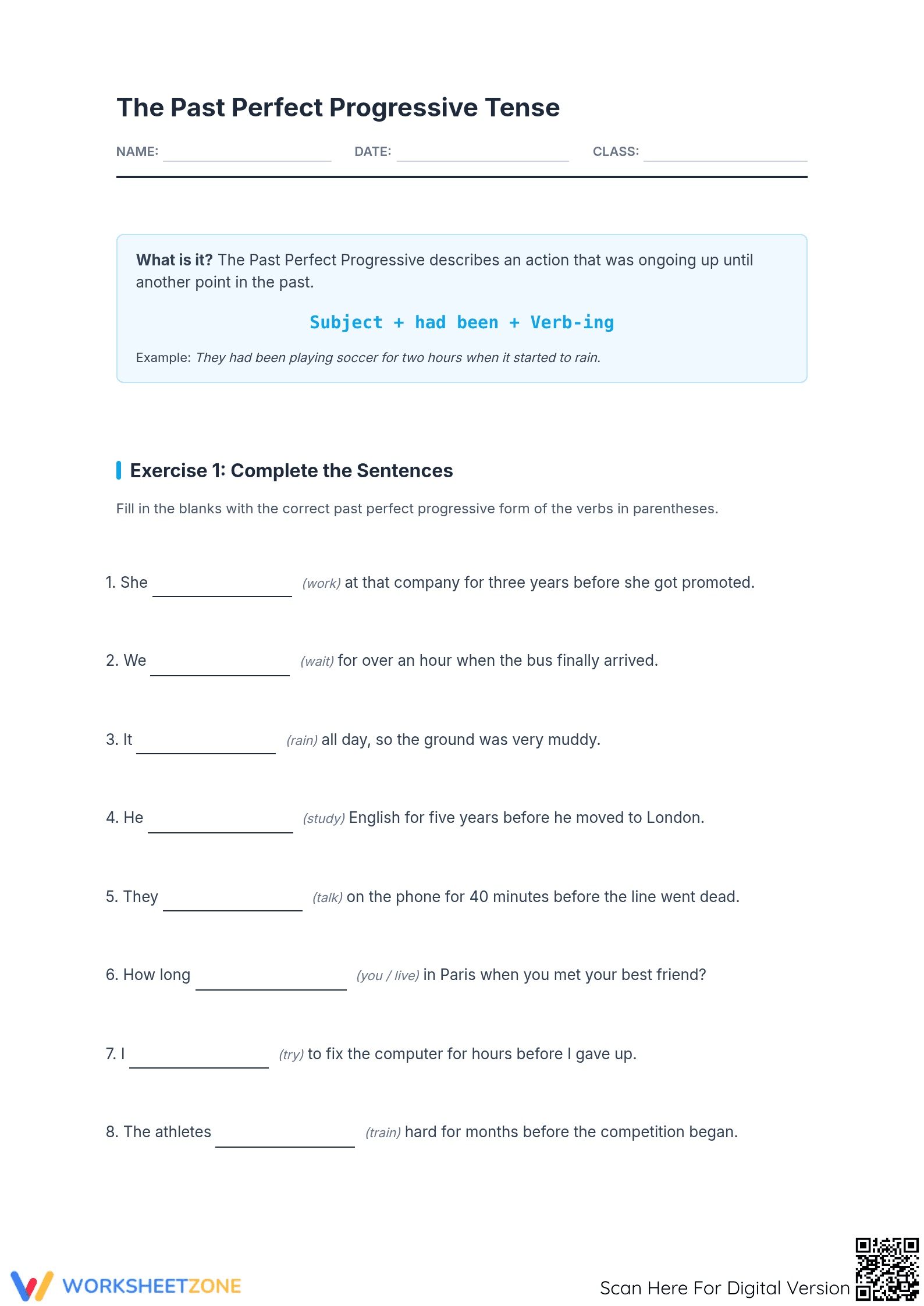
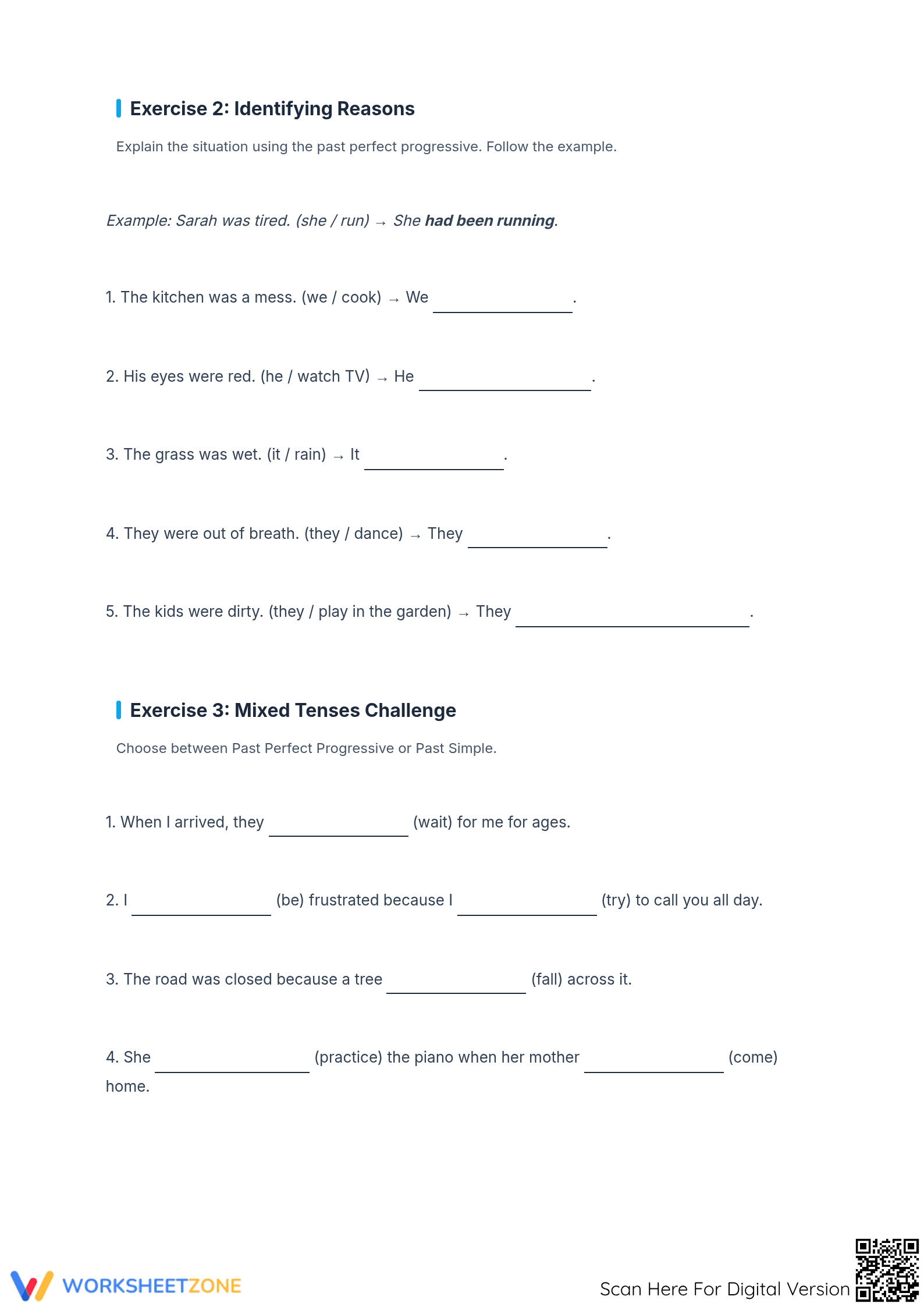
Mastering the past perfect progressive tense allows students to clarify the sequence and duration of past events with precision. This comprehensive worksheet provides nineteen exercises that transition learners from basic conjugation to complex causal analysis. Students will achieve structural mastery of the had been plus verb-ing formula while learning to differentiate it from the simple past tense in context.
At a Glance
- Grade: 5–8 · Subject: English Language Arts
- Standard:
L.5.1— Use perfect verb tenses to convey times, sequences, states, and conditions- Skill Focus: Past Perfect Progressive Tense Formation
- Format: 2 pages · 19 problems · Answer key included · PDF
- Best For: Grammar centers, independent practice, and emergency sub plans
- Time: 15–25 minutes
What's Inside
This two-page resource contains three distinct exercises totaling nineteen tasks. Exercise 1 focuses on sentence completion using parenthetical verb prompts to reinforce basic syntax. Exercise 2 requires students to explain reasons for past states, bridging the gap between mechanical grammar and logical reasoning. Exercise 3 provides a mixed-tense challenge to ensure students can choose the correct aspect. A comprehensive answer key is included for rapid feedback.
Zero-Prep Workflow
Teachers can implement this resource in under two minutes with a simple three-step workflow. First, print the two-page document. Second, distribute the sheets to students. Third, review the completed work using the answer key. This efficient design makes it a top choice for emergency sub plans or quick bell-ringers where zero teacher setup is required for instructional success.
Standards Alignment
This resource is primarily aligned with CCSS.ELA-LITERACY.L.5.1, focusing on the conventions of standard English grammar and mechanics. Specifically, it targets the ability to form and use perfect verb tenses effectively to indicate timing and states of being. This standard code can be copied directly into lesson plans, IEP goals, or district curriculum mapping tools to ensure instructional consistency across the language arts curriculum.
How to Use It
Assign this worksheet as a formative assessment during a grammar unit or as focused independent practice following a lesson on verb tenses. Teachers can utilize the instructional box at the top as a mini-anchor chart for students working in small groups. The expected completion time ranges from 15 to 25 minutes, making it a perfect tool for checking student understanding mid-lesson before transitioning to writing.
Who It's For
This worksheet is ideal for Grade 5-8 students who are moving beyond basic verb conjugation toward sophisticated narrative structures. It provides the visual scaffolding necessary for English Language Learners (ELL) while offering enough challenge for native speakers. Pair this resource with a reading passage to help students identify the past perfect progressive tense in context during a literary analysis session.
Fisher & Frey (2014) emphasize that grammatical mastery, particularly with complex structures like the past perfect progressive, requires a scaffolded approach that moves from recognition to production. This worksheet aligns with CCSS.ELA-LITERACY.L.5.1 by requiring students to form and use perfect verb tenses to indicate sequences of events. By providing clear formulaic support followed by varied sentence-level application, the resource ensures students internalize the specific construction while understanding its functional utility in narrative writing. Research in NAEP performance indicates that students who master nuanced verb tenses demonstrate higher proficiency in reading comprehension and compositional clarity. Effective syntax instruction bridges the gap between mechanical correctness and stylistic maturity, providing students with the linguistic tools to describe complex temporal relationships. This resource provides the focused practice necessary for middle-grade students to achieve automaticity in their use of grammar, ultimately supporting more sophisticated and accurate expressive language in academic contexts.


