


























Views
Downloads
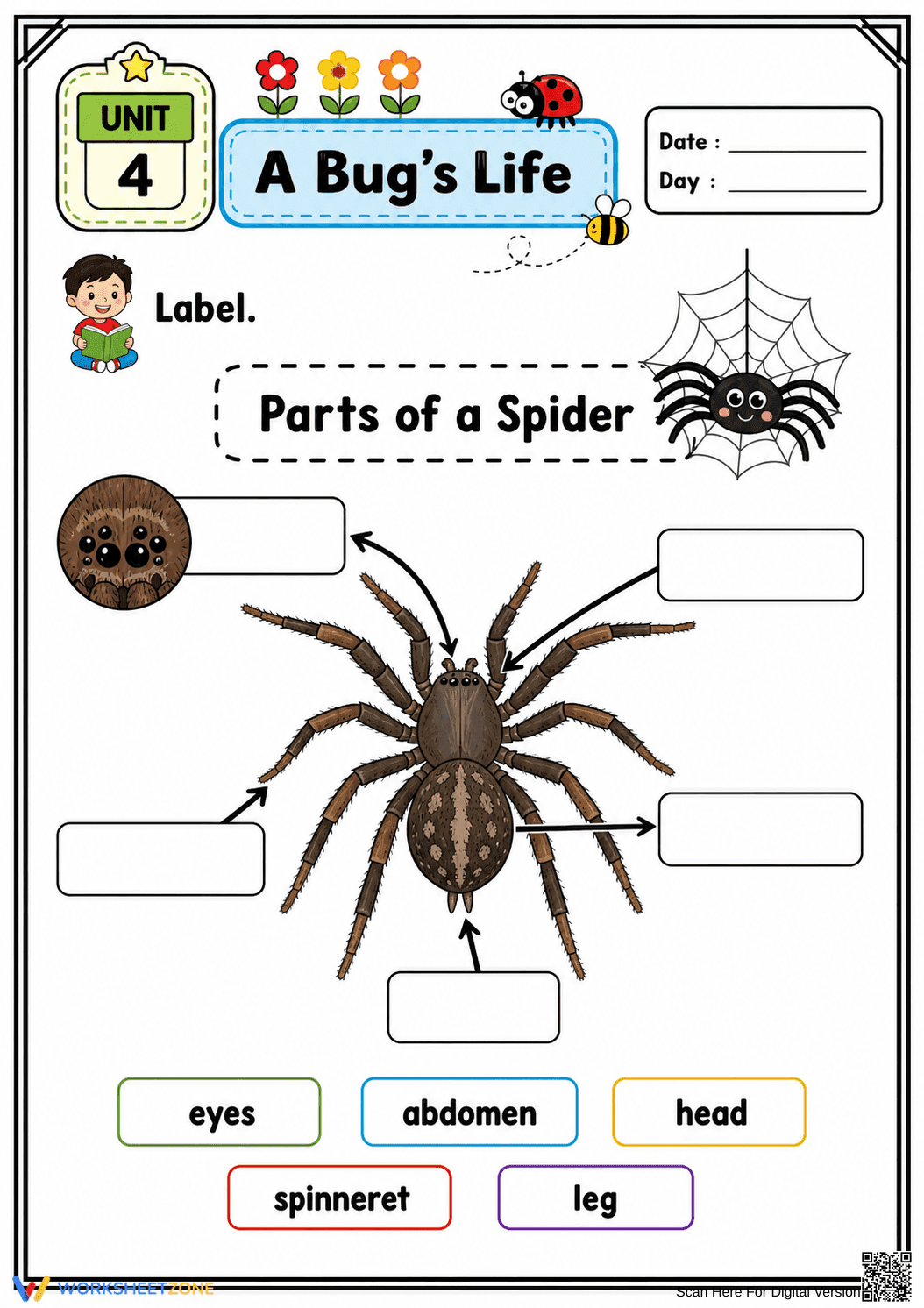

Spider Anatomy Worksheet | Grade 4 Science Printable
Paste this activity's link or code into your existing LMS (Google Classroom, Canvas, Teams, Schoology, Moodle, etc.).
Students can open and work on the activity right away, with no student login required.
You'll still be able to track student progress and results from your teacher account.
This printable science worksheet helps students identify and label the external anatomical structures of a spider. By matching key vocabulary terms to a detailed biological illustration, learners build foundational life science skills and develop a stronger understanding of how arachnid body parts function to support survival in their environments.
At a Glance
- Grade: 4 · Subject: Science
- Standard:
4-LS1-1— Identify external structures of animals- Skill Focus: Labeling spider anatomy
- Format: 1 page · 5 problems · Answer key included · PDF
- Best For: Independent practice
- Time: 10–15 minutes
This single-page resource features a large, clear illustration of a spider with five distinct anatomical features marked by arrows. Students utilize a provided word bank containing terms like "abdomen," "spinneret," and "head" to correctly label each part. The straightforward layout minimizes confusion, while the included answer key ensures accurate grading for educators.
Zero-Prep Workflow:
- Print (1 minute): Simply download the PDF and print a class set. The black-and-white friendly design saves ink.
- Distribute (1 minute): Hand out the worksheets alongside standard writing utensils. No extra materials are required.
- Review (3 minutes): Use the included answer key to quickly check student work or project it on the board.
With under two minutes of total teacher prep time, this resource is an excellent addition to emergency sub plans or busy science blocks.
Aligned to primary standard 4-LS1-1: Construct an argument that plants and animals have internal and external structures that function to support survival, growth, behavior, and reproduction. This activity specifically targets the identification of external structures in arachnids. Both standard codes can be copied directly into lesson plans, IEP goals, or district curriculum mapping tools.
This worksheet serves as an effective independent practice activity following a direct instruction lesson on arthropods and arachnids. Alternatively, use it as a quick morning work assignment to activate prior knowledge before a science lab. As students work, teachers can observe their ability to use process-of-elimination skills with the word bank, providing a quick formative assessment of their vocabulary retention. Expected completion time is 10 to 15 minutes.
Designed primarily for fourth-grade science students, this worksheet is also highly effective for ESL learners needing visual vocabulary support. The clear word bank provides built-in differentiation for students who struggle with spelling or recall. Pair this activity with an informational text about spider web construction to connect the "spinneret" structure to its biological function.
Aligning elementary science instruction with 4-LS1-1 requires students to accurately identify external structures of animals before they can effectively argue how those specific structures support survival, growth, and reproduction. According to EdReports 2024, integrating clear visual models with targeted vocabulary practice significantly improves student retention of complex biological terms and concepts. By isolating five specific anatomical features of an arachnid and providing a structured word bank, this worksheet deliberately reduces cognitive load. This allows young learners to focus strictly on structural identification without being overwhelmed by spelling or recall demands. This targeted, visually supported approach ensures that foundational life science concepts are firmly established in the student's working memory. Consequently, educators can easily transition from this basic identification task into higher-order classroom discussions about behavioral adaptations, web-spinning mechanics, and environmental survival strategies in subsequent science lessons.


