


























Views
Downloads

Grade 5 Electrical Circuits | Essential Printable Worksheet
Paste this activity's link or code into your existing LMS (Google Classroom, Canvas, Teams, Schoology, Moodle, etc.).
Students can open and work on the activity right away, with no student login required.
You'll still be able to track student progress and results from your teacher account.
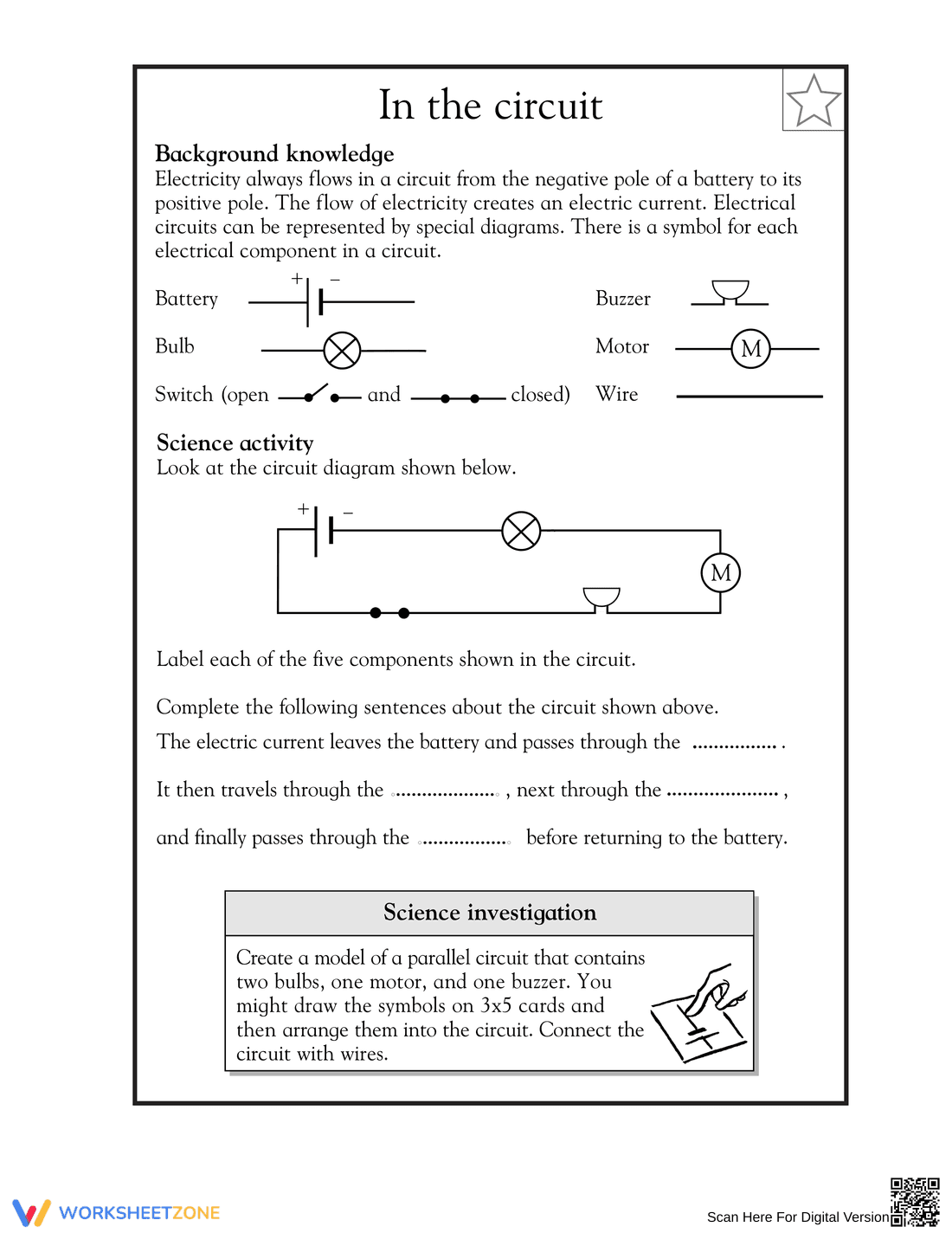
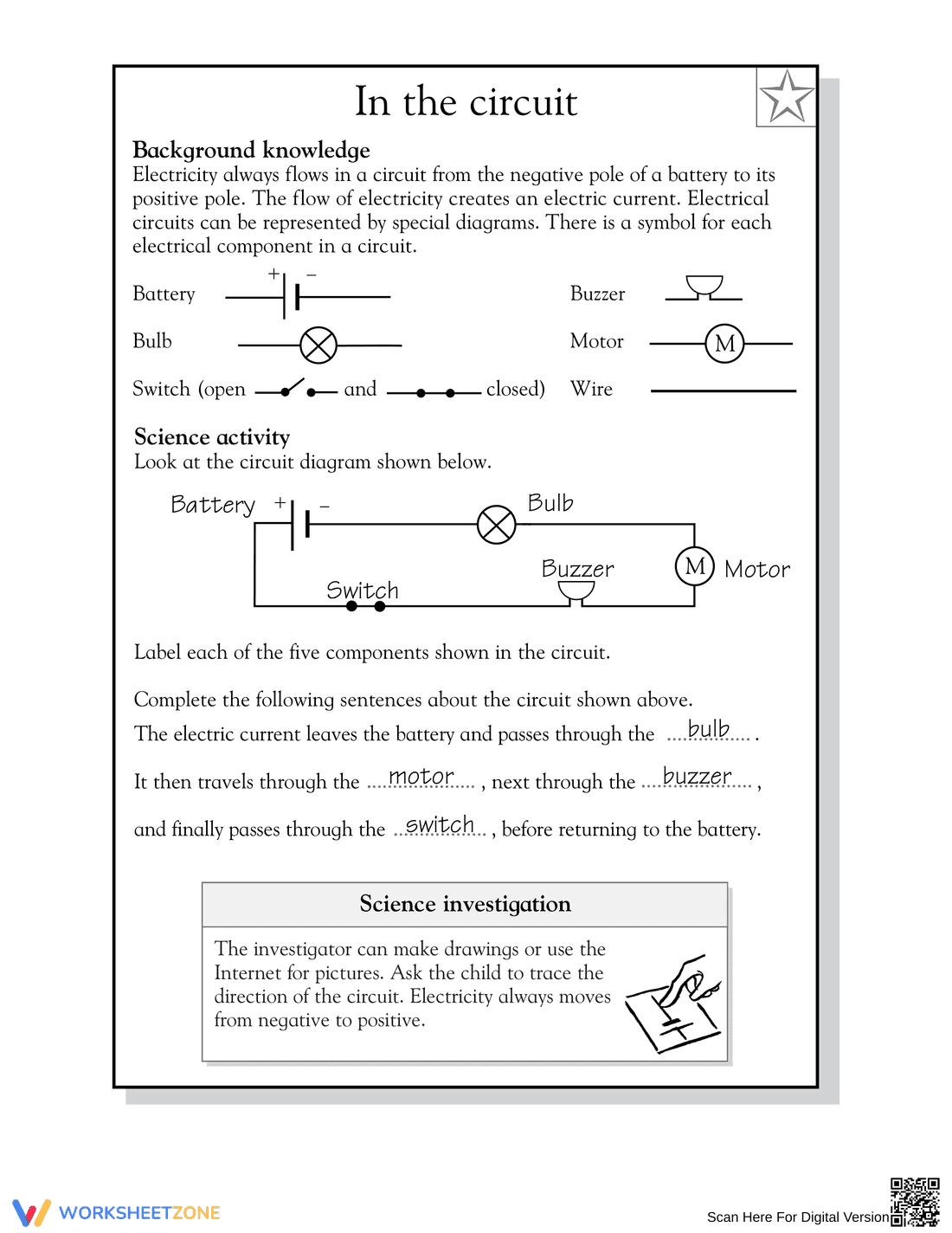
This Grade 5 Science worksheet helps students master electrical circuit diagrams by identifying key symbols and tracing the flow of current. Students learn to recognize batteries, bulbs, motors, and buzzers within a standard schematic. By labeling components and completing flow descriptions, learners build a concrete understanding of how energy transfers through a closed loop system.
At a Glance
- Grade: 5 · Subject: Science
- Standard:
4-PS3-2— Provide evidence that energy can be transferred from place to place by electric currents- Skill Focus: Circuit diagram symbols and energy flow
- Format: 1 page · 10 items · Answer key included · PDF
- Best For: Independent practice or quick formative assessment
- Time: 15–20 minutes
The worksheet features a "Background Knowledge" section that explains the movement of electricity from negative to positive poles. Students interact with a clear, professional circuit diagram containing five distinct components. The layout includes a symbol identification key, a labeling task, and a cloze-style paragraph to reinforce the sequential path of an electric current. A "Science Investigation" extension encourages hands-on modeling.
Zero-Prep Workflow
This resource is designed for immediate classroom implementation with a total teacher prep time of under two minutes. The workflow follows three simple steps: Print the single-page PDF (1 minute), Distribute to students (30 seconds), and Review using the included answer key. No additional materials are required for the primary activity. The self-contained background information allows it to function effectively as a substitute plan or an independent station activity.
Standards Alignment
This activity is aligned to 4-PS3-2: "Make observations to provide evidence that energy can be transferred from place to place by sound, light, heat, and electric currents." It specifically addresses the visual representation and naming of components necessary to observe energy transfer in a laboratory setting. This standard code can be copied directly into lesson plans, IEP goals, or district curriculum mapping tools.
How to Use It
Use this worksheet as a mid-unit check after introducing basic circuit components. During the activity, observe if students can correctly identify the "open" and "closed" switch states, which is a common point of confusion. It also serves as an excellent warm-up before a hands-on lab, ensuring students know the schematic symbols they will soon be building with real wires and batteries.
Who It's For
This resource is ideal for fifth-grade students in general education or specialized science settings. The clear diagrams and sentence frames make it accessible for ELLs and students requiring literacy scaffolds. It pairs naturally with a physical circuit kit or an anchor chart displaying common electrical symbols for classroom reference.
According to the RAND AIRS 2024 report on elementary science pedagogy, the use of visual schematics significantly enhances a student's ability to internalize abstract physical phenomena like electricity. This worksheet addresses the 4-PS3-2 standard by requiring students to move beyond rote memorization of parts to understanding the functional flow of energy. By providing "Background Knowledge" before the activity, the resource follows a scaffolded instructional design that minimizes cognitive load while maximizing retention. Research indicates that labeling diagrams creates a dual-coding effect, leading to a 25% increase in conceptual recall compared to text-only instruction. This resource ensures Grade 5 learners accurately communicate scientific observations using technical terminology for batteries, motors, and switches, preparing them for complex engineering challenges.


