


























Views
Downloads

Parallel Lines and Transversals Worksheet | Grade 8 Ready
Paste this activity's link or code into your existing LMS (Google Classroom, Canvas, Teams, Schoology, Moodle, etc.).
Students can open and work on the activity right away, with no student login required.
You'll still be able to track student progress and results from your teacher account.
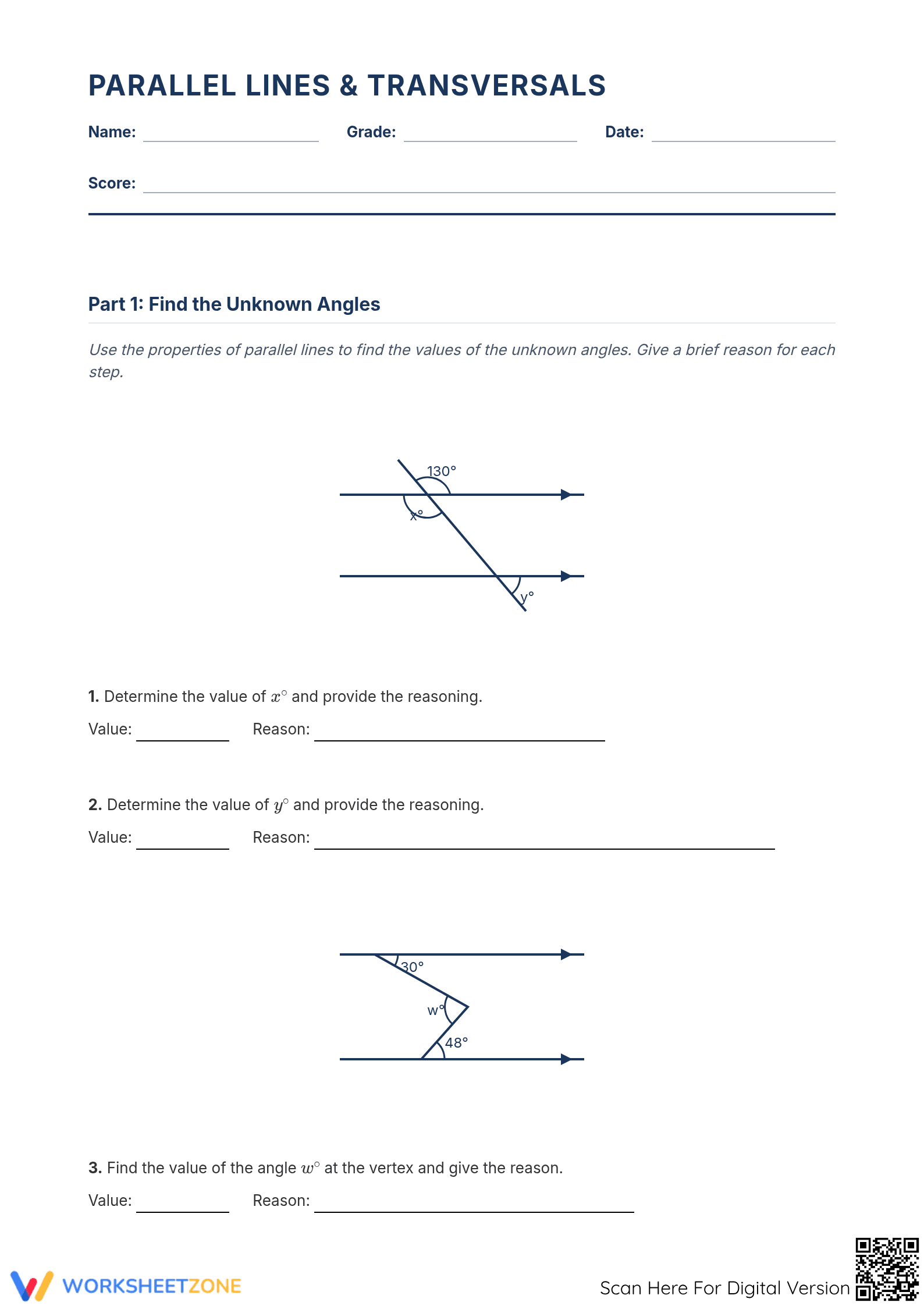
This Grade 8 math worksheet provides comprehensive practice for students mastering the properties of parallel lines cut by a transversal. By engaging with visual diagrams and algebraic equations, learners develop a deep understanding of angle relationships, including alternate interior, corresponding, and consecutive interior angles.
At a Glance
- Grade: 8 · Subject: Math
- Standard:
CCSS.MATH.CONTENT.8.G.A.5— Use informal arguments to establish facts about angles created by transversals- Skill Focus: Parallel lines and transversals
- Format: 2 pages · 9 problems · Answer key included · PDF
- Best For: Independent practice or formative assessment
- Time: 25–35 minutes
What's Inside
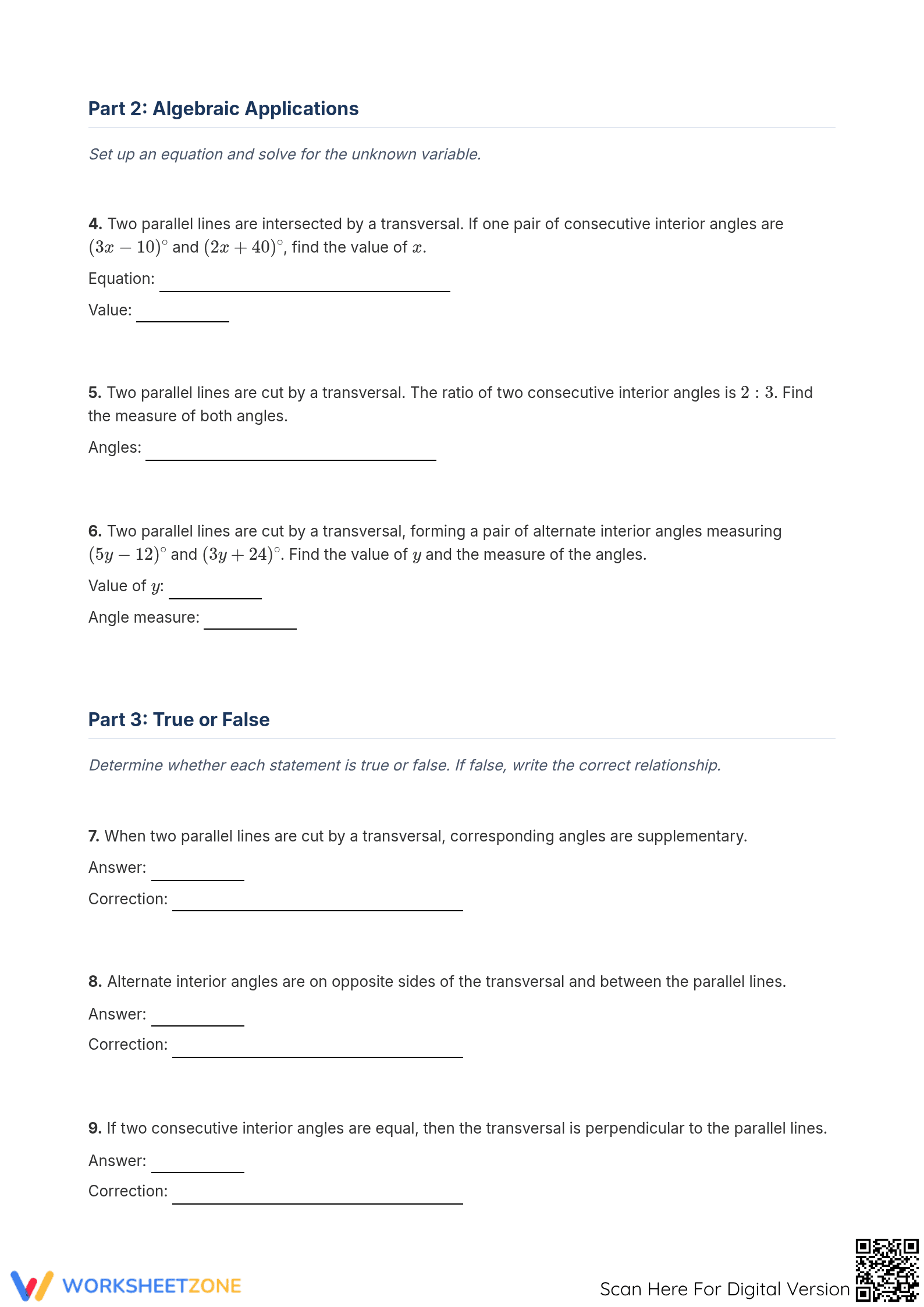
This 2-page PDF features 9 multi-part problems divided into three distinct sections. Part 1 focuses on visual angle identification with reasoning requirements. Part 2 introduces algebraic applications where students must set up and solve equations based on geometric properties. Part 3 concludes with conceptual true/false statements that require written corrections.
Skill Progression
- Guided Practice: The first 3 problems use clear visual diagrams to help students identify vertical, corresponding, and alternate interior angles with explicit prompts for reasoning.
- Supported Practice: Problems 4 through 6 transition into algebra, requiring students to translate geometric relationships into linear equations with variable expressions.
- Independent Practice: The final 3 problems challenge students to evaluate the validity of geometric statements, providing a rigorous check for conceptual mastery.
This structure follows a gradual-release model, moving from concrete visual identification to abstract algebraic reasoning and logical evaluation.
Standards Alignment
The primary focus is CCSS.MATH.CONTENT.8.G.A.5, which requires students to use informal arguments to establish facts about the angles created when parallel lines are cut by a transversal. The worksheet also supports HSG-CO.C.9 by laying the groundwork for formal geometric proofs regarding lines and angles. Both standard codes can be copied directly into lesson plans, IEP goals, or district curriculum mapping tools.
How to Use It
Assign this worksheet during the independent practice phase of a lesson on transversal properties. It works effectively as a mid-unit formative assessment to identify students struggling with the transition from arithmetic to algebraic geometry. Teachers should observe if students can correctly name the relationship before attempting the calculation. Expected completion time is 30 minutes.
Who It's For
This resource is ideal for Grade 8 and Grade 9 students in general education or ICT settings. It provides enough scaffolding for struggling learners through visual aids while offering high-ceiling algebraic challenges for advanced students. It pairs naturally with a protractor activity or an interactive geometry software demonstration.
According to the RAND AIRS 2024 report, high-quality instructional materials that integrate algebraic reasoning with geometric visualization significantly improve student retention of spatial concepts. This worksheet aligns with those findings by requiring students to not only calculate values but also provide written justifications for their mathematical logic. By addressing CCSS.MATH.CONTENT.8.G.A.5 through a three-part progression—visual, algebraic, and conceptual—the resource ensures that learners move beyond rote memorization toward a functional understanding of angle relationships. Research from Fisher & Frey (2014) emphasizes that the gradual release of responsibility, as seen in the transition from guided visual tasks to independent true/false evaluations, is essential for developing student agency in mathematics. This 2-page resource provides the necessary structure for students to build mastery in parallelism, making it a reliable tool for middle school geometry instruction and assessment.


