


























Views
Downloads

Our 2nd Grade Class Word Search | Printable ELA Guide
Paste this activity's link or code into your existing LMS (Google Classroom, Canvas, Teams, Schoology, Moodle, etc.).
Students can open and work on the activity right away, with no student login required.
You'll still be able to track student progress and results from your teacher account.
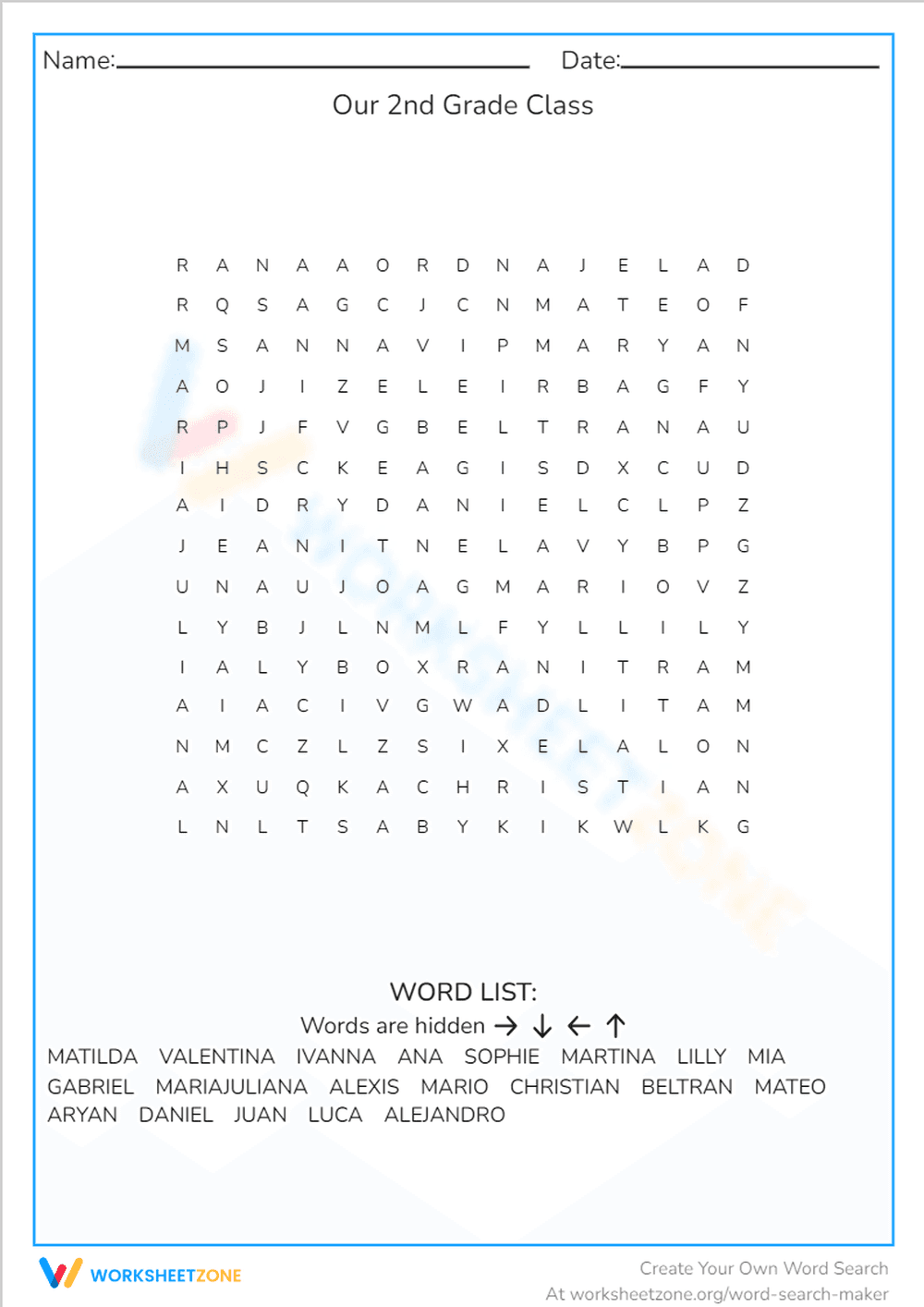
This Grade 2 word search worksheet provides students with 20 specific names to locate within a dense letter grid. By identifying complex spelling patterns and letter sequences, learners strengthen their visual scanning abilities and orthographic awareness. It serves as an engaging community-building activity while reinforcing foundational literacy skills in a structured, low-stakes format.
At a Glance
- Grade: 2 · Subject: ELA
- Standard:
CCSS.ELA-LITERACY.L.2.2— Demonstrate command of the conventions of standard English capitalization, punctuation, and spelling.- Skill Focus: Letter recognition & pattern matching
- Format: 1 page · 20 problems · Answer key included · PDF
- Best For: Morning work or early finishers
- Time: 15–20 minutes
Inside this resource, you will find a single-page word search containing 20 unique names. The grid is designed with clear, legible uppercase letters to support second-grade readers. The word list is positioned at the bottom for easy reference, and the layout includes dedicated space for the student's name and date. A full answer key is provided to facilitate quick self-correction or teacher grading.
The zero-prep workflow for this worksheet is designed for maximum efficiency. First, print the single-page PDF (30 seconds). Next, distribute the sheets to students as they enter the room or finish a primary task (1 minute). Finally, review the completed grids or provide the answer key for independent checking (1 minute). Total teacher preparation time is under 2 minutes, making it an ideal sub-plan or transition activity.
This worksheet aligns with CCSS.ELA-LITERACY.L.2.2, focusing on the ability to recognize and spell high-frequency words and names. By scanning for specific letter combinations, students practice the foundational skills necessary for fluent reading and writing. This standard code can be copied directly into lesson plans, IEP goals, or district curriculum mapping tools.
Use this worksheet during the first week of school as a community-building icebreaker or as a quiet morning work option. It is also effective as a formative assessment for visual tracking; observe if students use a systematic approach (row-by-row) or random scanning. Expect most Grade 2 students to complete the 20-word search within 15 to 20 minutes.
This resource is designed for general education second-grade classrooms, but it also serves English Language Learners (ELL) by familiarizing them with common names and letter sounds. It pairs naturally with a classroom name chart or a beginning-of-year "All About Me" unit to reinforce social connections alongside literacy.
According to the RAND AIRS 2024 report on supplemental literacy materials, structured word-finding tasks like this CCSS.ELA-LITERACY.L.2.2 worksheet contribute to orthographic mapping by requiring students to hold letter sequences in working memory. This specific activity targets letter recognition and pattern matching, which are essential precursors to reading fluency. Research by Fisher & Frey (2014) emphasizes that low-stakes practice opportunities allow students to develop "word consciousness," or an interest in and awareness of words. By engaging with 20 distinct names, learners practice scanning horizontally, vertically, and diagonally, which mirrors the complex eye movements required for advanced reading. This worksheet provides a high-utility, zero-prep solution for teachers looking to integrate spelling conventions into daily routines. The inclusion of an answer key ensures that the feedback loop is immediate, supporting the gradual release of responsibility model in early elementary ELA instruction.


