


























Views
Downloads

Ordinal Number Race Worksheet | Grade 3 Printable
Paste this activity's link or code into your existing LMS (Google Classroom, Canvas, Teams, Schoology, Moodle, etc.).
Students can open and work on the activity right away, with no student login required.
You'll still be able to track student progress and results from your teacher account.
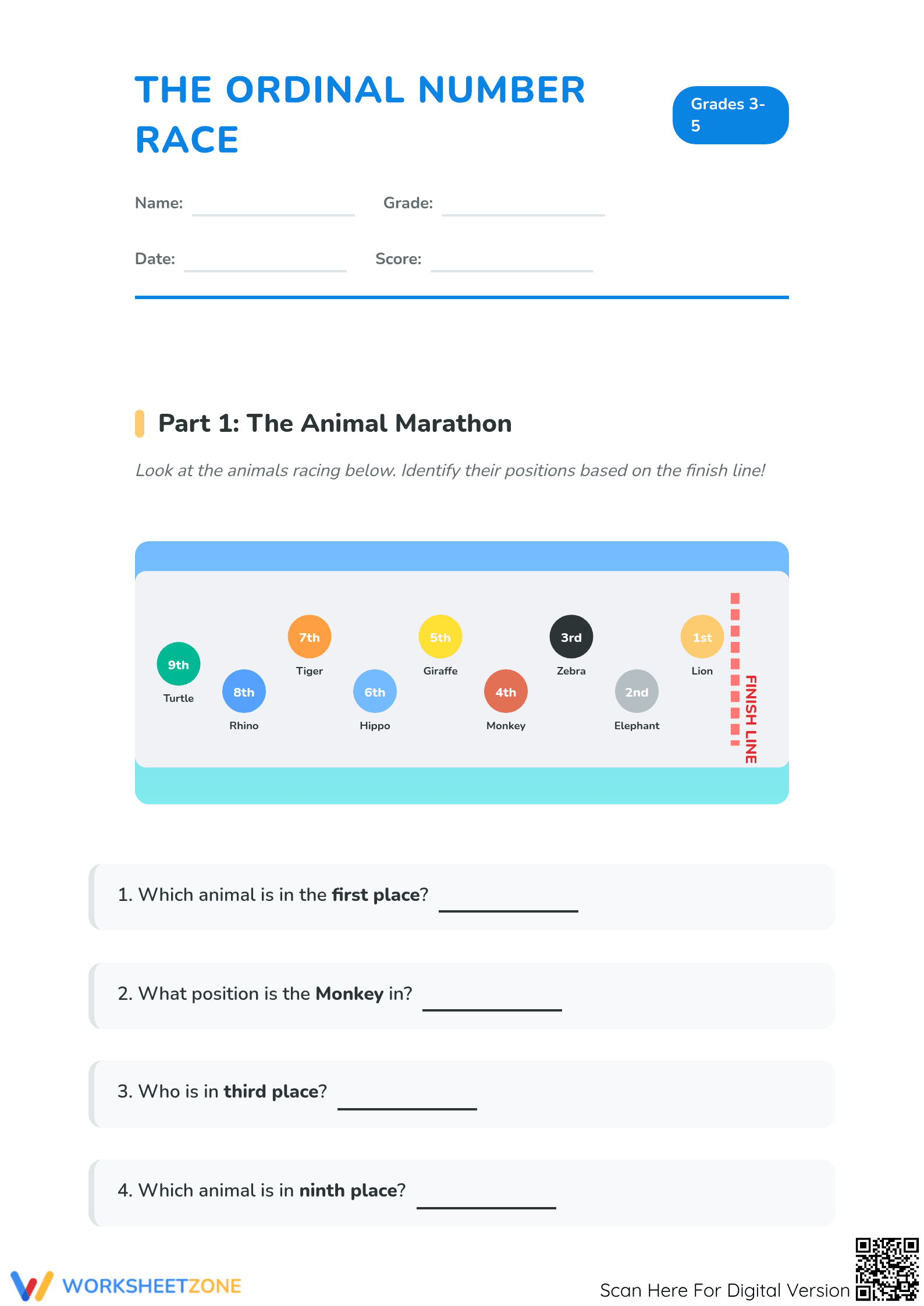
This Grade 3 math worksheet transforms the abstract concept of ordinal numbers into a high-interest animal racing scenario. Students progress from basic identification of positions 1st through 10th to complex logic puzzles. This Essential tool ensures students master the sequential relationship between numbers and their positional names.
At a Glance
- Grade: 3 · Subject: Math
- Standard:
CCSS.MATH.CONTENT.3.NBT.A— Use place value understanding and properties of operations to perform multi-digit arithmetic- Skill Focus: Position and Ordinality
- Format: 3 pages · 15 problems · Answer key included · PDF
- Best For: Independent practice and small group review
- Time: 25–35 minutes
What's Inside
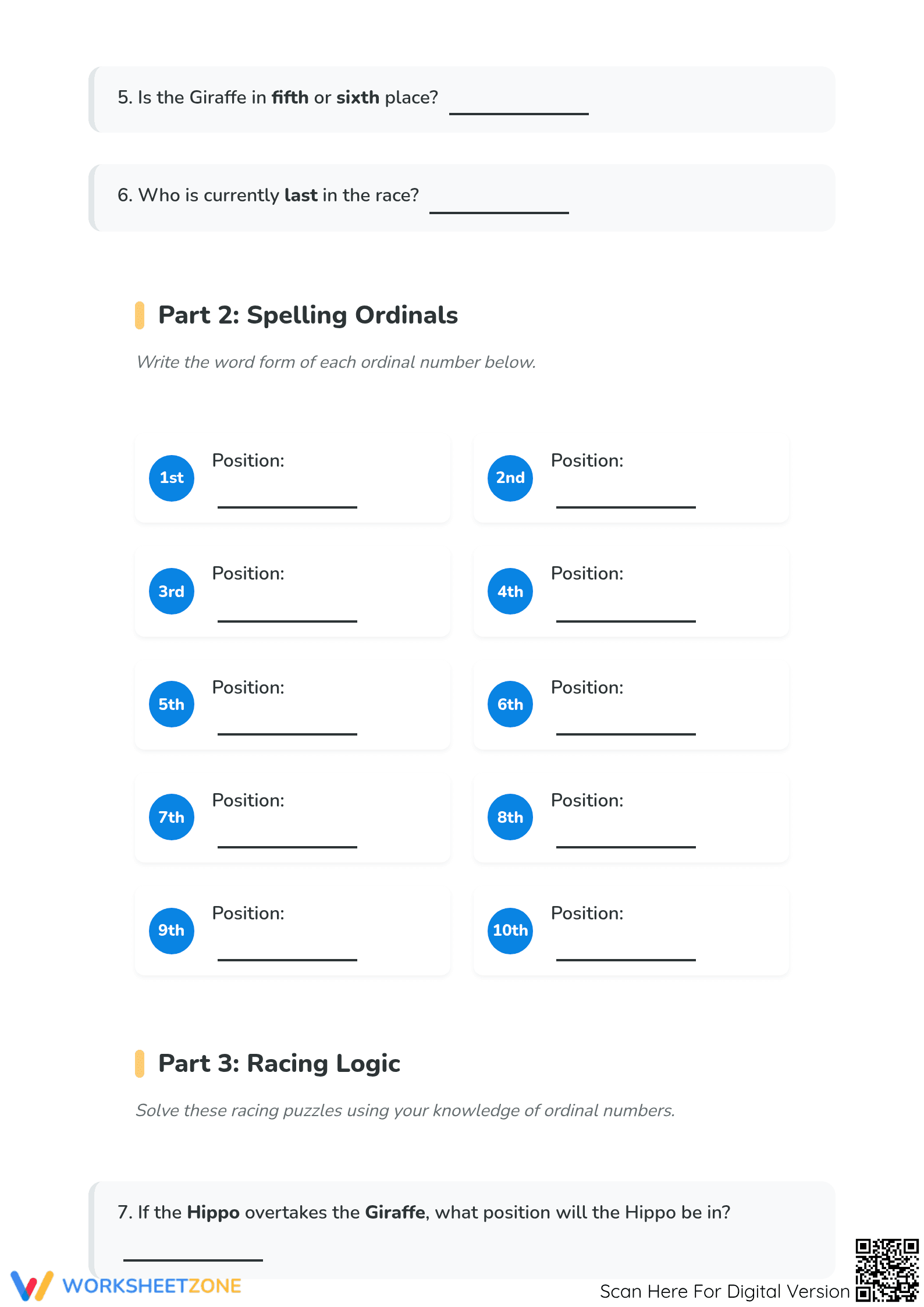
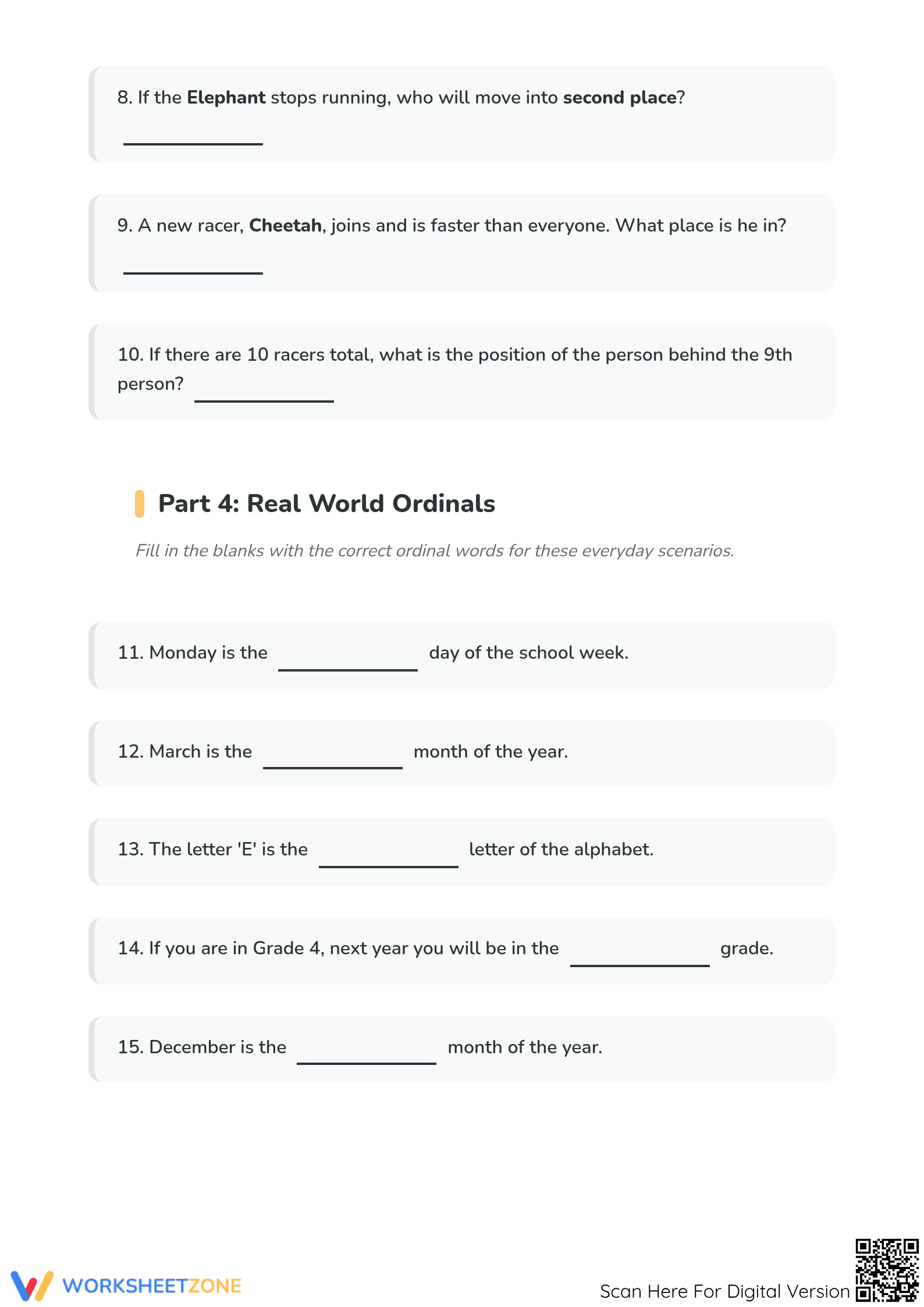
The packet consists of three instructional pages designed for a full lesson cycle. Part 1 features an "Animal Marathon" visual where students identify positions relative to a finish line. Part 2 focuses on ordinal spelling practice. Part 3 introduces higher-order logic puzzles involving overtaking. Finally, Part 4 bridges to functional usage in months and literacy. Each section includes a clear word bank or visual scaffold to support learners as they work through 15 structured tasks.
Zero-Prep Workflow
- Step 1: Print the three-page packet for your class set (30 seconds).
- Step 2: Distribute during independent practice or as a self-contained sub plan (1 minute).
- Step 3: Review answers using the provided key during whole-class checks or peer-grading (5 minutes).
Total teacher preparation time remains under two minutes, making it ideal for busy schedules. The clear formatting allows students to work with minimal teacher intervention.
Standards Alignment
This worksheet is primarily aligned to CCSS.MATH.CONTENT.3.NBT.A, focusing on the foundational understanding of number sequences. By requiring students to spell and apply ordinals, it also supports CCSS.ELA-LITERACY.L.3.2.F spelling patterns. Both standard codes can be copied directly into lesson plans, IEP goals, or district curriculum mapping tools to demonstrate rigorous adherence to state-mandated learning objectives.
How to Use It
Utilize this resource as a formative assessment after introducing sequence. During independent practice, observe students solving the Racing Logic puzzles; those struggling with position changes may need concrete modeling. Alternatively, use it as a station activity where students work in pairs to verify real-world applications. Completion typically takes 25 to 35 minutes, providing a substantial block of focused math content.
Who It's For
This resource is designed for Grade 3 general education but serves as an excellent remediation tool for older learners in Grades 4 and 5. It is naturally differentiated through its four-part structure, moving from concrete visual support to abstract logic. Pair this worksheet with a monthly calendar or alphabet chart to help students visualize the applications discussed in the final section.
Research indicates that mastery of ordinality is a critical predictor of later mathematical success, specifically in the areas of algebraic thinking and complex problem solving. According to Fisher & Frey (2014), instructional materials that combine visual modeling with logical application—such as the "Animal Marathon" scenarios used here—significantly improve retention of technical vocabulary. The CCSS.MATH.CONTENT.3.NBT.A standard requires students to understand the position and magnitude of numbers within a system; this worksheet bridges that gap by requiring students to identify, spell, and manipulate 1st through 10th place in various contexts. By moving from the concrete animal race to the abstract Racing Logic puzzles, students develop the mental flexibility needed for higher-level sequencing. This multi-modal approach ensures that students do not merely memorize terms but internalize the underlying logic of ordinal numbers in both academic and functional settings.


