


























Views
Downloads



Essential Order of Operations: Negative Fractions & Decimals
Paste this activity's link or code into your existing LMS (Google Classroom, Canvas, Teams, Schoology, Moodle, etc.).
Students can open and work on the activity right away, with no student login required.
You'll still be able to track student progress and results from your teacher account.
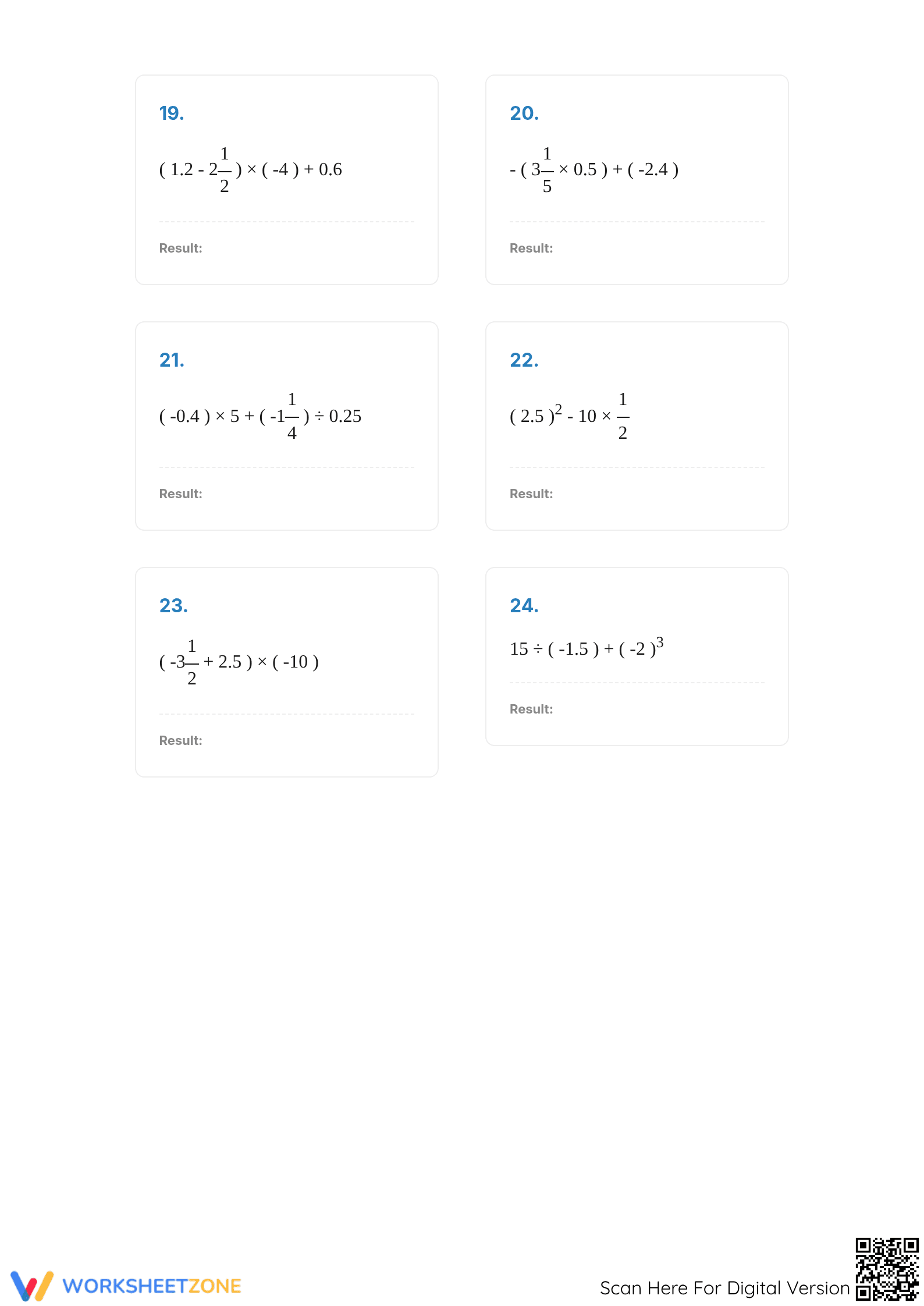
Master the complexities of rational number arithmetic with this comprehensive practice set. This worksheet focuses on the order of operations, requiring students to systematically apply PEMDAS rules to expressions featuring negative fractions, decimals, and exponents. Students will move beyond simple integer calculations to demonstrate true mathematical fluency with various numerical formats.
At a Glance
- Grade: 7 · Subject: Math
- Standard:
CCSS.MATH.CONTENT.7.NS.A.3— Solve mathematical problems involving the four operations with rational numbers- Skill Focus: Order of Operations (PEMDAS/BODMAS)
- Format: 4 pages · 24 problems · Answer key included · PDF
- Best For: Independent practice or formative assessment
- Time: 45–60 minutes
What's Inside: This four-page instructional resource contains 24 structured problems divided into four distinct levels of difficulty. Each page provides a clear layout with designated spaces for students to show their step-by-step calculations and record their final results. The set includes a visual PEMDAS/BODMAS reference header and a full, detailed answer key for efficient grading and student self-correction.
Skill Progression
- Guided Review: The resource begins with a visual anchor of the PEMDAS/BODMAS steps, providing 4 basic mastery problems that establish a foundation in handling negative signs alongside standard fraction multiplication.
- Supported Practice: Eight intermediate and expert-level problems introduce nested parentheses and multiple operations, requiring students to manage sign changes across three or more sequential steps.
- Independent Mastery: Twelve cumulative mastery problems integrate exponents and multi-step division with non-repeating decimals, challenging students to maintain precision without teacher intervention.
This structure follows a gradual-release model, ensuring students build confidence before tackling the most complex multi-step expressions.
Standards Alignment
This worksheet is primarily aligned to CCSS.MATH.CONTENT.7.NS.A.3: "Solve real-world and mathematical problems involving the four operations with rational numbers." It additionally supports Grade 6 fluency standards regarding algebraic expressions. Both standard codes can be copied directly into lesson plans, IEP goals, or district curriculum mapping tools.
How to Use It
This resource is best utilized as a post-instruction practice set after students have been introduced to negative rational numbers. For a formative assessment, assign Section 1 and Section 2 during class time; as students work, observe their handling of negative signs when clearing parentheses to identify common misconceptions. The final two pages can be assigned as a high-stakes challenge or homework to verify mastery of the concept. Expected completion time ranges from 45 minutes for proficient students to 60 minutes for those requiring more calculation time.
Who It's For
This practice set is designed for Grade 7 students learning pre-algebraic concepts, though it is highly effective for Grade 8 review or high school students needing RTI support in rational number operations. It pairs naturally with a number line anchor chart or a lesson on absolute value to help students visualize the direction of operations when working with negative decimals.
According to the RAND AIRS 2024 report on middle school mathematics, student proficiency in rational number operations is a primary predictor of success in high school algebra. This worksheet addresses this critical need by isolating the procedural complexity of order of operations from word-problem context, allowing students to focus entirely on calculation accuracy. By requiring students to show their work across 24 varied problems, the resource creates a high-density practice environment that reinforces the mental models needed to manage multiple sign changes and nested grouping symbols. This systematic approach reduces the cognitive load associated with complex calculations, facilitating a smoother transition to solving multi-step linear equations and radical expressions in advanced secondary mathematics courses.


