


























Views
Downloads
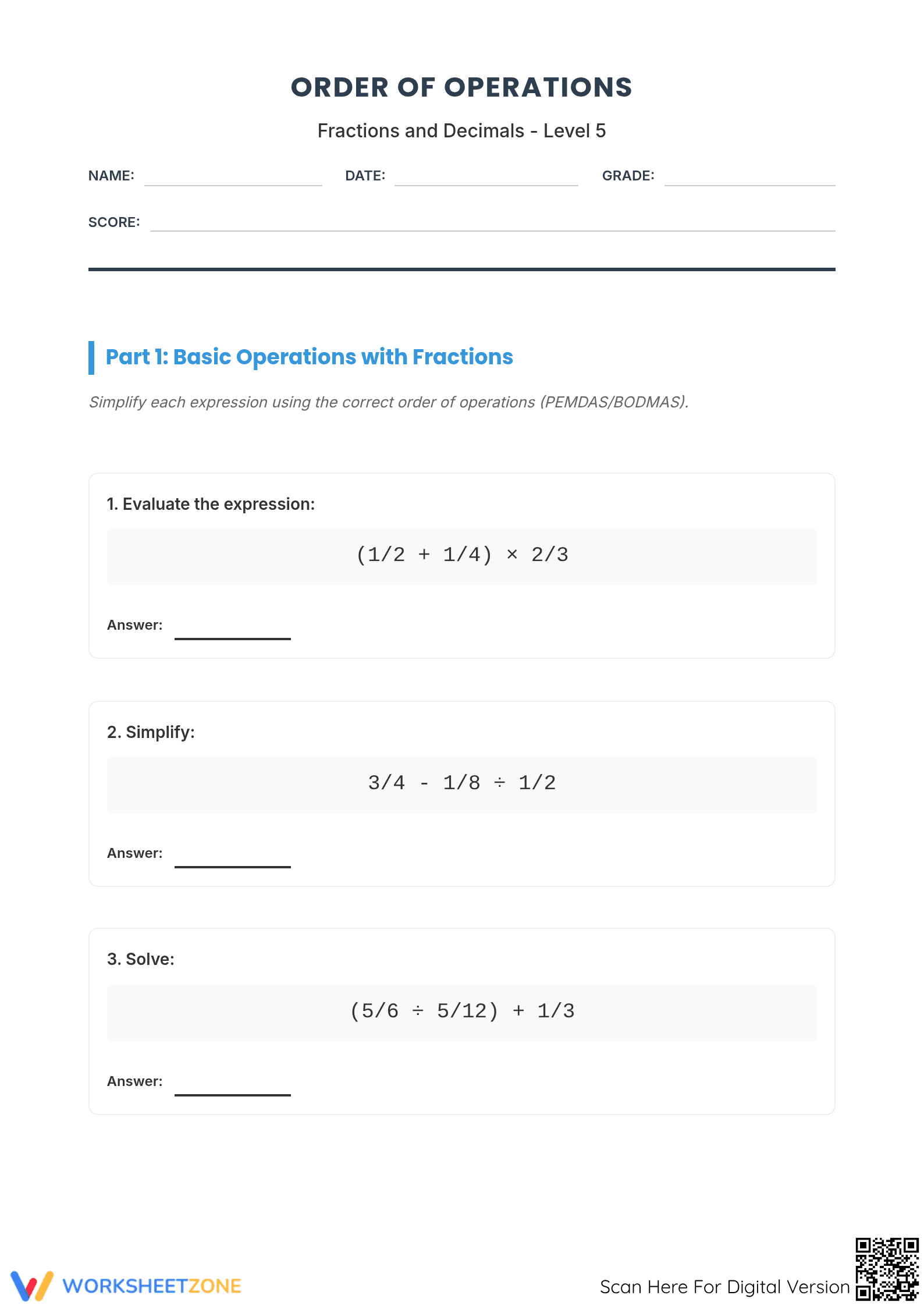
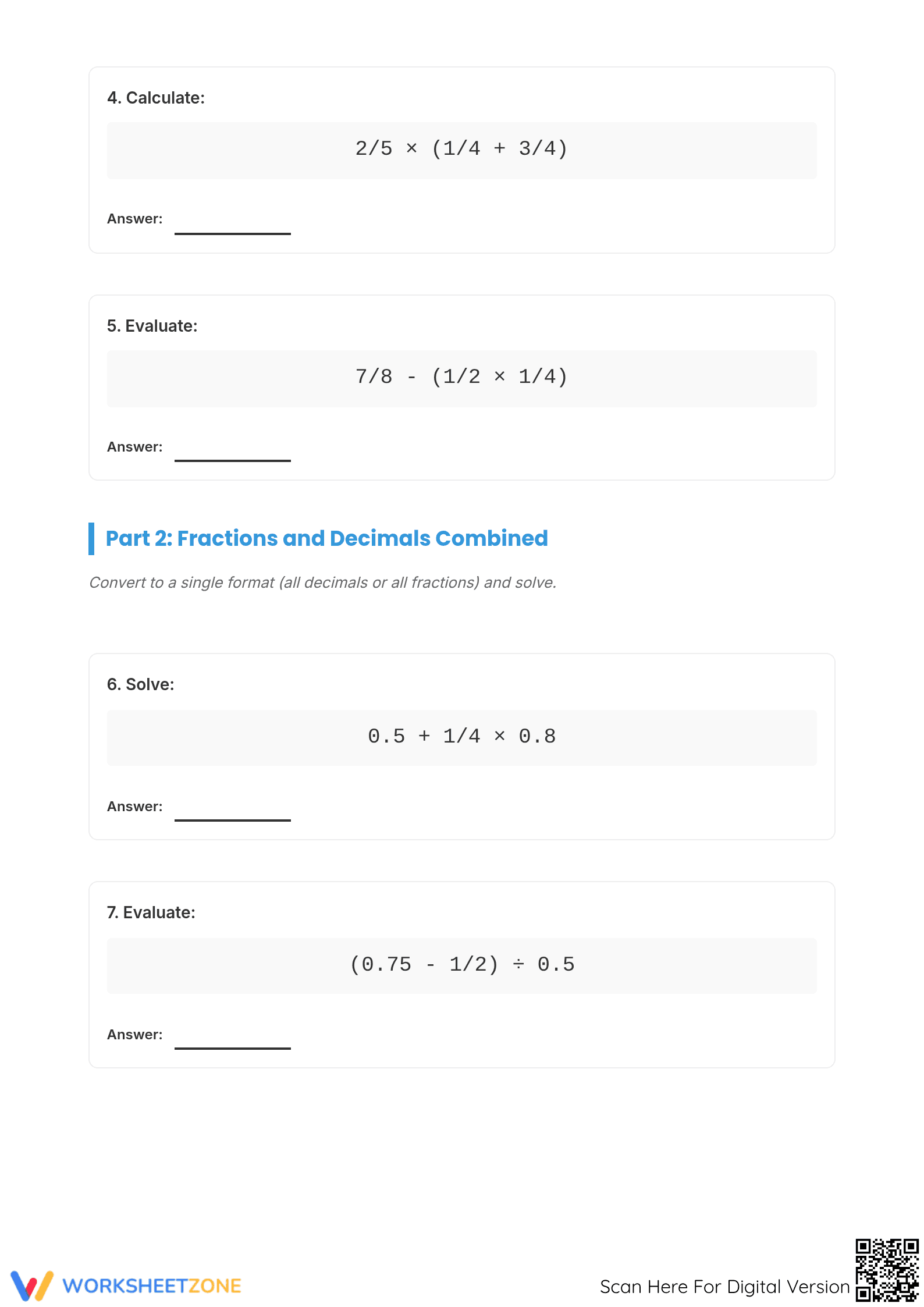
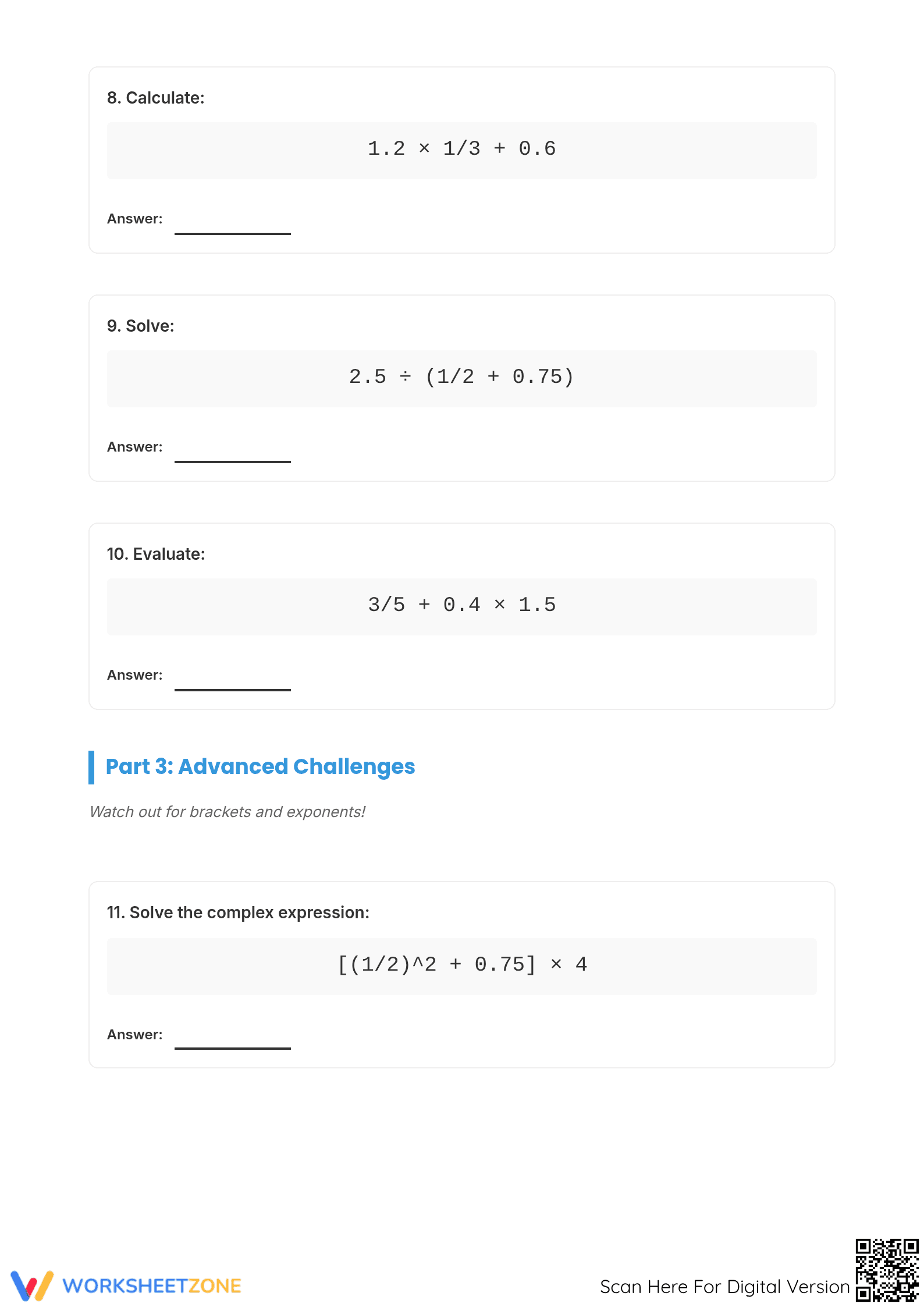
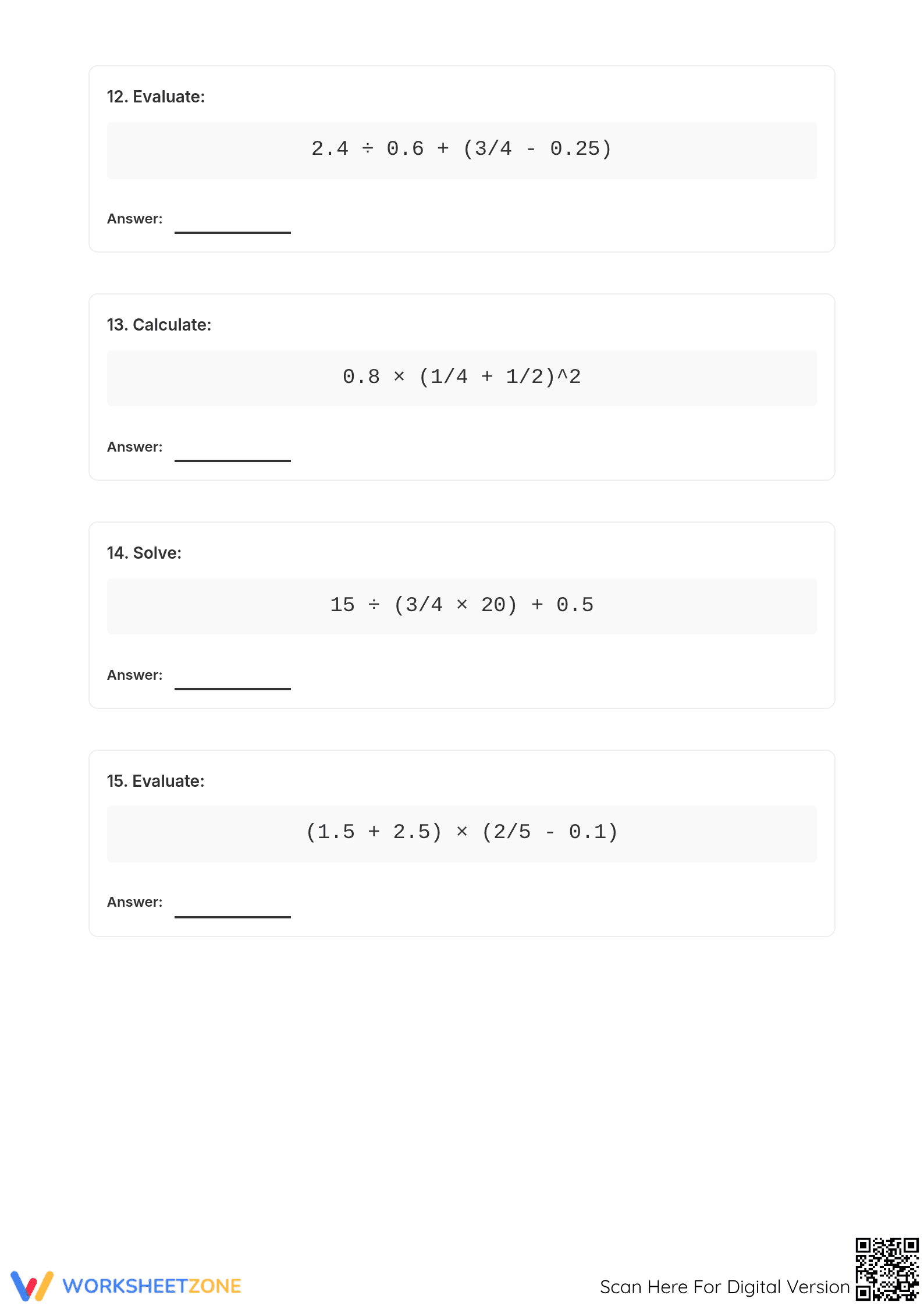
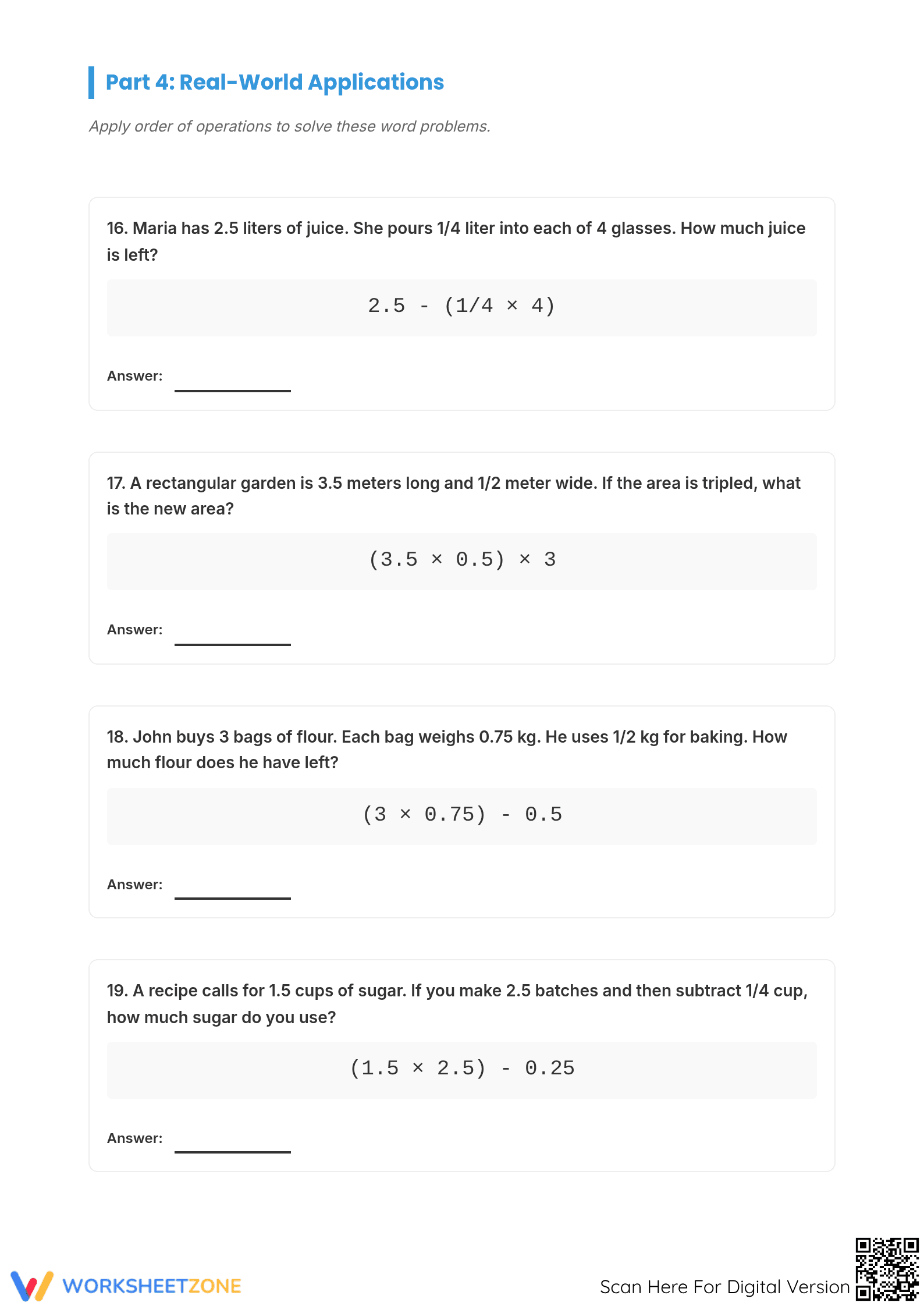

Order of Operations Worksheet | Grade 7 Math Essential
Paste this activity's link or code into your existing LMS (Google Classroom, Canvas, Teams, Schoology, Moodle, etc.).
Students can open and work on the activity right away, with no student login required.
You'll still be able to track student progress and results from your teacher account.
Order of operations mastery is foundational for secondary math. This five-page worksheet provides targeted practice to evaluate complex numerical expressions involving fractions and decimals. By solving 19 structured problems, students solidify their understanding of PEMDAS while applying mathematical reasoning to real-world scenarios and multi-step calculations across four distinct levels of difficulty.
At a Glance
- Grade: 7 · Subject: Math
- Standard:
CCSS.MATH.CONTENT.7.NS.A.3— Evaluate multi-step expressions involving fractions, decimals, and word problems- Skill Focus: Order of operations with mixed rational numbers
- Format: 5 pages · 19 problems · Answer key included · PDF
- Best For: Rational number operations and order of operations mastery
- Time: 45–60 minutes
What's Inside
This extensive PDF collection features four distinct parts that increase in complexity. Students begin with five problems focused on basic operations with fractions, then transition to five mixed-format exercises combining fractions and decimals. The third section introduces five advanced challenges involving brackets and exponents, while the final section presents four real-world word problems. A complete five-page answer key allows for immediate feedback and independent grading.
Skill Progression
The worksheet employs a strategic skill progression to ensure student success.
- Guided Practice: The first five problems focus on isolated fraction operations, allowing students to apply PEMDAS in a controlled environment.
- Supported Practice: The middle sections integrate decimals and mixed formats, requiring students to convert between representations before solving.
- Independent Practice: The final sections introduce higher-order challenges with exponents and word problems that demand independent application of logical steps.
This approach follows the gradual-release model of I Do, We Do, You Do.
Standards Alignment
This resource is rigorously aligned to CCSS.MATH.CONTENT.7.NS.A.3: "Solve real-world and mathematical problems involving the four operations with rational numbers." It also supports 5.OA.A.1 by requiring students to evaluate expressions with parentheses and brackets. Both standard codes can be copied directly into lesson plans, IEP goals, or district curriculum mapping tools.
How to Use It
Use this resource during the independent practice phase of a lesson on rational number operations. Teachers can observe student conversion methods as a formative-assessment observation tip to identify common misconceptions. The expected completion time is 45 to 60 minutes, making it ideal for a full block period or a comprehensive multi-day homework assignment.
Who It's For
This worksheet is designed for middle school students in Grades 5 through 8 who are refining their algebraic thinking skills. It serves as an excellent differentiation tool for high-achieving 5th graders or as a scaffolded review for high school students. It pairs naturally with a number line anchor chart or a direct instruction lesson on rational number conversions.
Adherence to the order of operations is identified by EdReports 2024 as a critical gateway skill for success in Algebra I. This worksheet targets the integration of fractions and decimals, addressing common error patterns in student computation. Research by Fisher & Frey (2014) emphasizes the importance of a scaffolded approach when students encounter "mixed representation" problems, where they must toggle between fraction and decimal logic. By providing 19 problems that transition from procedural basics to complex real-world applications, this resource ensures students develop the stamina and precision required for standard CCSS.MATH.CONTENT.7.NS.A.3. Evaluators of math curricula highlight the need for multi-step problems that mirror the complexity found in NAEP assessments. This printable collection provides that necessary rigor while maintaining clear formatting for student focus and teacher utility, ensuring students are prepared for high-stakes testing and future STEM coursework.


