


























Views
Downloads
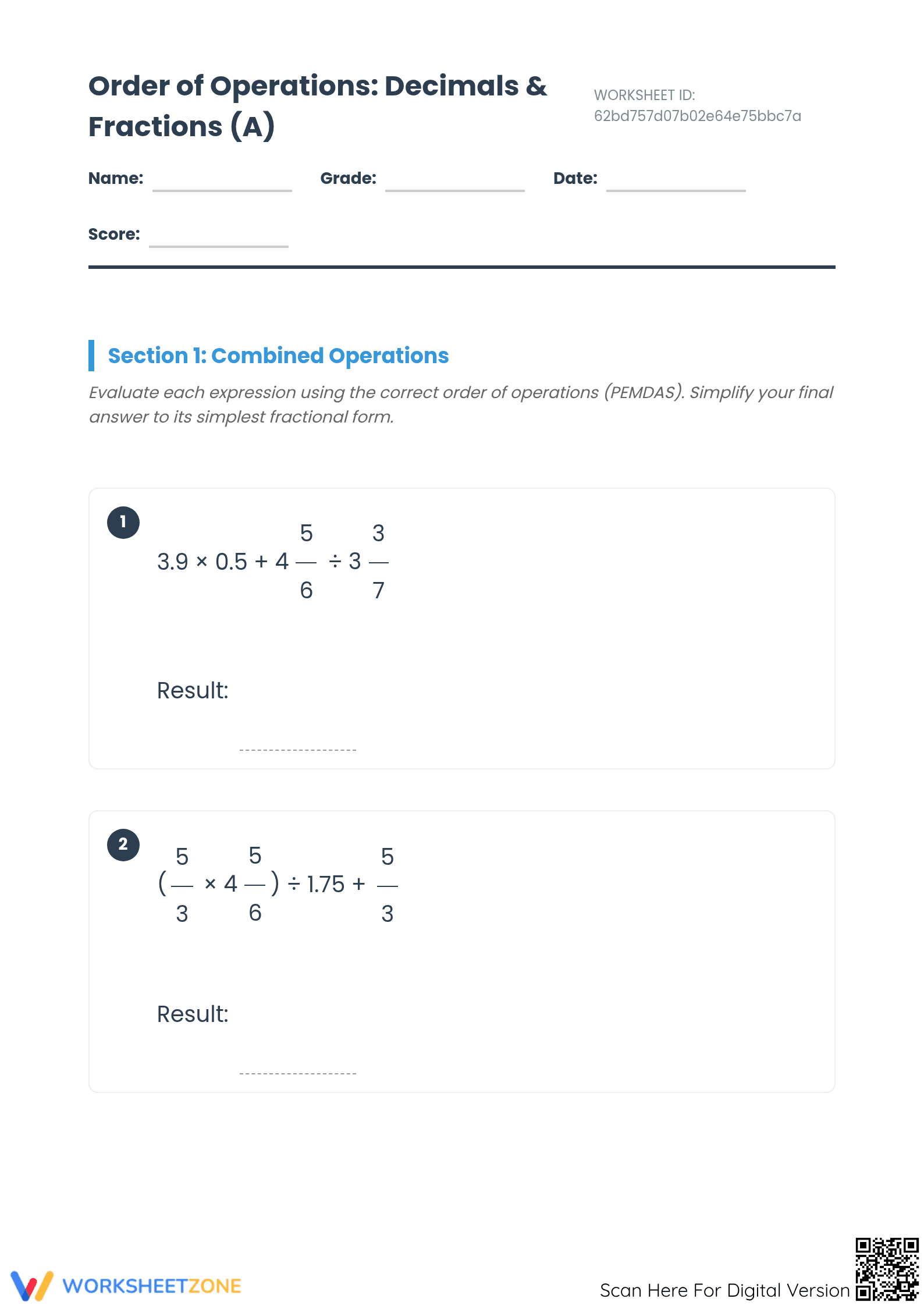


Essential Order of Operations with Fractions and Decimals
Paste this activity's link or code into your existing LMS (Google Classroom, Canvas, Teams, Schoology, Moodle, etc.).
Students can open and work on the activity right away, with no student login required.
You'll still be able to track student progress and results from your teacher account.
Master the complexities of numerical expressions with this comprehensive worksheet focusing on the order of operations. Students solve 15 multi-step problems involving mixed fractions, decimals, and exponents. By applying PEMDAS, learners build the computational precision required for middle school math and beyond while developing fluency with rational number operations.
At a Glance
- Grade: 7 · Subject: Math
- Standard:
CCSS.MATH.CONTENT.7.NS.A.3— Solve multi-step problems involving the four operations with rational numbers- Skill Focus: Order of Operations (PEMDAS) with Fractions and Decimals
- Format: 5 pages · 15 problems · Answer key included · PDF
- Best For: Independent practice and mastery assessment
- Time: 30–45 minutes
This five-page PDF includes 15 structured mathematical expressions across three distinct sections. The worksheet features mixed numbers, improper fractions, terminating decimals, and exponents. It is designed with clear spacing for students to show their work, a dedicated result line for each problem, and a complete answer key for rapid grading and self-correction.
Skill Progression
- Guided Practice: The first section presents combined operations using PEMDAS, requiring students to simplify final answers to their simplest fractional form over 6 targeted problems.
- Supported Practice: Section two introduces exponents and powers, challenging students to integrate squaring and cubing within multi-step decimal and fraction calculations for 4 problems.
- Independent Practice: The final section provides extra practice with 5 complex, mixed-format problems featuring brackets and multi-layered parentheses to ensure total skill transfer.
This sequence follows a gradual-release model, moving students from foundational expression evaluation to complex, multi-layered rational number manipulation.
Standards Alignment
This resource is rigorously aligned to CCSS.MATH.CONTENT.7.NS.A.3, which requires students to solve real-world and mathematical problems involving the four operations with rational numbers. The problems specifically target the evaluation of numerical expressions containing parentheses and exponents as described in 6.EE.A.1 and 5.OA.A.1. Both standard codes can be copied directly into lesson plans, IEP goals, or district curriculum mapping tools.
How to Use It
Use this worksheet during the "You Do" phase of a lesson on rational number operations to assess individual student mastery. It also serves as an excellent formative assessment tool; teachers should observe if students are correctly identifying which operation to perform first within parentheses. Expected completion time ranges from 30 to 45 minutes depending on student fluency.
Who It's For
This resource is primarily designed for Grade 7 students but is highly effective for Grade 6 acceleration or Grade 8 intervention. It provides necessary differentiation for learners who have mastered basic PEMDAS and are ready to apply those rules to more complex number systems. It pairs naturally with a rational number anchor chart or a direct instruction lesson on converting decimals to fractions.
Rigorous practice with multi-step expressions is a cornerstone of algebraic readiness. According to NAEP, students who demonstrate high proficiency in rational number operations are significantly more likely to succeed in high school algebra. This worksheet specifically addresses the cognitive demands of CCSS.MATH.CONTENT.7.NS.A.3 by requiring students to manage multiple layers of PEMDAS while performing fraction and decimal arithmetic. Research from ScienceDirect TpT Analysis indicates that structured worksheets with clear sectional progression improve student accuracy and reduce cognitive load during complex tasks. By providing 15 high-quality problems with mixed formats, this resource ensures students move beyond rote memorization of acronyms toward a deep, functional understanding of mathematical hierarchy. It is an essential component for any curriculum focused on building durable numerical fluency and precision in the middle grades.


