


























Views
Plays
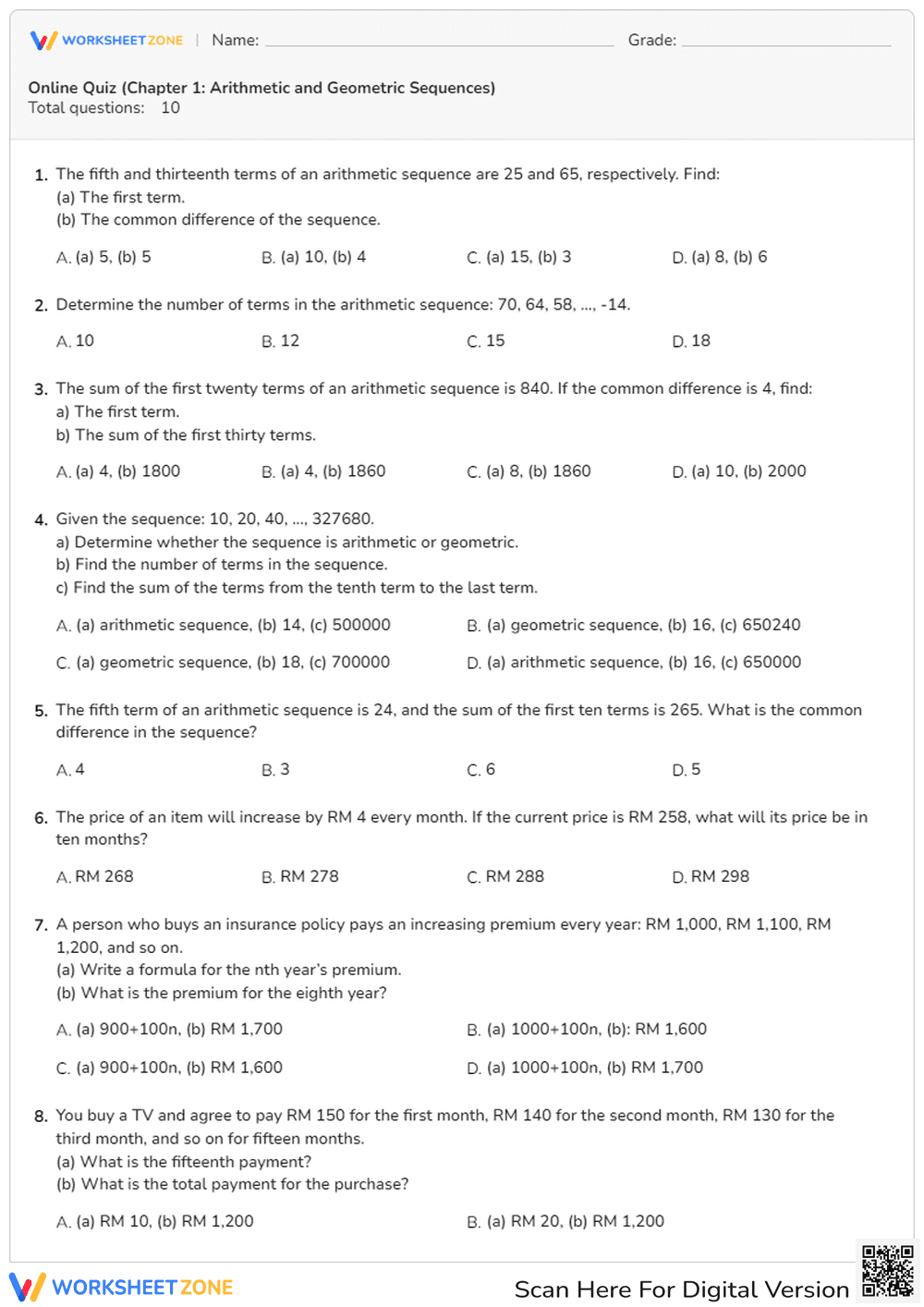
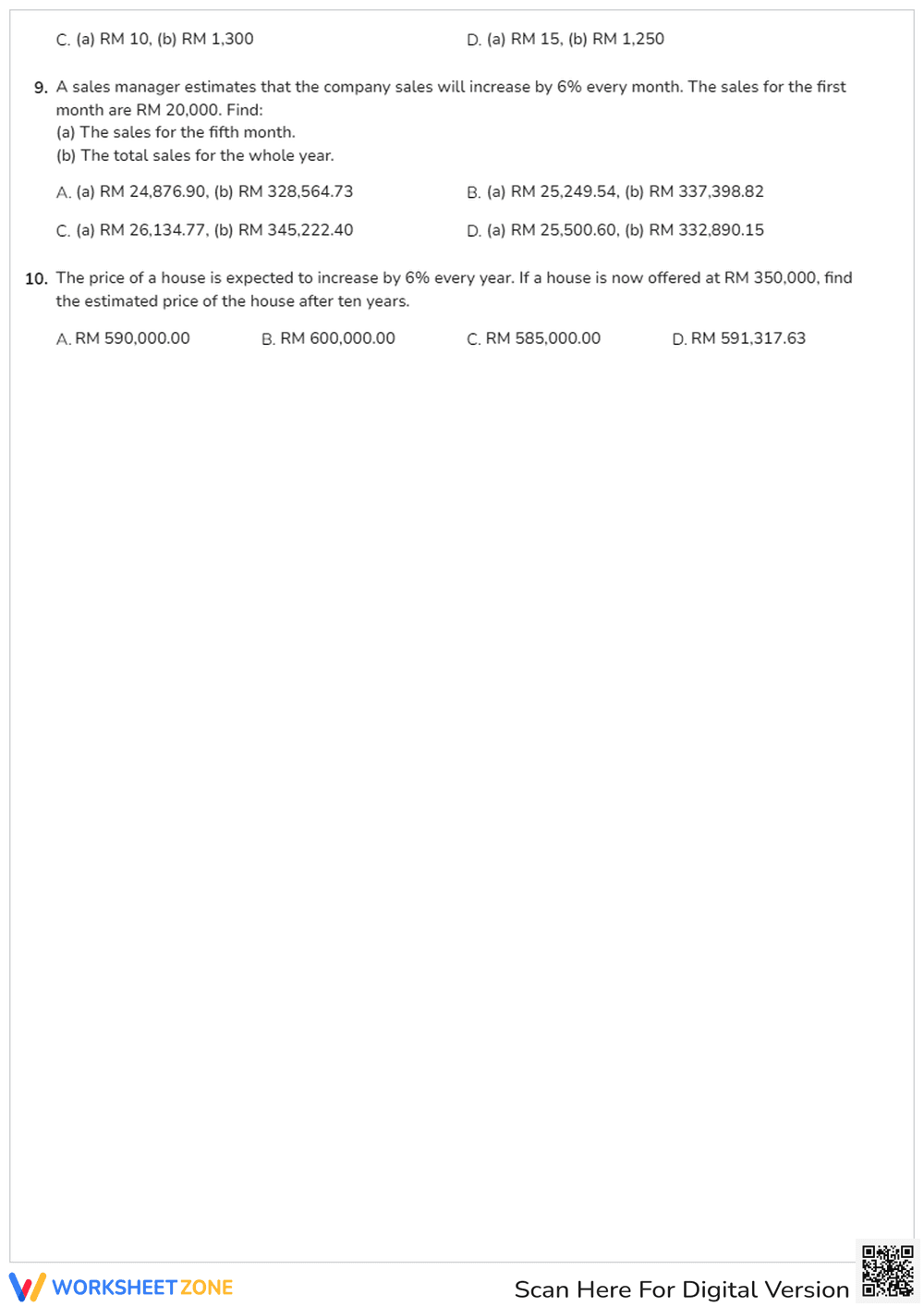

Arithmetic and Geometric Sequences Quiz | Essential Math
Paste this activity's link or code into your existing LMS (Google Classroom, Canvas, Teams, Schoology, Moodle, etc.).
Students can open and work on the activity right away, with no student login required.
You'll still be able to track student progress and results from your teacher account.
This high school math quiz provides a comprehensive assessment of arithmetic and geometric sequences. Students solve 10 rigorous problems to demonstrate mastery of finding specific terms, common differences, and series sums. It bridges theoretical calculation with practical financial applications, ensuring students can apply sequence formulas to real-world scenarios effectively.
At a Glance
- Grade: 9–12 · Subject: Mathematics
- Standard:
HSF.BF.A.2— Write arithmetic and geometric sequences recursively and with explicit formulas- Skill Focus: Sequence Identification & Summation
- Format: 2 pages · 10 problems · Answer key included · PDF
- Best For: Chapter assessment or test preparation
- Time: 30–45 minutes
Inside this 2-page PDF, you will find 10 multiple-choice questions designed to test depth of understanding. The worksheet includes pure mathematical derivations, such as finding the first term from non-consecutive values, alongside complex word problems involving insurance premiums and sales growth. A clear layout ensures students have space for scratch work and formula derivation.
Skill Progression
- Guided practice: Questions 1-3 focus on basic identification and formula application for arithmetic sequences with given parameters like the fifth and thirteenth terms.
- Supported practice: Questions 4-5 require students to determine the sequence type (arithmetic vs. geometric) before calculating sums or specific terms from a provided list.
- Independent practice: Questions 6-10 present multi-step word problems where students must model real-world growth and decay using sequence formulas for price increases and sales estimates.
This structure follows the gradual-release model, moving from abstract computation to concrete application in financial contexts.
Standards Alignment
This resource is aligned to HSF.BF.A.2, which requires students to write arithmetic and geometric sequences both recursively and with an explicit formula, use them to model situations, and translate between the two forms. It also supports HSF.LE.A.2 by requiring the construction of linear and exponential functions. Both standard codes can be copied directly into lesson plans, IEP goals, or district curriculum mapping tools.
How to Use It
Use this worksheet as a formal summative assessment at the end of a sequences unit or as a high-stakes review before a midterm exam. During the session, observe if students correctly identify the common ratio in geometric word problems versus the common difference in arithmetic ones. Expect completion within 40 minutes for most high school learners.
Who It's For
This quiz is ideal for Algebra 2 or Pre-Calculus students. It provides necessary rigor for college-bound learners while offering structured multiple-choice options to support students who benefit from recognition-based testing. Pair this with a formula anchor chart for students requiring additional scaffolding during the assessment phase.
Mathematical proficiency in sequences is a foundational requirement for higher-level calculus and financial literacy. This assessment targets HSF.BF.A.2, a standard that demands students move beyond rote memorization to functional modeling. According to the RAND AIRS 2024 report, structured assessments that combine abstract sequence problems with contextualized word problems significantly improve long-term retention of algebraic patterns. By requiring students to calculate sums of the first twenty terms or predict house price increases over ten years, this worksheet reinforces the connection between discrete mathematics and real-world exponential growth. Research from Fisher & Frey (2014) emphasizes that checking for understanding through varied problem types—ranging from simple term identification to complex summation—allows educators to pinpoint specific misconceptions in recursive thinking. This 10-question set provides the necessary data points for effective formative feedback and curriculum adjustment.


