


























Views
Downloads

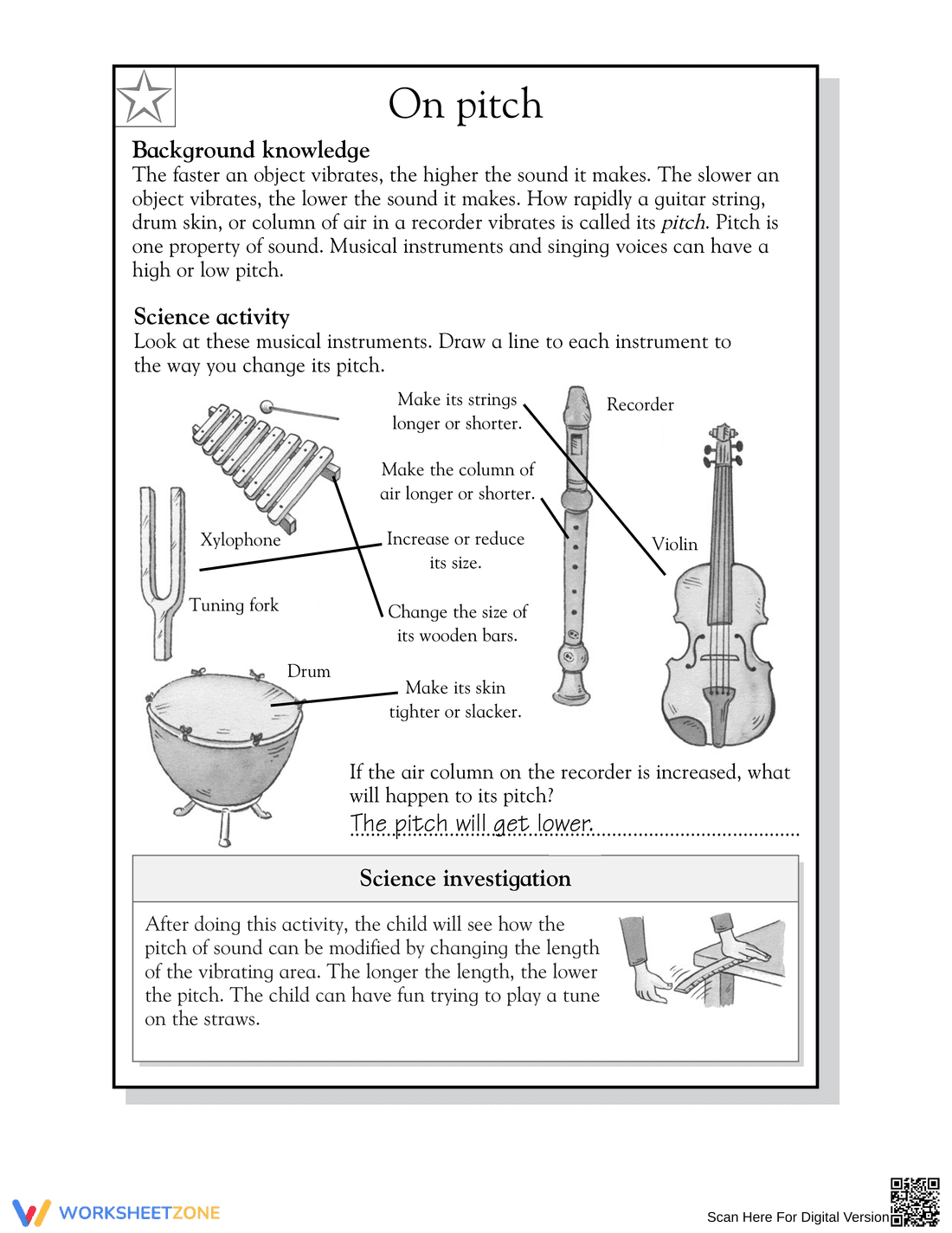

Grade 4 Sound Pitch — Printable No-Prep Worksheet
Paste this activity's link or code into your existing LMS (Google Classroom, Canvas, Teams, Schoology, Moodle, etc.).
Students can open and work on the activity right away, with no student login required.
You'll still be able to track student progress and results from your teacher account.
This worksheet provides a focused introduction to the scientific concept of pitch for Grade 4 students. Through a combination of background reading, a matching activity with musical instruments, and a hands-on investigation, learners will discover how vibrations create sound and how properties like length, tension, and size affect an instrument's pitch.
At a Glance
- Grade: 4 · Subject: Science
- Standard:
4-PS4-1— Describe wave patterns and how they move objects.- Skill Focus: Sound, Pitch, and Vibration
- Format: 1 page · 2 problems · Answer key included · PDF
- Best For: Introduction, reinforcement, or a science station activity.
- Time: 20–30 minutes
What's Inside
This single-page PDF starts with a brief "Background Knowledge" section. The main "Science Activity" has students match five instruments to how their pitch is changed and answer a question. It concludes with a "Science Investigation" to build a simple straw instrument. An answer key for the main activity is included.
Zero-Prep Workflow
A true print-and-go resource, this is perfect for substitute plans or a quick science lesson.
- Print (1 min): The resource is a single, self-contained PDF.
- Distribute (1 min): Hand out the worksheet; instructions are written directly to the student.
- Review (5 min): Use the provided answer key for a quick whole-class review.
Total teacher preparation time is well under five minutes.
Standards Alignment
This worksheet supports NGSS standard 4-PS4-1, where students use models to describe wave patterns. The activities provide a concrete, hands-on model for understanding wave properties by linking physical changes in instruments to changes in pitch. This builds the framework for understanding frequency. The standard code can be copied into lesson plans.
How to Use It
Use this worksheet to introduce a unit on sound or as reinforcement after a lesson. It is effective for activating knowledge or as formative assessment. To assess understanding, note which instrument pairings are most challenging for students. The activities are designed to be completed in 20-30 minutes, fitting easily into a single class period.
Who It's For
Designed for 4th-grade students, this resource's clear layout is accessible for most learners. For support, read the background text as a class. For an extension, have students design a new investigation using rubber bands. This worksheet pairs well with hands-on exploration of classroom instruments or a sound wave anchor chart.
This worksheet offers an entry point for Grade 4 students to engage with NGSS standard 4-PS4-1 by modeling wave patterns. Exploring how instrument properties change pitch provides a tangible understanding of sound as a vibration-based phenomenon. This aligns with research on the importance of hands-on, inquiry-based activities in elementary science for building robust conceptual models (RAND AIRS 2024). The connection between a physical action (shortening a string) and an auditory result (a higher pitch) makes abstract wave frequency concrete. The worksheet’s structure supports a gradual release of responsibility, moving from background knowledge to a final investigation. This is a practical tool for addressing the core concepts of 4-PS4-1 in an engaging, scientifically sound way.


