




























Views
Downloads
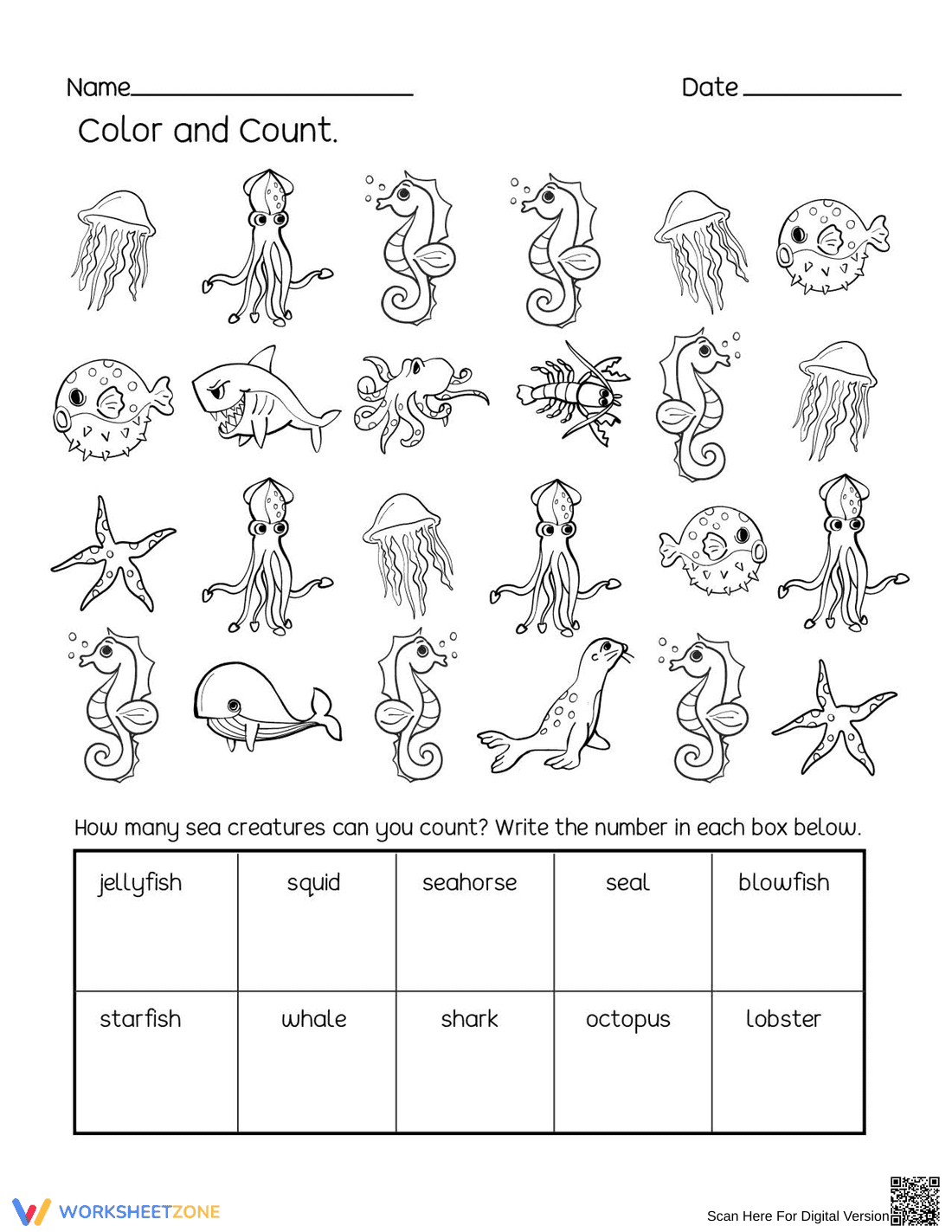

Printable Ocean Animals Counting Worksheet | Grade K

Paste this activity's link or code into your existing LMS (Google Classroom, Canvas, Teams, Schoology, Moodle, etc.).
Students can open and work on the activity right away, with no student login required.
You'll still be able to track student progress and results from your teacher account.
This Grade K ocean animals worksheet gives students an engaging way to practice counting and visual discrimination. Young learners locate and count ten different types of sea creatures scattered across the page, strengthening foundational numeracy skills while exploring marine life.
At a Glance
- Grade: Kindergarten · Subject: Math & Science
- Standard:
CCSS.MATH.CONTENT.K.CC.B.4— Count objects to tell the number of things- Skill Focus: Counting to 10 and visual discrimination
- Format: 1 page · 10 problems · Answer key included · PDF
- Best For: Independent practice or math centers
- Time: 15–20 minutes
Inside this single-page PDF, you will find a collection of illustrated marine organisms ready for identification. The worksheet features clear line art of jellyfish, squids, seahorses, seals, blowfish, starfish, whales, sharks, octopuses, and lobsters. Below the visual field, a structured grid provides ten labeled boxes for students to write the final count for each species. An answer key is included for quick grading.
Zero-Prep Workflow
This resource is designed for immediate use. Following a simple three-step process, integrate this into your schedule with minimal effort. First, print the single-page document (1 minute). Second, distribute sheets with crayons (1 minute). Third, review counts using the included answer key (3 minutes). This workflow requires under five minutes of teacher preparation time, making it an ideal activity for emergency sub plans.
Standards Alignment
The primary alignment is `CCSS.MATH.CONTENT.K.CC.B.4`: Understand the relationship between numbers and quantities; connect counting to cardinality. Students assign one number name to each object, recognizing the last number named is the total count. Both standard codes can be copied directly into lesson plans, IEP goals, or district curriculum mapping tools.
How to Use It
Use this worksheet as independent practice following a lesson on ocean habitats or as morning work. During the activity, observe if students use a touch-and-count strategy to ensure accuracy. This provides a quick formative assessment of one-to-one correspondence. Most Kindergarten students will complete the counting process within 15 to 20 minutes.
Who It's For
This resource is tailored for Kindergarten students developing counting fluency. It is effective for English Language Learners as it pairs visual representations with vocabulary labels for sea creatures. For differentiation, provide a highlighter to mark each animal as it is counted. It pairs naturally with a read-aloud about the ocean.
Research emphasizes visual scaffolding in the gradual release of responsibility for early learners mastering identification tasks. By providing clear, labeled boxes for data entry, this worksheet reduces cognitive load, allowing students to focus on counting and classification. According to Fisher & Frey (2014), structured independent practice is essential for consolidating new skills into long-term memory. This worksheet provides exactly that kind of integrated practice, helping students bridge the gap between abstract number sense and concrete biological observation in a classroom-ready format. The inclusion of ten distinct categories ensures sustained attention to detail, a critical executive function skill for early academic success. By aligning with CCSS.MATH.CONTENT.K.CC.B.4 to count objects to tell the number of things, educators can confidently deploy this resource knowing it meets rigorous developmental benchmarks.


