


























Views
Downloads

Ocean Animal Bingo | Printable Kindergarten Phonics
Paste this activity's link or code into your existing LMS (Google Classroom, Canvas, Teams, Schoology, Moodle, etc.).
Students can open and work on the activity right away, with no student login required.
You'll still be able to track student progress and results from your teacher account.
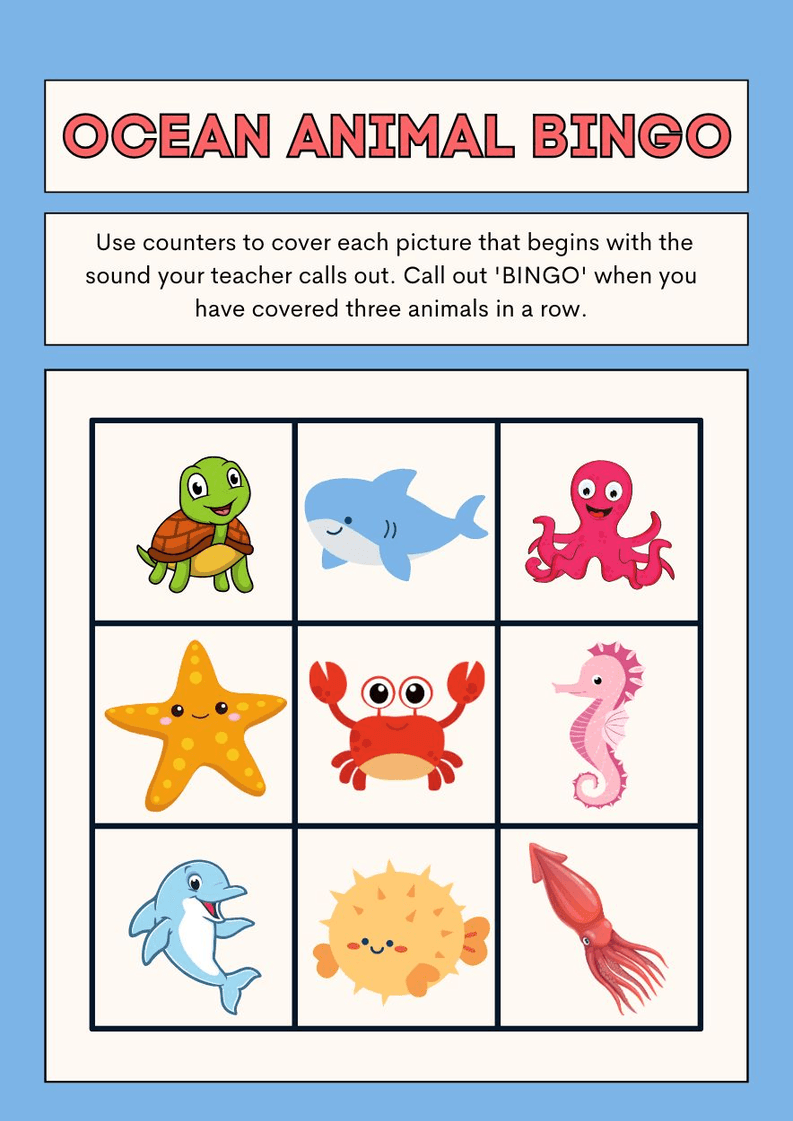
This engaging Ocean Animal Bingo worksheet helps early learners practice identifying initial letter sounds. Students listen to a teacher call out a specific phonetic sound and cover the corresponding marine animal on their 3x3 grid. This interactive activity builds foundational phonemic awareness while keeping young students actively focused on their learning targets.
At a Glance
- Grade: Kindergarten · Subject: ELA
- Standard:
CCSS.ELA-LITERACY.RF.K.3.A— Identify primary sounds for consonants- Skill Focus: Initial Sounds
- Format: 1 page · 9 problems · No answer key · PDF
- Best For: Whole group phonics games
- Time: 10–15 minutes
This single-page resource features a vibrant 3x3 bingo grid containing nine distinct ocean animals, including a turtle, shark, octopus, and starfish. The layout is clean and visually appealing, designed specifically for early childhood visual processing. The top of the page includes clear, simple instructions for the teacher to call out initial sounds rather than animal names, transforming a standard game into a targeted phonics exercise.
Zero-Prep Workflow
- Print (1 minute): Simply print the single-page PDF for each student. Graphics print well in grayscale.
- Distribute (1 minute): Hand out the cards along with small counters, buttons, or dry-erase markers if laminated.
- Review (10 minutes): Call out initial sounds (e.g., "/sh/" for shark, "/t/" for turtle) and monitor as students cover their squares until someone gets three in a row.
Total teacher preparation requires under two minutes, making this an excellent, self-explanatory activity for substitute teacher plans or quick transitions.
Standards Alignment
This activity aligns directly with CCSS.ELA-LITERACY.RF.K.3.A: Demonstrate basic knowledge of one-to-one letter-sound correspondences by producing the primary sound or many of the most frequent sounds for each consonant. It also supports broader phonological awareness goals by requiring students to isolate the initial phoneme of spoken words. Both standard codes can be copied directly into lesson plans, IEP goals, or district curriculum mapping tools.
How to Use It
Use this bingo game as a warm-up before direct phonics instruction, or as a Friday review session. Teachers can conduct quick formative assessments by observing which students identify the correct animal based on the sound and which look to peers for guidance. The expected completion time ranges from 10 to 15 minutes.
Who It's For
This resource is primarily designed for Kindergarten and Preschool students developing their early literacy skills. It serves as an excellent intervention tool for small groups needing extra practice with initial consonant sounds. For differentiation, teachers can pair this game with an alphabet anchor chart so students who need visual scaffolding can reference the letters associated with the sounds being called out.
Game-based learning directly impacts student retention of critical phonemic concepts in early childhood classrooms. This resource targets CCSS.ELA-LITERACY.RF.K.3.A, helping students identify primary sounds for consonants through a highly interactive format. According to a 2024 report by EdReports, foundational skills instruction that incorporates active, multi-sensory participation—such as using physical counters on a visual bingo grid—increases student engagement and accelerates the mastery of letter-sound correspondence. By shifting the instructional focus from simply naming the pictured animals to isolating their initial spoken phonemes, this activity effectively bridges the gap between basic vocabulary acquisition and essential phonological awareness. The structured repetition inherent in bingo ensures that early learners receive multiple exposures to targeted sounds in a low-stakes, highly motivating environment. This approach aligns with established best practices for early childhood education, developing reading skills systematically.


