




























Views
Downloads
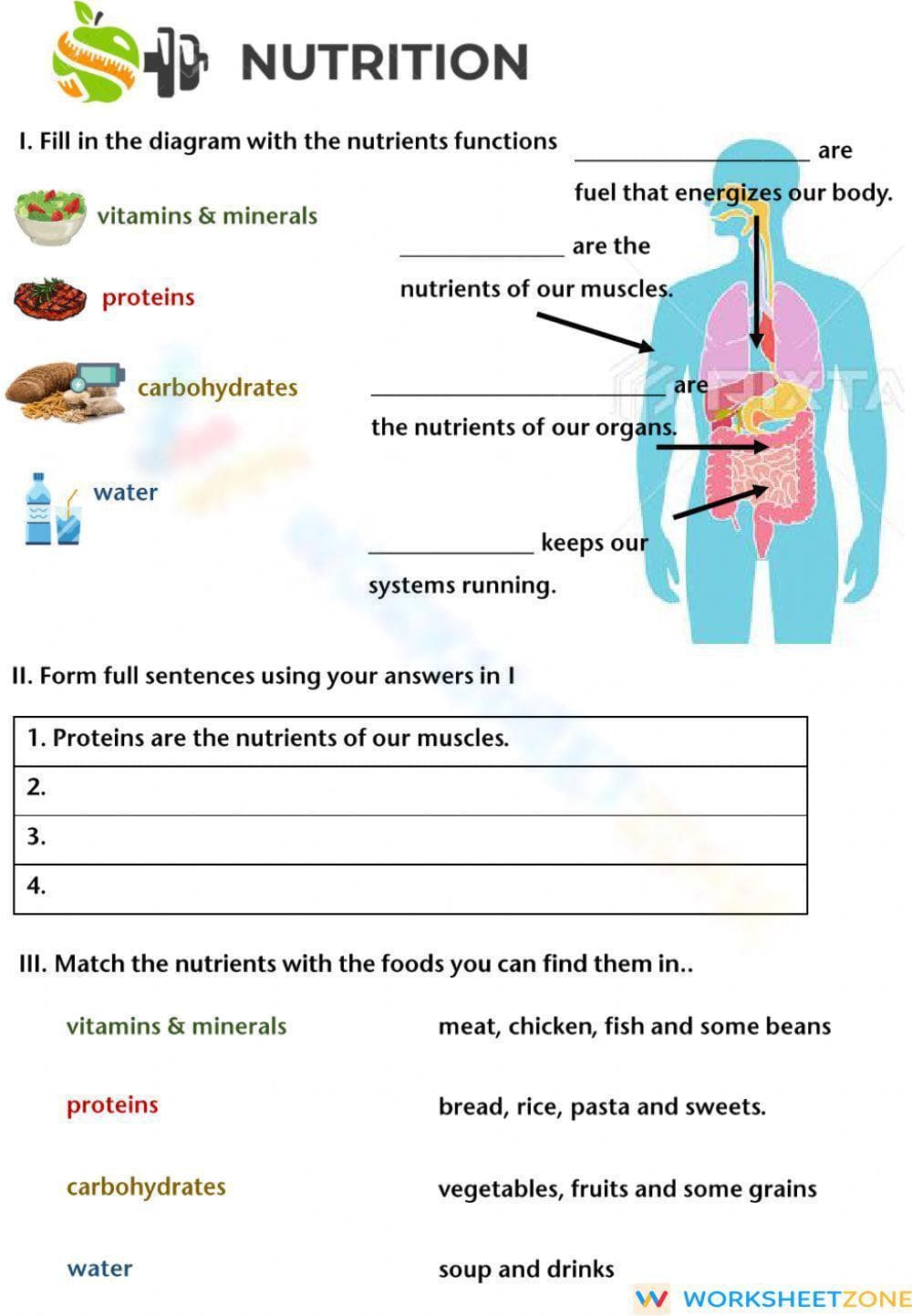

Grade 3 Nutrition — Printable No-Prep Worksheet

Paste this activity's link or code into your existing LMS (Google Classroom, Canvas, Teams, Schoology, Moodle, etc.).
Students can open and work on the activity right away, with no student login required.
You'll still be able to track student progress and results from your teacher account.
This printable nutrition worksheet for Grade 3 empowers students to master human biology and healthy eating through structured reading and writing tasks. By identifying nutrient functions from a diagram and matching them to food sources, students build foundational health literacy while strengthening key informational text skills.
At a Glance
- Grade: 3 · Subject: ELA, Science
- Standard:
CCSS.ELA-LITERACY.RI.3.1— Use informational text to answer questions about a topic.- Skill Focus: Nutrient functions and food sources
- Format: 1 page · 11 problems · Answer key included · PDF
- Best For: Health literacy & reading comprehension practice
- Time: 15–20 minutes
What's Inside
This single-page PDF is structured into three distinct learning segments. The first section requires students to use a diagram of the human body to identify the functions of key nutrients. The second section builds on this by having students construct full sentences from their findings. The final section reinforces learning through a matching activity connecting nutrients to their common food sources.
Zero-Prep Workflow
This resource is designed for maximum teacher efficiency. Print: The single-page PDF prints in seconds. Distribute: The clear, self-explanatory instructions allow students to begin working immediately without a lengthy introduction. Review: Use the included answer key for a quick peer-review session or whole-class check-in, taking about 10 minutes. The entire workflow requires less than two minutes of teacher preparation, making it a perfect fit for substitute plans or quick academic transitions.
Standards Alignment
This worksheet directly aligns with Common Core standard CCSS.ELA-LITERACY.RI.3.1, which requires students to "ask and answer questions to demonstrate understanding of a text, referring explicitly to the text as the basis for the answers." Students use the provided nutrition diagram as their informational text to complete all tasks. This standard code can be copied directly into lesson plans, IEP goals, or district curriculum mapping tools.
How to Use It
Use this worksheet as a pre-assessment to gauge prior knowledge before beginning a unit on health or the human body. It also functions as an effective post-reading comprehension check after a science lesson on nutrition. For a formative assessment tip, observe whether students can correctly transfer information from the visual diagram (Part I) to the written sentences (Part II), which demonstrates text-based evidence skills. The activity is designed to be completed in 15 to 20 minutes.
Who It's For
This resource is ideal for 3rd-grade students working on informational text skills. The visual nature of the diagram provides strong support for English Language Learners and visual learners. For a more comprehensive lesson, pair this worksheet with a "MyPlate" anchor chart or a short informational video about balanced diets to provide students with additional context and vocabulary.
This cross-curricular worksheet supports CCSS.ELA-LITERACY.RI.3.1 by having students use a scientific diagram as an informational text to understand nutrient functions and food sources. The design reflects findings from the `ScienceDirect TpT Analysis` on the effectiveness of multi-modal learning, which shows that combining visual aids with sentence construction tasks improves knowledge retention in elementary science. With 11 structured problems across three sections—diagram completion, sentence writing, and matching—the activity provides scaffolded practice in extracting and applying information. The zero-prep, single-page PDF format is optimized for independent practice, formative assessment, or as a component in a substitute teacher's folder. By integrating foundational health concepts with ELA standards, this worksheet helps students build domain-specific vocabulary and the critical skill of using text-based evidence, promoting both academic and real-world literacy.


