


























Views
Downloads

Integers Vocabulary Worksheet | Grade 6 Math Ready
Paste this activity's link or code into your existing LMS (Google Classroom, Canvas, Teams, Schoology, Moodle, etc.).
Students can open and work on the activity right away, with no student login required.
You'll still be able to track student progress and results from your teacher account.
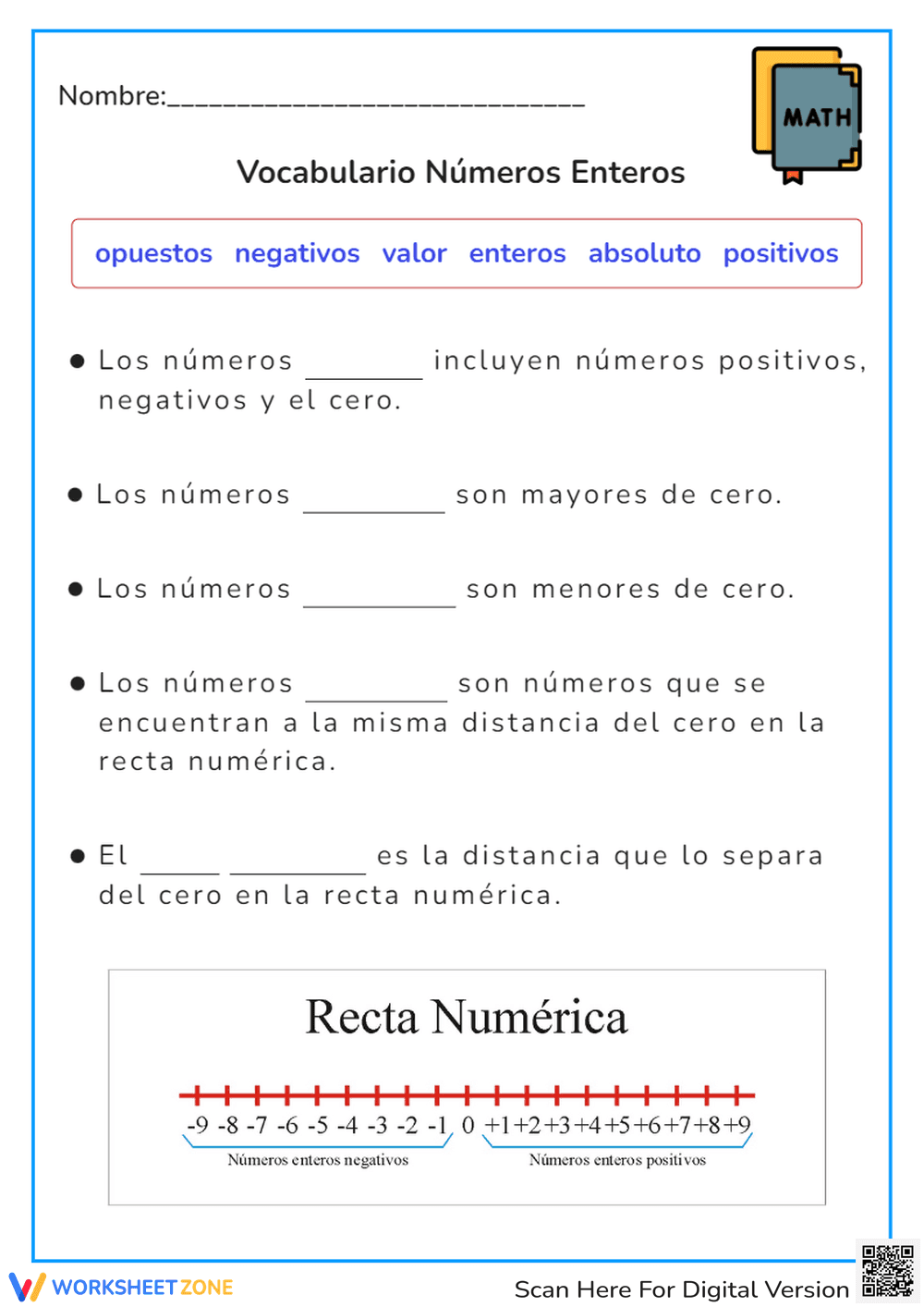
This Grade 6 math worksheet focuses on essential integer vocabulary, helping students define positive numbers, negative numbers, and absolute value. By completing structured fill-in-the-blank sentences, learners build a conceptual foundation for the number system. This resource ensures students can accurately describe the relationship between numbers and their distance from zero on a number line.
At a Glance
- Grade: 6 · Subject: Mathematics
- Standard:
CCSS.MATH.CONTENT.6.NS.C.5— Understand that positive and negative numbers describe quantities with opposite directions.- Skill Focus: Integer vocabulary and number line concepts
- Format: 1 page · 5 problems · Answer key included · PDF
- Best For: Quick vocabulary check or bell ringer
- Time: 10–15 minutes
This single-page PDF features a clear word bank containing six key terms: opuestos, negativos, valor, enteros, absoluto, and positivos. Students apply these terms to five descriptive sentences that define the properties of integers. A visual number line is provided at the bottom of the page to reinforce the spatial relationship between positive and negative values relative to zero, providing a concrete reference for abstract concepts.
This resource is designed for immediate classroom implementation. Teachers can print the single-sheet PDF in less than 2 minutes. Distribution takes seconds, and because the worksheet includes a word bank, students can begin working independently without additional instruction. Reviewing the five answers as a whole group takes approximately 3 minutes, making this an ideal tool for tight schedules or emergency sub plans.
The primary focus is CCSS.MATH.CONTENT.6.NS.C.5, which requires students to understand that positive and negative numbers are used together to describe quantities having opposite directions or values. It also supports CCSS.MATH.CONTENT.6.NS.C.7.C regarding the understanding of absolute value as a number's distance from zero. Both standard codes can be copied directly into lesson plans, IEP goals, or district curriculum mapping tools.
Use this worksheet as a formative assessment immediately after introducing the number line. It serves as an excellent exit ticket to verify that students have internalized the difference between opposites and absolute value. Alternatively, assign it as a warm-up activity to activate prior knowledge before moving into integer operations. Expected completion time ranges from 10 to 15 minutes depending on student familiarity with the terms.
This resource is tailored for sixth-grade students beginning their study of the rational number system. It is particularly effective for English Language Learners or students in dual-language programs, as the Spanish terminology is paired with clear visual cues. Pair this with a physical classroom number line or an interactive anchor chart for maximum instructional impact during the introductory phase of the unit.
According to the RAND AIRS 2024 report on mathematics instruction, the acquisition of precise domain-specific vocabulary is a critical predictor of long-term success in algebraic reasoning. This worksheet addresses that need by targeting CCSS.MATH.CONTENT.6.NS.C.5, ensuring students can articulate the properties of integers, including absolute value and opposite directions on a number line. By providing a word bank and visual aids, the resource reduces cognitive load, allowing students to focus on the semantic meaning of mathematical terms. Research from Fisher & Frey (2014) emphasizes that scaffolded vocabulary practice, such as fill-in-the-blank tasks with visual supports, bridges the gap between informal language and formal mathematical discourse. This 5-task activity provides the necessary repetition for students to master the foundational concepts required for more complex operations with signed numbers in later middle school grades.


