


























Views
Downloads


Essential Numeric Patterns Worksheet | Grade 5-7 Math
Paste this activity's link or code into your existing LMS (Google Classroom, Canvas, Teams, Schoology, Moodle, etc.).
Students can open and work on the activity right away, with no student login required.
You'll still be able to track student progress and results from your teacher account.
This comprehensive numeric patterns worksheet helps students in grades 5-7 master mathematical sequences. By focusing on rule-based thinking and functional relationships, students develop algebraic foundations. This resource ensures learners can confidently move from simple arithmetic sequences to complex input-output tables.
At a Glance
- Grade: 5-7 · Subject: Math
- Standard:
CCSS.MATH.CONTENT.5.OA.B.3— Generate two numerical patterns using two given rules and identify relationships- Skill Focus: Numeric pattern identification and rule application
- Format: 4 pages · 24 problems · Answer key included · PDF
- Best For: Independent practice and algebraic foundation building
- Time: 30–45 minutes
What's Inside
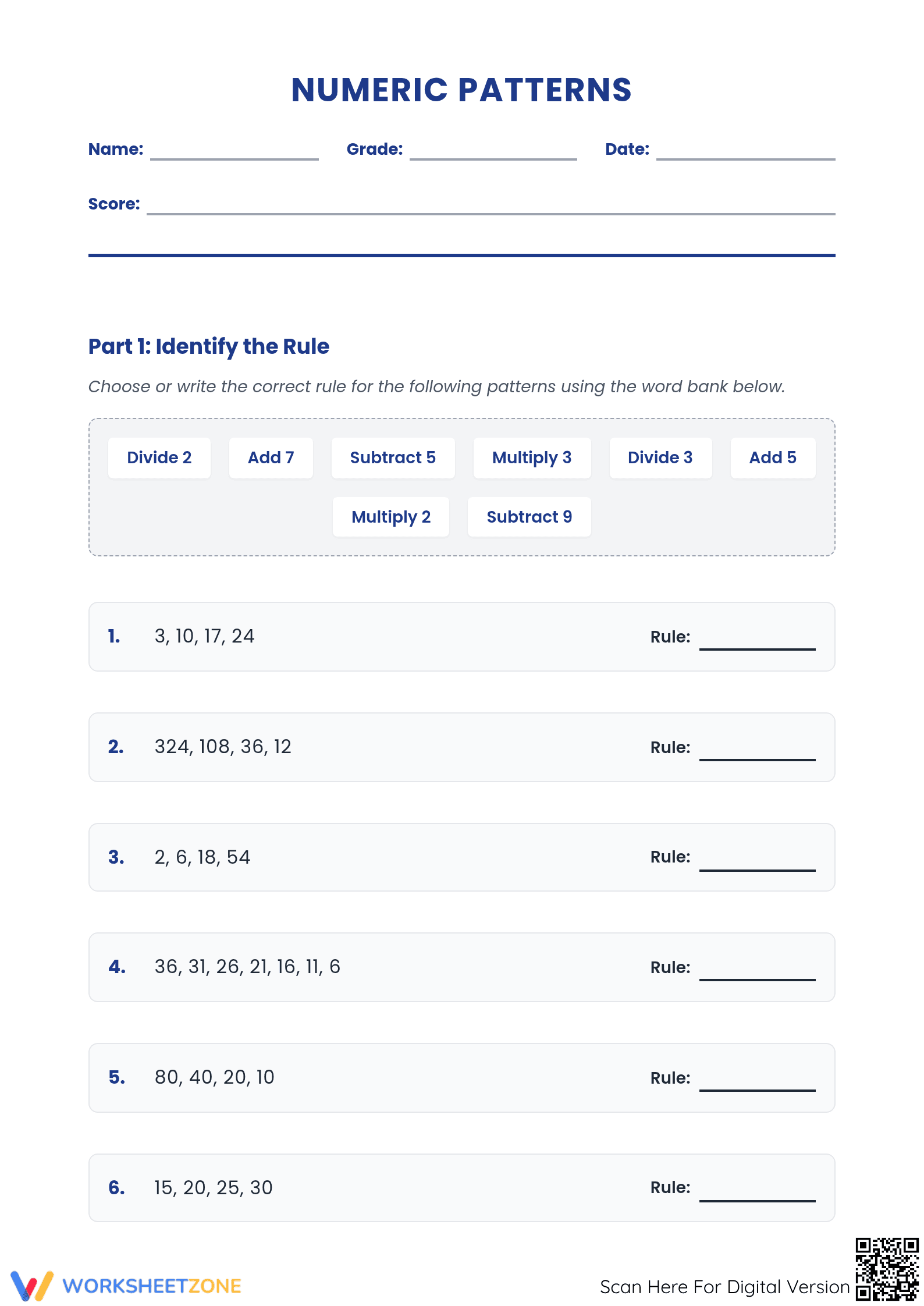
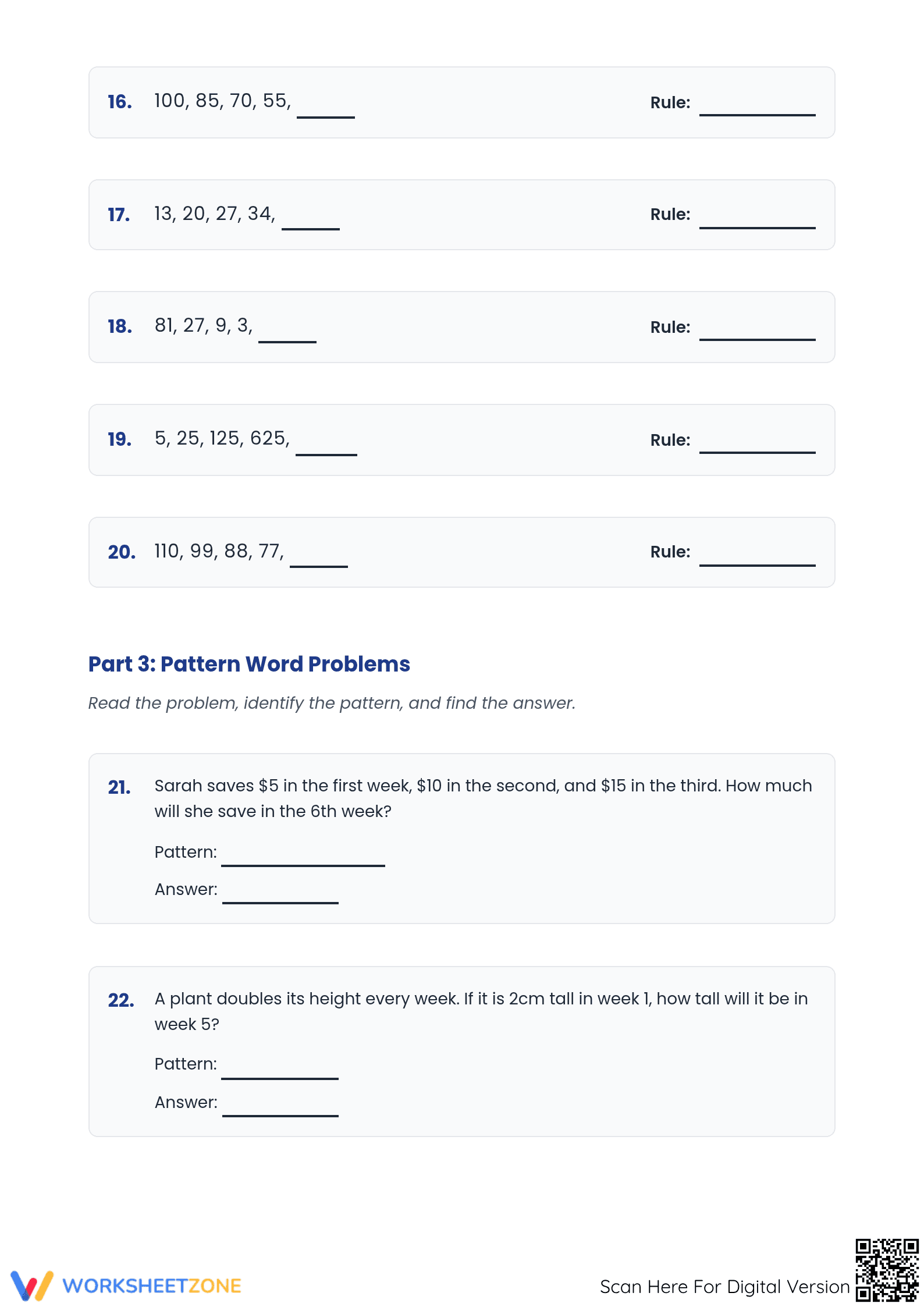
This four-page packet contains 24 problems designed to build pattern fluency. Students encounter linear sequences, missing-term challenges, and input-output tables requiring rule identification. The layout provides ample workspace, and a complete answer key is included for immediate feedback.
Skill Progression
- Guided Practice: 8 problems extend basic sequences with provided rules, reinforcing mechanics.
- Supported Practice: Tasks transition to identifying rules from existing sequences.
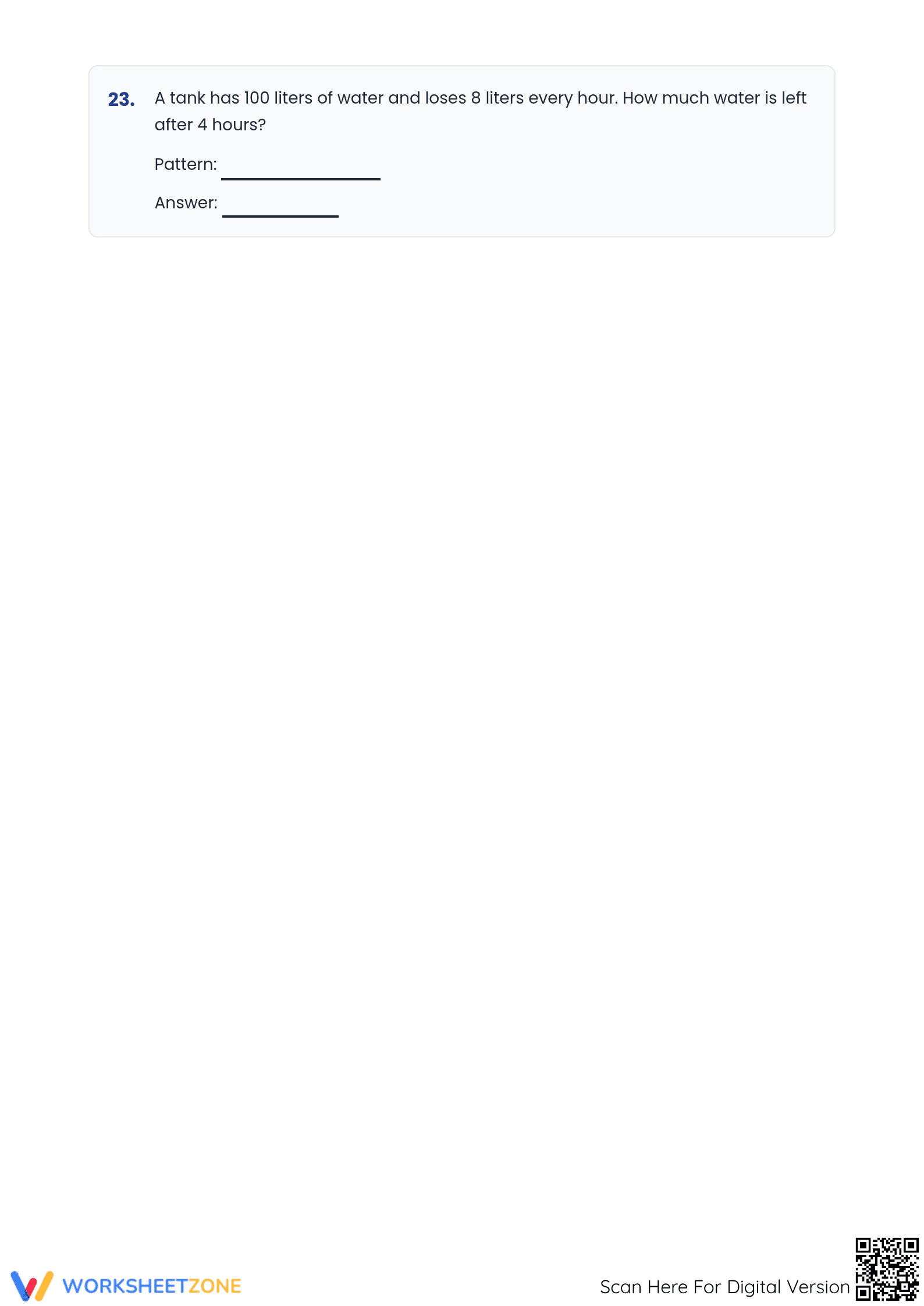
- Independent Practice: Students analyze complex tables and word problems to generate patterns.
This follows a gradual-release model moving from support to independent mastery.
Standards Alignment
The primary focus is `CCSS.MATH.CONTENT.5.OA.B.3`, which requires students to generate two numerical patterns using two given rules and identify apparent relationships between corresponding terms. This worksheet also supports middle-school foundations for expressions and equations. Both standard codes can be copied directly into lesson plans, IEP goals, or district curriculum mapping tools.
How to Use It
Use this as a main-lesson practice after introducing function rules. It is effective for collaboration during the "We Do" phase. For formative assessment, observe students on page two to identify those struggling with non-linear increments.
Who It's For
This is for Grade 5-7 students requiring practice on numerical relationships. It bridges arithmetic and early algebra. The structured layout supports students with IEPs needing visual boundaries. Pair this with an anchor chart for maximum effectiveness.
Aligned to CCSS.MATH.CONTENT.5.OA.B.3, this worksheet targets the critical cognitive shift from arithmetic computation to algebraic pattern recognition. By requiring students to generate sequences and identify underlying rules, the resource promotes "functional thinking," a prerequisite for success in secondary mathematics. According to a ScienceDirect TpT Analysis, high-quality printable resources that utilize structured problem sets significantly improve student retention of abstract mathematical concepts by reducing extraneous cognitive load. This packet provides 24 opportunities for students to apply rule-based logic across various contexts, including tables and sequences. The inclusion of an answer key allows for self-directed learning, which research indicates is vital for developing student agency in STEM subjects. Educators can utilize these 4 pages as a complete unit supplement, ensuring that students meet the rigorous demands of state and national standards while building a durable foundation for future coursework in expressions and functions.


