


























Views
Downloads

Numbers 11-20 Review: Printable Preschool Math Worksheet
Paste this activity's link or code into your existing LMS (Google Classroom, Canvas, Teams, Schoology, Moodle, etc.).
Students can open and work on the activity right away, with no student login required.
You'll still be able to track student progress and results from your teacher account.
Help your preschool students master the tricky "teen" numbers with this comprehensive Numbers 11-20 Review worksheet. This three-page resource provides immediate, focused practice in identifying, counting, and writing double-digit numerals. By engaging with multiple modalities—counting, matching, and tracing—learners build the foundational number sense required for Kindergarten success and beyond.
At a Glance
At a Glance
- Grade: Preschool · Subject: Math
- Standard:
K.CC.A.3— Write numbers from 0 to 20 and represent a number of objects- Skill Focus: Counting and Writing 11–20
- Format: 3 pages · 12 tasks · Answer key included · PDF
- Best For: Independent practice or small group review
- Time: 15–20 minutes
What's Inside
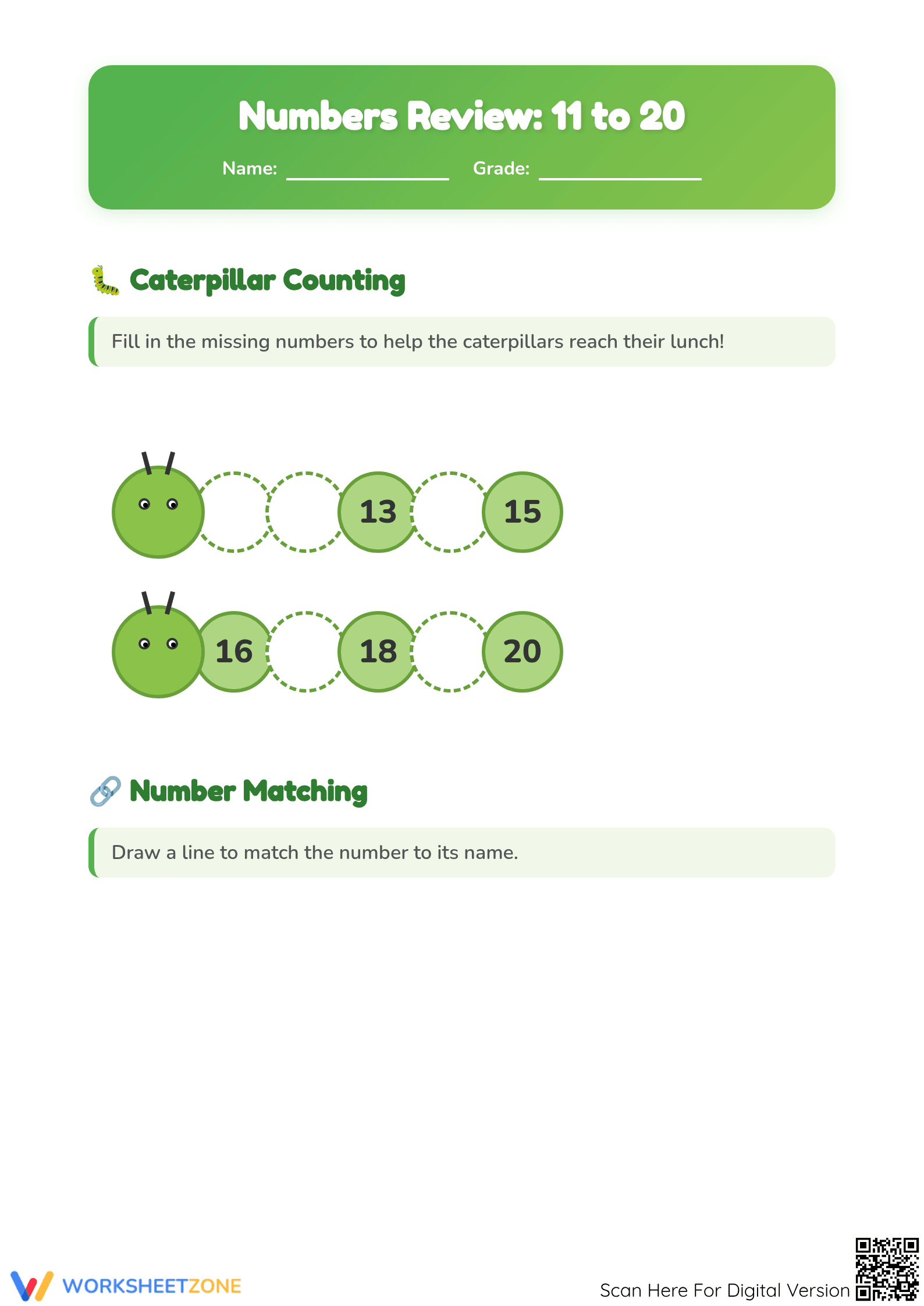
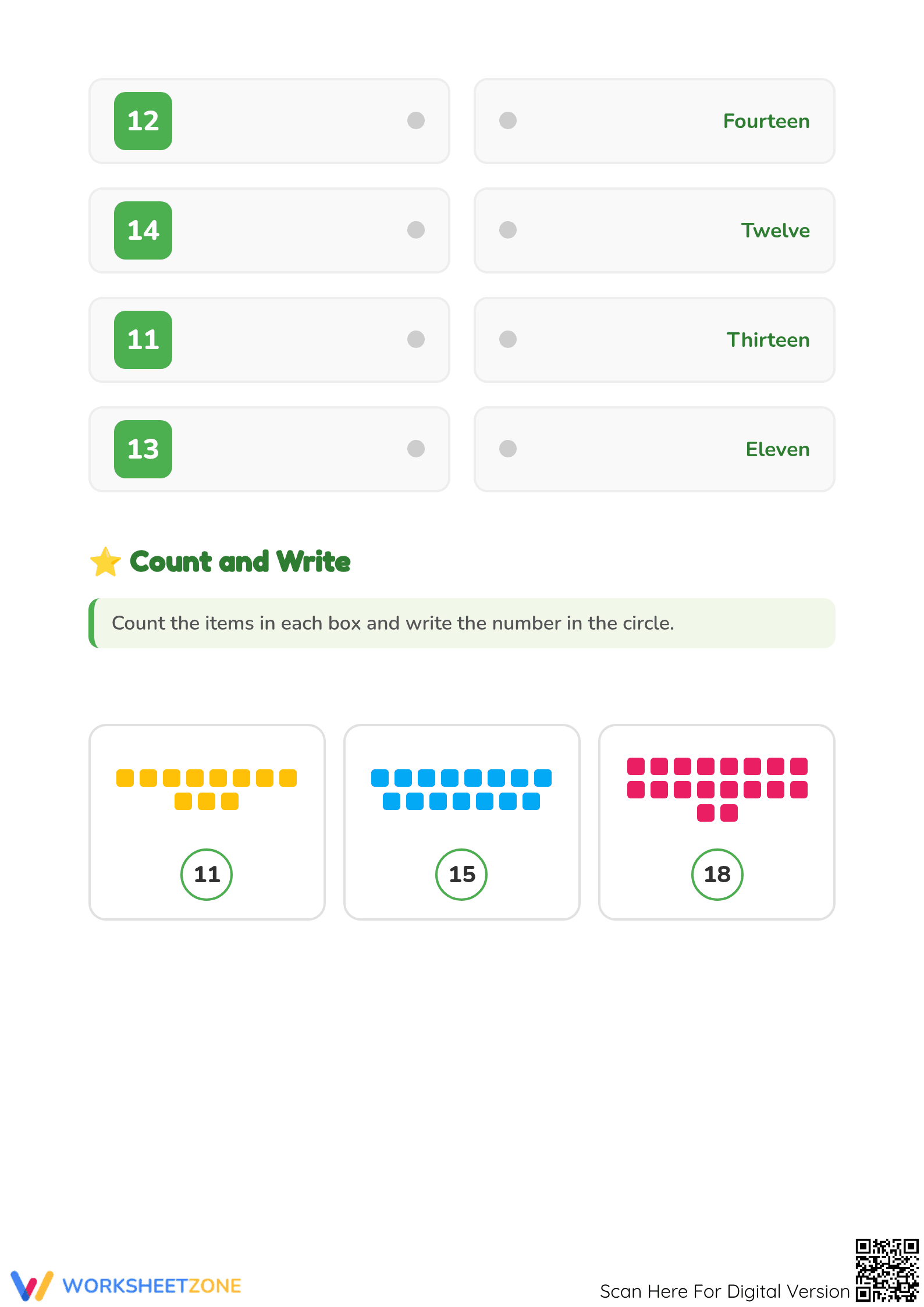
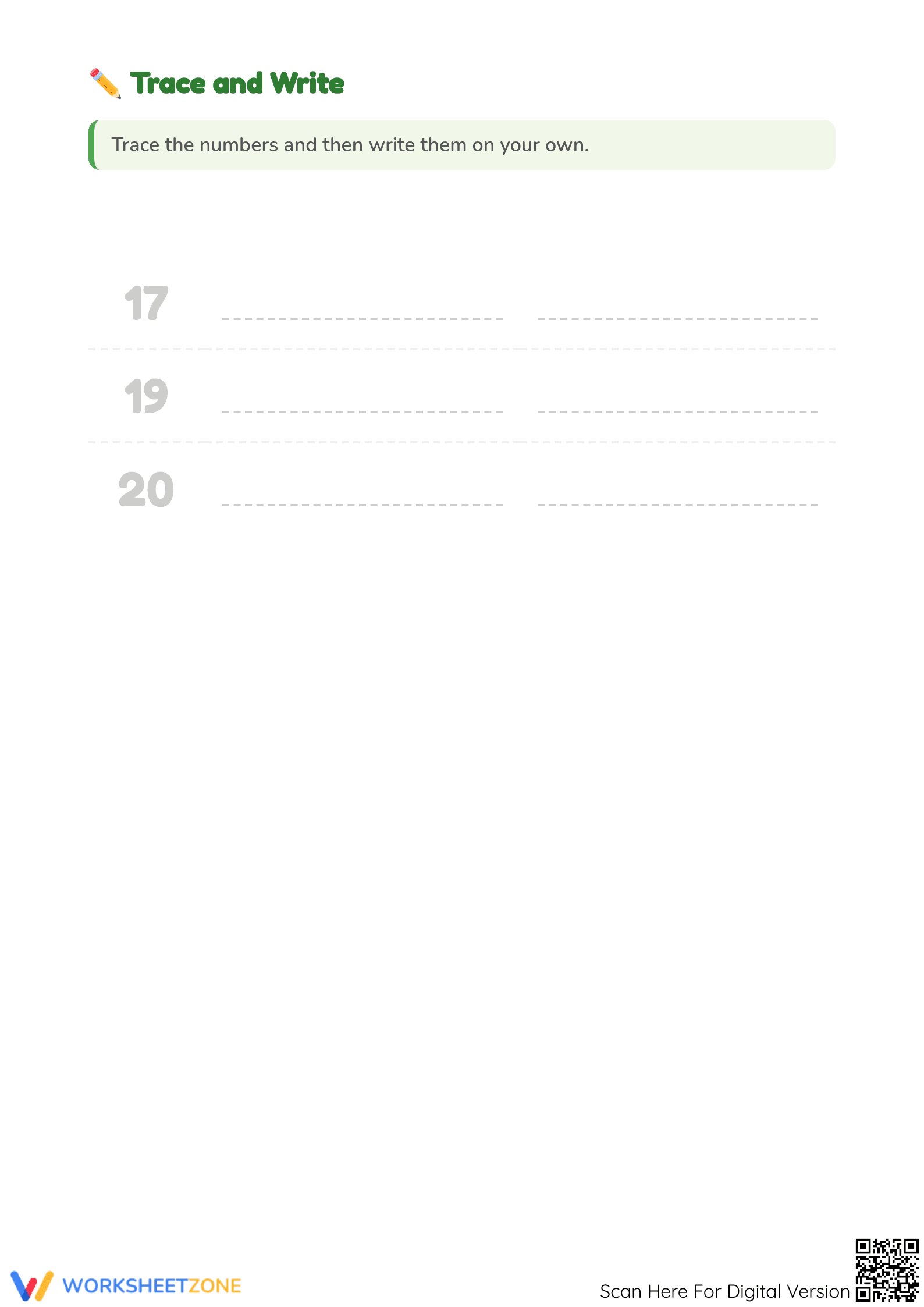
This packet contains three distinct pages of activities designed to reinforce teen number recognition. Students will encounter two caterpillar missing-number sequences, four matching exercises linking numerals to their written names, and three "count and write" blocks using visual manipulatives. The final page features tracing and independent writing practice for numbers 17, 19, and 20, providing a complete cycle of number acquisition.
Zero-Prep Workflow
This resource is designed for high-impact instruction with minimal teacher effort. First, print the three-page PDF (approx. 30 seconds). Second, distribute the packets and explain the "Caterpillar Counting" goal (approx. 1 minute). Finally, use the included answer key for rapid grading or self-correction during student review (approx. 2 minutes). This efficient design makes the worksheet ideal for emergency sub plans or last-minute morning work.
Standards Alignment
The primary alignment is K.CC.A.3, which requires students to write numbers from 0 to 20 and represent a number of objects with a written numeral. This worksheet specifically targets the upper half of this range, ensuring students can transition from rote counting to symbolic representation. This standard code can be copied directly into lesson plans, IEP goals, or district curriculum mapping tools to document student progress.
How to Use It
Deploy this worksheet after students have been introduced to the numbers 11-20 via concrete manipulatives like ten-frames or counting bears. It serves as an excellent formative assessment tool; observe students during the "Count and Write" section to see if they are utilizing one-to-one correspondence or "counting on" strategies. Expect most preschool learners to complete the full three-page set within 20 minutes of focused classroom time.
Who It's For
This packet is tailor-made for preschool students nearing Kindergarten transition, as well as early Kindergarteners who need a "booster" in teen number recognition. The clear fonts and ample whitespace support students with fine motor delays or those requiring visual clarity. Pair this resource with a physical number line or a "numbers to 20" anchor chart to provide additional scaffolding for struggling learners.
Research from EdReports (2024) emphasizes that early math success is heavily dependent on the integration of symbolic number writing with concrete counting tasks. This worksheet addresses that need by bridging the gap between seeing a numeral, hearing its name, and physically writing the digits. By focusing on the 11-20 range—often cited as the most difficult for early learners due to the irregular naming conventions of eleven and twelve—this resource provides targeted intervention where students need it most. Structured practice in number tracing and writing, as seen on the final page of this packet, has been shown to improve both mathematical fluency and fine motor control. The inclusion of multiple activity types ensures that students remain engaged while repeatedly encountering the same numerical concepts. This evidence-based approach to early numeracy ensures that every learner has a path toward mastering the core competencies of the K.CC.A.3 standard.


