


























Views
Downloads

Printable Number 7 Handwriting Practice | Kindergarten
Paste this activity's link or code into your existing LMS (Google Classroom, Canvas, Teams, Schoology, Moodle, etc.).
Students can open and work on the activity right away, with no student login required.
You'll still be able to track student progress and results from your teacher account.
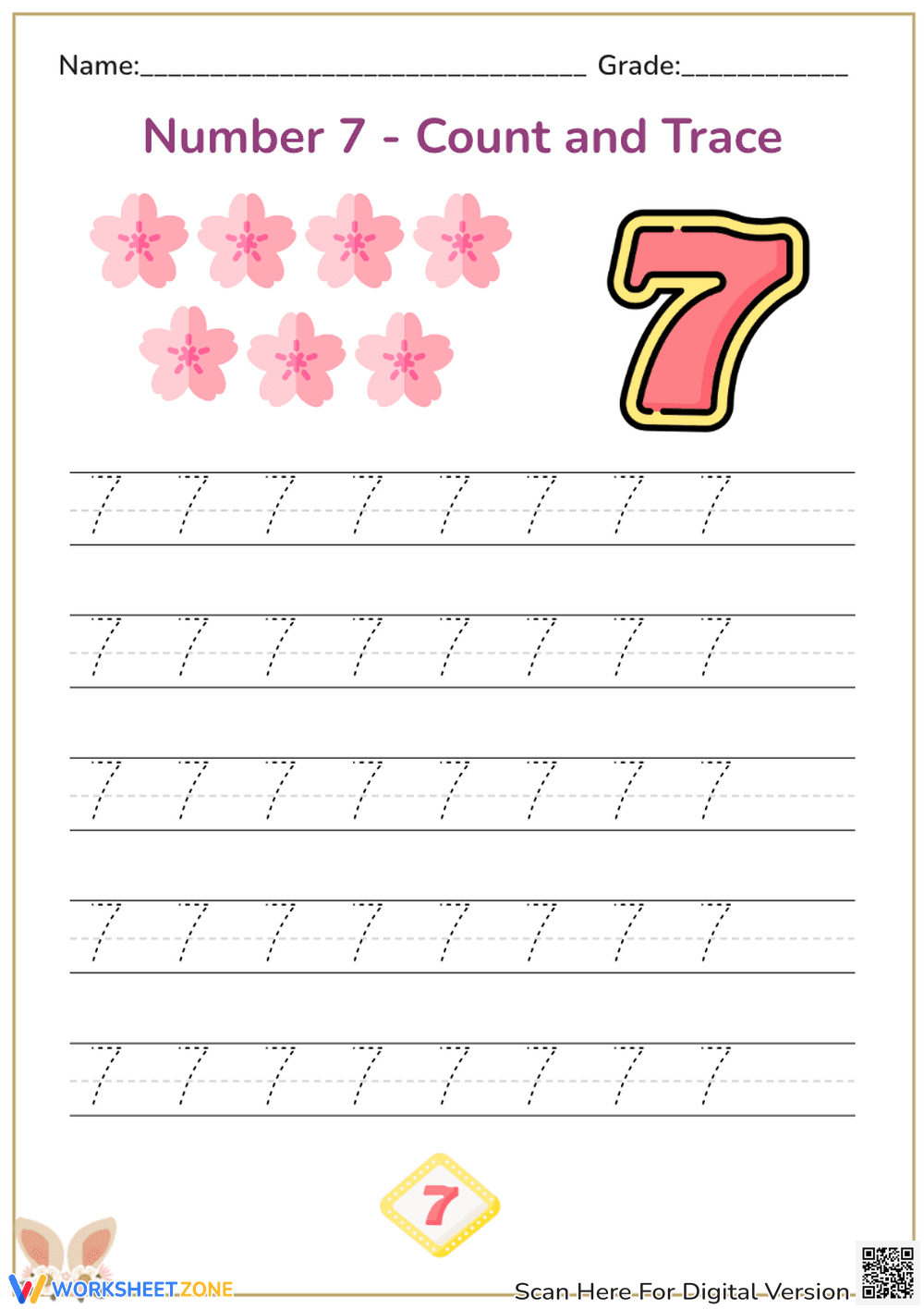
This essential number 7 handwriting worksheet helps early learners master numeral formation through repetitive tracing and visual counting. By connecting the quantity of seven flowers to the written symbol, students develop a concrete understanding of number value while refining the fine motor control necessary for legible penmanship in primary grades.
At a Glance
- Grade: Kindergarten · Subject: Handwriting
- Standard:
CCSS.MATH.CONTENT.K.CC.A.3— Write numbers from 0 to 20 to represent a number of objects- Skill Focus: Number 7 formation and counting
- Format: 1 page · 41 tasks · Answer key included · PDF
- Best For: Morning work or fine motor centers
- Time: 10–15 minutes
Inside this single-page PDF, students find a clear, large-format counting exercise featuring seven illustrated flowers. Below the visual aid, five structured rows provide 40 individual tracing opportunities. The dashed-line font includes a midline guide to help children maintain consistent height and slant, ensuring a professional look for their first attempts at writing.
Skill Progression
- Guided Practice: Students begin by counting the seven flowers and observing the large model number to understand the stroke order.
- Supported Practice: Children trace the number 7 across five rows, using the dashed lines to maintain proper proportions and alignment.
- Independent Practice: The repetitive nature of the 40 tasks builds muscle memory, allowing students to transition toward writing the number without visual aids.
This worksheet follows a gradual-release approach, ensuring students move from simple recognition to confident production of the numeral.
Standards Alignment
This resource is specifically designed to meet `CCSS.MATH.CONTENT.K.CC.A.3`, which requires students to write numbers from 0 to 20. It also supports fine motor development goals often found in occupational therapy plans. Both standard codes can be copied directly into lesson plans, IEP goals, or district curriculum mapping tools.
How to Use It
Use this worksheet during your math block after introducing the number seven. It serves as an excellent formative assessment; observe if students start at the top-left and use a single fluid motion. It also works well as a quiet "fast-finisher" activity or a simple homework assignment. Expect completion within 10 to 15 minutes depending on the student's motor proficiency.
Who It's For
This practice page is ideal for preschoolers and kindergarteners who are just beginning their journey with numerals. It is particularly helpful for students requiring extra fine motor support or those who benefit from visual counting cues. Pair this with a tactile sand tray or a number 7 anchor chart for a multi-sensory experience.
According to the RAND AIRS 2024 report on early childhood literacy and numeracy, repetitive tracing exercises are fundamental in establishing the neural pathways required for automaticity in handwriting. This worksheet targets the specific standard CCSS.MATH.CONTENT.K.CC.A.3, which bridges the gap between conceptual counting and symbolic representation. By providing 40 distinct tracing opportunities, the resource ensures that students move beyond mere recognition into fluent production. Research from Fisher & Frey (2014) emphasizes that such structured practice, when combined with visual aids like the flower illustrations provided here, supports the gradual release of responsibility model. This allows educators to monitor student progress effectively while providing a low-stakes environment for mastery. The inclusion of midline guides further assists in developing spatial awareness, a critical component of early writing success identified in recent NAEP assessments of primary grade readiness.


