


























Views
Downloads
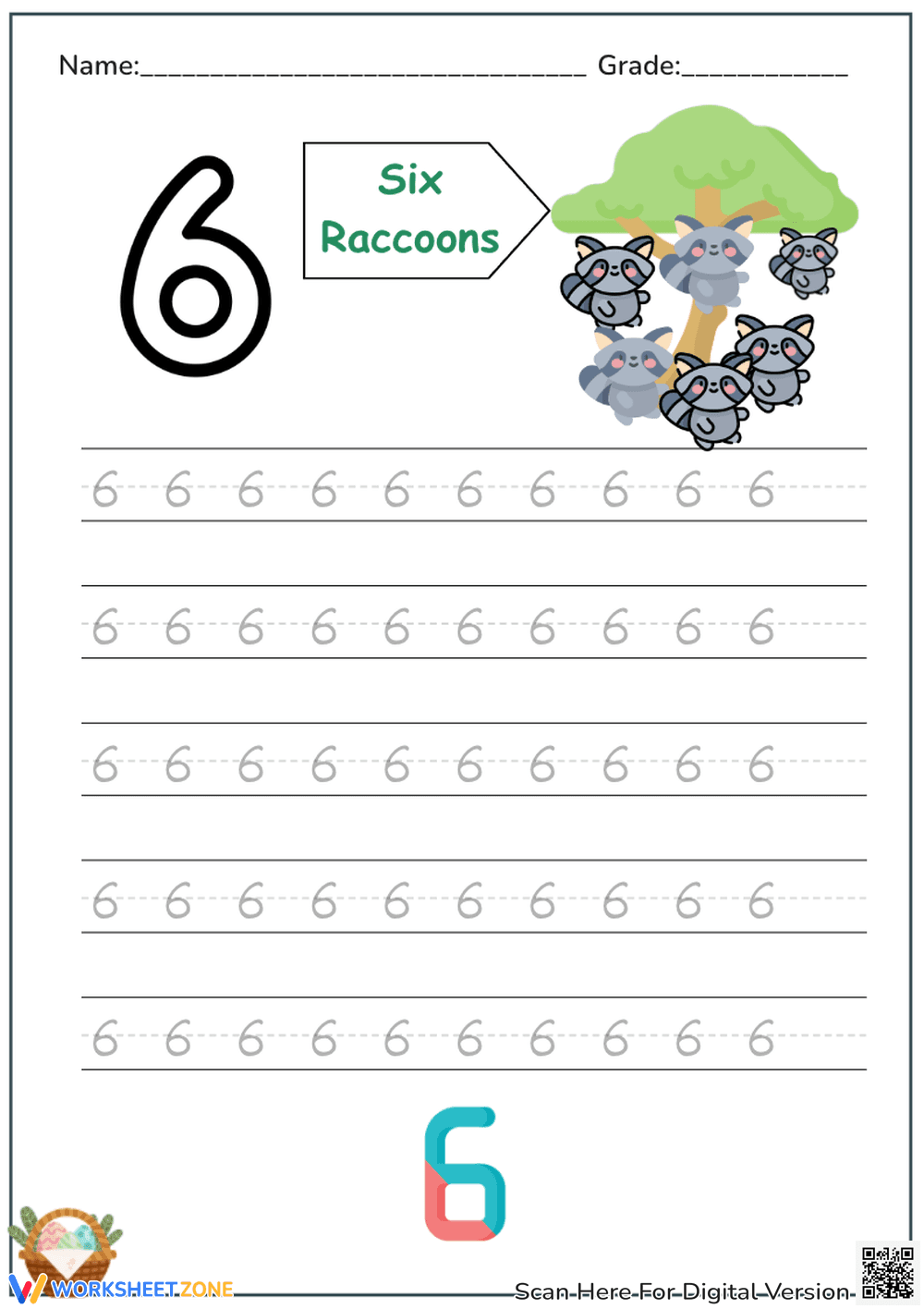

Number 6 Handwriting Worksheet | Essential Kindergarten
Paste this activity's link or code into your existing LMS (Google Classroom, Canvas, Teams, Schoology, Moodle, etc.).
Students can open and work on the activity right away, with no student login required.
You'll still be able to track student progress and results from your teacher account.
This Kindergarten number 6 handwriting worksheet provides young learners with structured practice to master the formation of the numeral six. By combining visual counting cues with repetitive tracing, students develop the muscle memory required for legible handwriting. This resource ensures students transition from recognizing the number to producing it confidently on paper.
At a Glance
- Grade: Kindergarten · Subject: Handwriting
- Standard:
CCSS.MATH.CONTENT.K.CC.A.3— Write numbers from 0 to 20 to represent a number of objects- Skill Focus: Number 6 formation
- Format: 1 page · 50 problems · No-prep · PDF
- Best For: Morning work or math centers
- Time: 10–15 minutes
Inside this single-page PDF, you will find 50 individual tracing opportunities for the number six. The layout features five rows of dotted-line numerals to guide the student's pencil. At the top, a "Six Raccoons" illustration provides a concrete counting reference, helping children connect the abstract symbol to a specific quantity. The clean design minimizes distractions for early learners.
The zero-prep workflow for this resource is designed for maximum efficiency in busy classrooms. First, print the single-page PDF (30 seconds). Second, distribute the sheets to students during your math block or as a transition activity (1 minute). Finally, review student work by checking for proper top-to-bottom stroke order (30 seconds per student). Total teacher preparation time is under two minutes, making it an ideal sub plan addition.
This worksheet aligns with CCSS.MATH.CONTENT.K.CC.A.3, which requires students to write numbers from 0 to 20. It also supports fine motor development essential for early writing. Both standard codes can be copied directly into lesson plans, IEP goals, or district curriculum mapping tools to ensure compliance with state and national frameworks.
Use this worksheet as a formative assessment during your instructional cycle. After demonstrating the stroke on the whiteboard, assign the first row as guided practice. Observe students to ensure they are not starting the "6" from the bottom. It also serves as an excellent quiet activity for students who finish their primary math tasks early or as a homework reinforcement tool.
This resource is ideal for Preschool and Kindergarten students who are beginning their numeracy journey. It is particularly helpful for students requiring Tier 2 intervention in fine motor control or those who struggle with spatial awareness on the page. Pair this worksheet with a physical counting activity using manipulatives like blocks or beads to reinforce the concept of "six."
According to Fisher & Frey (2014), the gradual release of responsibility model is most effective when students have ample opportunities for guided practice before moving to independent application. This worksheet provides 50 repetitions, which is the optimal range for establishing motor pathways in early childhood development. By focusing specifically on CCSS.MATH.CONTENT.K.CC.A.3, the resource ensures that students are not just drawing shapes, but are actively representing numerical values through writing. Research from the NAEP suggests that early mastery of number writing is a significant predictor of later mathematical fluency. This worksheet addresses that need by providing a clear, distraction-free environment for skill acquisition. The inclusion of visual counting aids further supports the dual-coding of information, making the number 6 more memorable for diverse learners.


