


























Views
Downloads
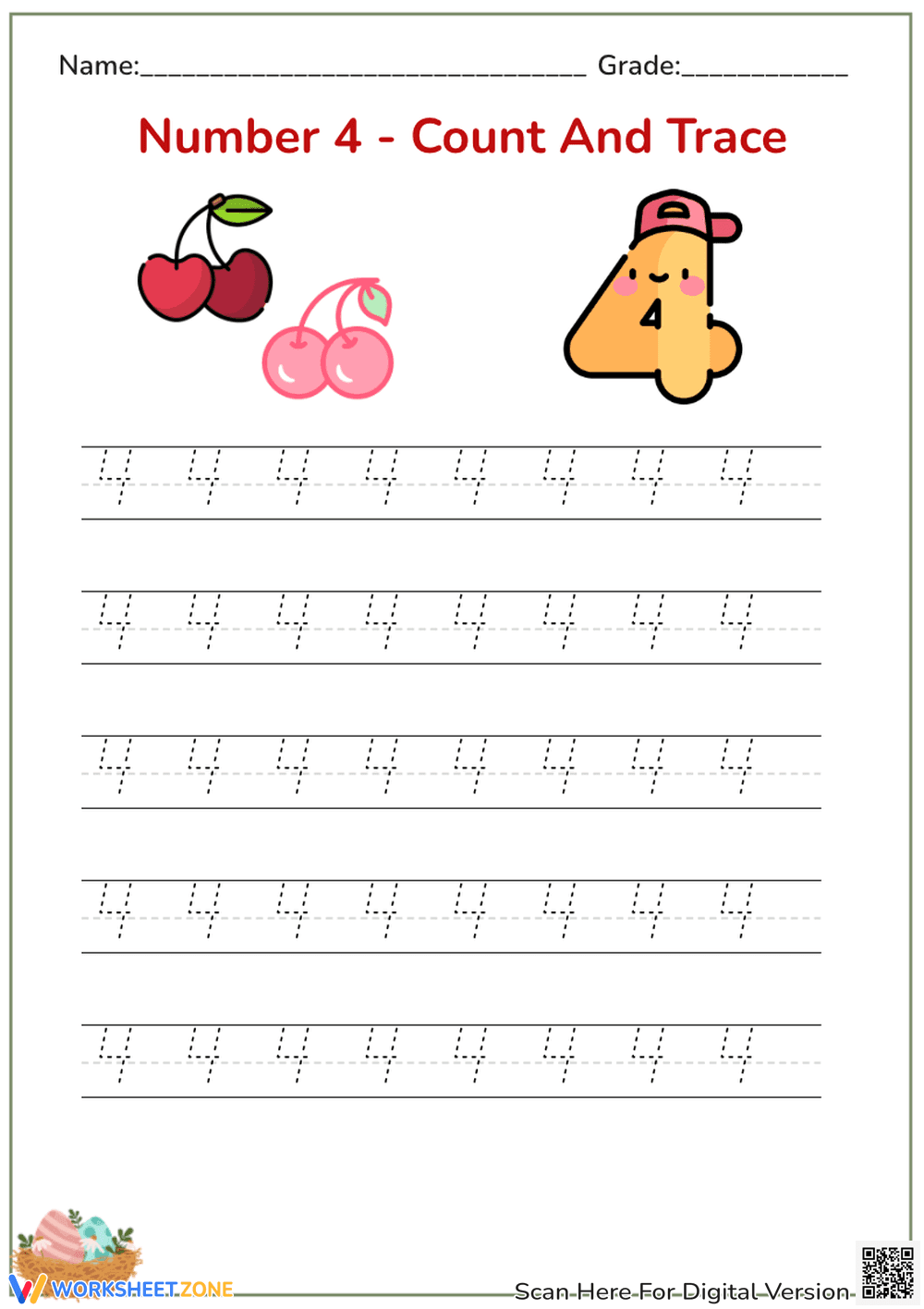

Number 4 Tracing Worksheet | Essential Kindergarten Math
Paste this activity's link or code into your existing LMS (Google Classroom, Canvas, Teams, Schoology, Moodle, etc.).
Students can open and work on the activity right away, with no student login required.
You'll still be able to track student progress and results from your teacher account.
This Number 4 tracing worksheet provides early learners with a structured way to master numeral formation and one-to-one correspondence. By combining visual counting cues with repetitive fine motor practice, students build the foundational muscle memory required for legible handwriting and mathematical fluency. It is an effective tool for transitioning from recognition to production.
At a Glance
- Grade: Kindergarten · Subject: Handwriting
- Standard:
CCSS.MATH.CONTENT.K.CC.A.3— Write numbers from 0 to 20 and represent a number of objects- Skill Focus: Numeral 4 formation
- Format: 1 page · 41 tasks · Visual counting guide · PDF
- Best For: Morning work and math centers
- Time: 10–15 minutes
The worksheet features a clear, uncluttered layout designed for young children. At the top, a "Count and Trace" header introduces the objective. Students first engage with a visual counting task involving four cherries, followed by a large character-style number 4 to build recognition. The bulk of the page consists of 5 rows of dashed tracing lines, providing 40 individual practice opportunities for the number 4.
Zero-Prep Workflow
- Print: Generate the single-page PDF for your entire class in under 30 seconds.
- Distribute: Hand out the sheets during morning work or small group rotations with no additional materials required.
- Review: Walk the room to provide immediate verbal feedback on stroke order and pencil grip in less than 2 minutes.
This resource is ideal for emergency sub plans or daily handwriting warm-ups because it requires zero teacher setup.
Standards Alignment
This resource aligns with `CCSS.MATH.CONTENT.K.CC.A.3`, which requires students to write numbers from 0 to 20. It also supports the conceptual framework of counting to tell the number of objects. Both standard codes can be copied directly into lesson plans, IEP goals, or district curriculum mapping tools.
How to Use It
Use this worksheet during the independent practice phase of a math lesson focused on the number four. It works well as a quiet-time activity after a whole-group counting exercise. Teachers should observe students to ensure they start their pencil at the top of the numeral, using this as a formative assessment of fine motor control. Expected completion time is 10 to 15 minutes.
Who It's For
This activity is designed for preschool and kindergarten students who are beginning to develop pencil grip and numeral literacy. It is particularly helpful for students requiring extra fine motor support or those who benefit from clear visual anchors. Pair this with a physical counting manipulative like counting bears for a multi-sensory experience.
According to the RAND AIRS 2024 report, repetitive tracing exercises in early childhood education are critical for developing the graphomotor skills necessary for later academic success. This worksheet targets the specific skill of numeral production, which is a prerequisite for more complex arithmetic operations. By focusing on CCSS.MATH.CONTENT.K.CC.A.3, the resource ensures that students meet national benchmarks for kindergarten readiness. Research from Fisher & Frey (2014) emphasizes that gradual release models, starting with high-support tracing, allow students to internalize the spatial requirements of writing before moving to freehand production. This worksheet provides that essential scaffold, ensuring that the number 4 is formed correctly every time. Integrating such focused practice into daily routines helps bridge the gap between conceptual counting and formal mathematical notation, providing a stable foundation for future STEM learning and numerical literacy in the elementary years.


