




























Views
Downloads
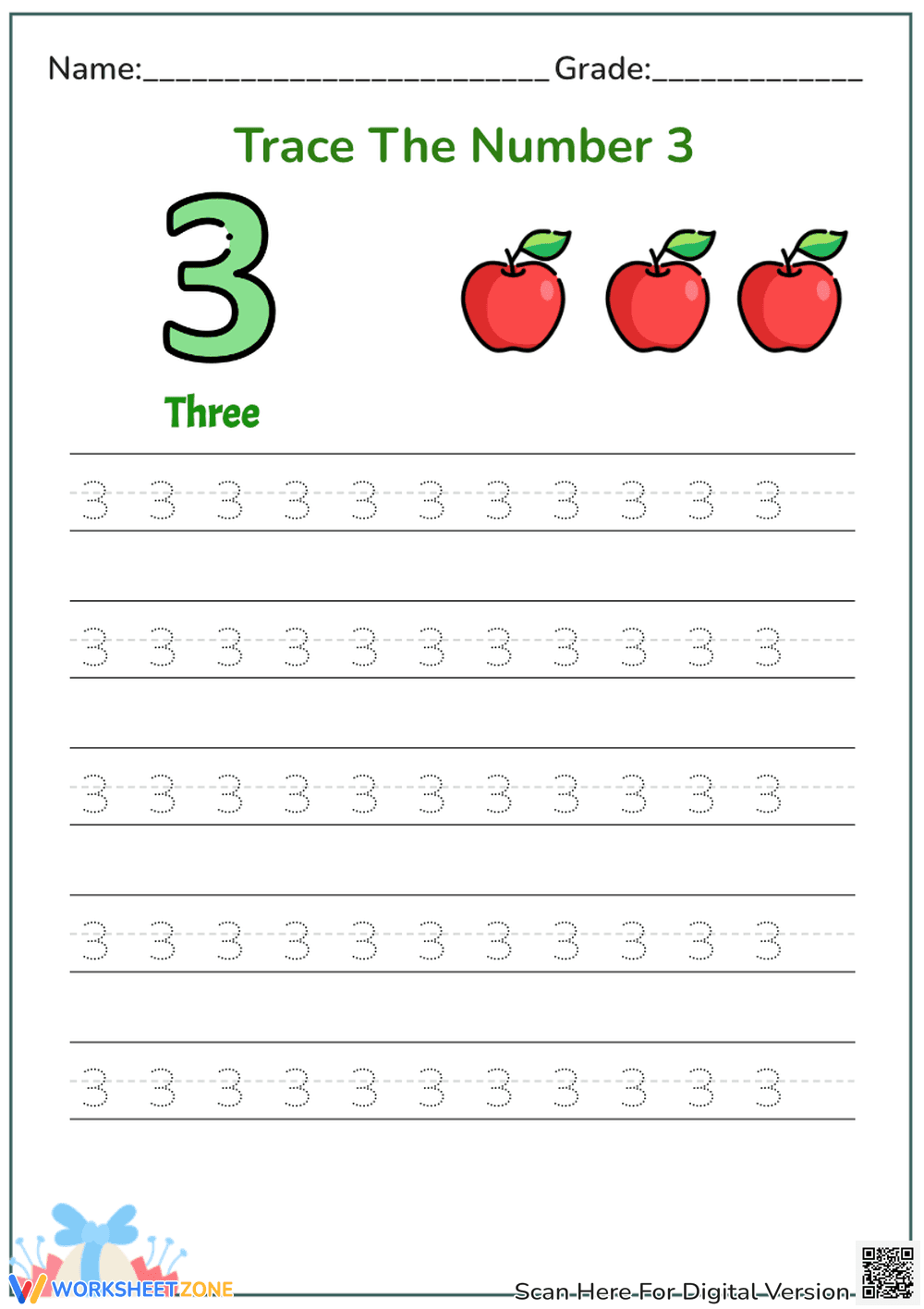

Number 3 Tracing Worksheet | Essential Grade K Practice

Paste this activity's link or code into your existing LMS (Google Classroom, Canvas, Teams, Schoology, Moodle, etc.).
Students can open and work on the activity right away, with no student login required.
You'll still be able to track student progress and results from your teacher account.
This Kindergarten number 3 tracing worksheet provides foundational handwriting practice combined with early numeracy. Students develop fine motor control by tracing the numeral while reinforcing the concept of quantity through visual apple counting. It offers a clear, structured path for young learners to master number formation and word recognition in one session.
At a Glance
- Grade: Kindergarten · Subject: Handwriting
- Standard:
CCSS.MATH.CONTENT.K.CC.A.3— Write numbers from 0 to 20 and represent object quantities- Skill Focus: Numeral formation and counting
- Format: 1 page · 55 tasks · No answer key needed · PDF
- Best For: Morning work or independent center practice
- Time: 10–15 minutes
The worksheet features a large "3" for visual reference, three vibrant red apples for counting, and the word "Three" for literacy integration. Below the header, five rows of dotted guidelines provide 55 individual tracing opportunities. The layout is clean and distraction-free, ensuring students remain focused on the specific motor movements required for the curves of the number three.
This resource is designed for immediate classroom implementation. Teachers can print the single-page PDF in less than 30 seconds. Distribution takes approximately one minute during transition periods. Reviewing student work is instantaneous, as the repetitive tracing allows for quick visual checks of grip and stroke order. Total teacher preparation time is under two minutes, making it an ideal sub-plan addition.
Aligned to CCSS.MATH.CONTENT.K.CC.A.3, this worksheet requires students to "Write numbers from 0 to 20. Represent a number of objects with a written numeral 0-20." It also supports fine motor development necessary for early writing standards. Both standard codes can be copied directly into lesson plans, IEP goals, or district curriculum mapping tools.
Use this worksheet during the independent practice phase of a lesson on number recognition. It serves as an excellent formative assessment tool; observe students to ensure they start at the top and follow the correct directional flow. The 15-minute completion time makes it ideal for small-group rotations or as a quiet activity for early finishers during math blocks.
This resource is tailored for Preschool and Kindergarten students, including those requiring occupational therapy support for pencil control. It pairs naturally with a physical counting activity using manipulatives or a "Number of the Day" anchor chart. The high-repetition format benefits English Language Learners by connecting the numeral, word, and visual quantity in a single view.
According to the RAND AIRS 2024 report, repetitive motor practice in early childhood is a critical predictor of later mathematical fluency and writing stamina. This worksheet addresses the specific need for high-frequency numeral tracing, which helps automate the physical act of writing so cognitive resources can be redirected toward complex problem-solving. By integrating visual counting cues with 55 tracing repetitions, the resource aligns with Fisher & Frey (2014) principles of scaffolded learning. The CCSS.MATH.CONTENT.K.CC.A.3 alignment ensures that students are not just drawing shapes but are actively connecting the symbol "3" to its quantitative value. Research indicates that early mastery of number formation reduces the likelihood of number reversals in later grades. This printable provides the structured environment necessary for students to build the muscle memory required for academic success in primary mathematics and literacy.


