




























Views
Downloads
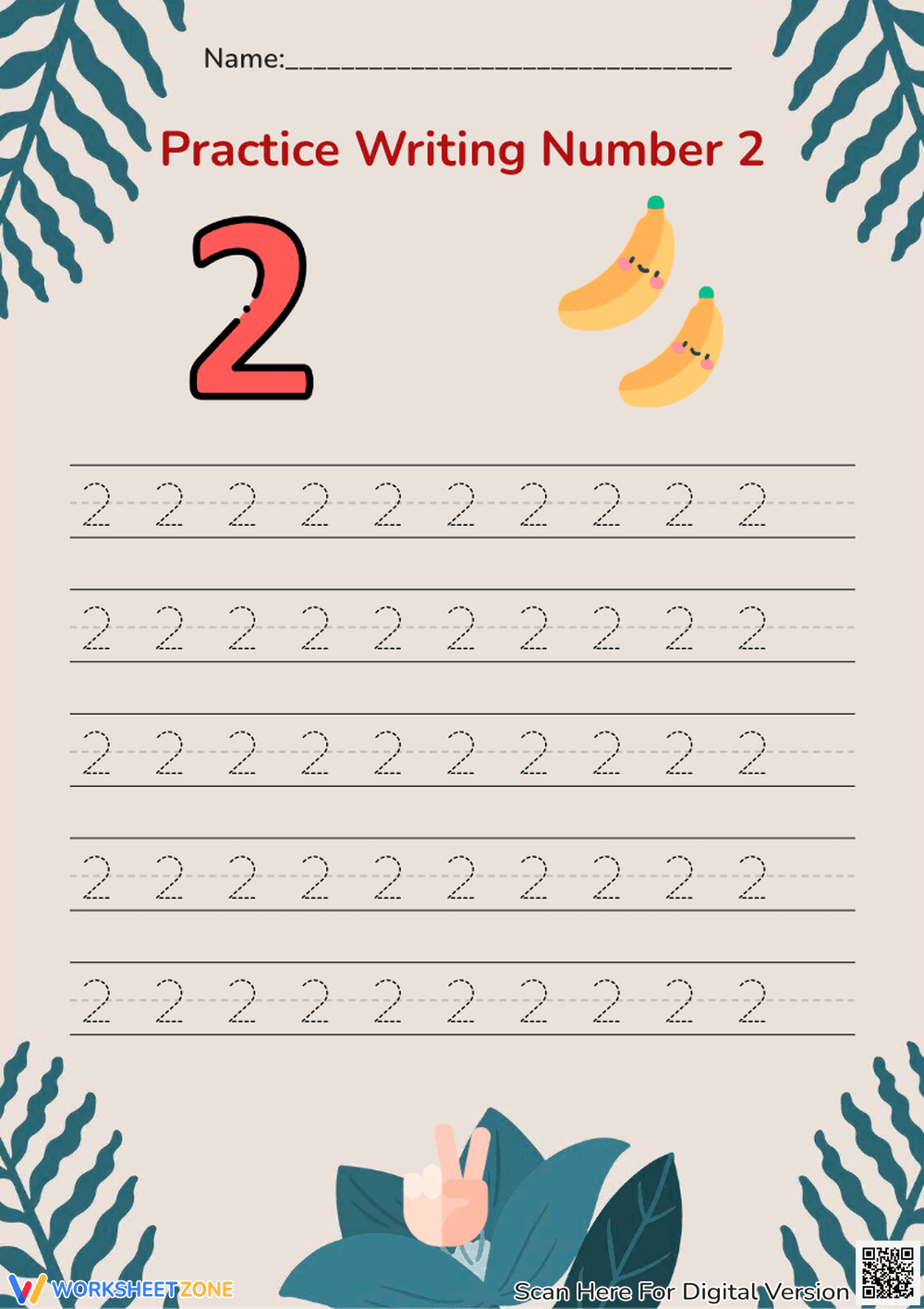

Number 2 Writing Practice | Essential Kindergarten Worksheet

Paste this activity's link or code into your existing LMS (Google Classroom, Canvas, Teams, Schoology, Moodle, etc.).
Students can open and work on the activity right away, with no student login required.
You'll still be able to track student progress and results from your teacher account.
This foundational number 2 writing worksheet helps early learners master numeral formation through repetitive tracing and visual association. By focusing specifically on the number two, students build the muscle memory required for fluid handwriting while connecting the symbol to a concrete quantity represented by the banana graphics.
At a Glance
- Grade: Kindergarten · Subject: Handwriting
- Standard:
CCSS.MATH.CONTENT.K.CC.A.3— Write numbers from 0 to 20 to represent quantities- Skill Focus: Numeral formation (2)
- Format: 1 page · 50 problems · Answer key included · PDF
- Best For: Daily morning work or math centers
- Time: 5–10 minutes
Inside this single-page PDF, you will find 50 individual tracing opportunities organized into five clean rows. Each row features a dotted-line guide to support proper stroke order and height consistency. The top of the page includes a large reference numeral and two friendly banana illustrations to reinforce the concept of "two" as a quantity.
This resource follows a zero-prep workflow designed for busy educators. First, print the single-page PDF in under 30 seconds. Second, distribute to students during morning arrival or math rotations. Third, provide immediate feedback by checking for correct starting points and curve direction. Total teacher preparation time is under two minutes, making it an ideal sub-plan addition.
This worksheet is aligned with `CCSS.MATH.CONTENT.K.CC.A.3`, which requires students to write numbers from 0 to 20. It specifically addresses the motor skill component of numeral representation. Both standard codes can be copied directly into lesson plans, IEP goals, or district curriculum mapping tools.
Use this worksheet as a formative assessment during the first weeks of Kindergarten to identify students who may need additional occupational therapy support. It also functions perfectly as a quiet-time activity after direct instruction on the number two. Expect most students to complete the 50 tracing tasks within 5 to 10 minutes.
This resource is tailored for Preschool and Kindergarten students, as well as older learners requiring remedial fine motor practice. It pairs naturally with counting manipulatives or a "Number of the Day" anchor chart to provide a multi-sensory learning experience for young children.
According to Fisher & Frey (2014), the gradual release of responsibility begins with clear modeling and supported practice, which this tracing format provides. Research indicates that repetitive motor tasks in early childhood are essential for developing the automaticity needed for higher-level mathematical reasoning. By isolating the number 2, this worksheet reduces cognitive load, allowing the student to focus entirely on the physical mechanics of writing. The inclusion of 50 practice points ensures that the neural pathways for numeral formation are reinforced through consistent repetition. This approach aligns with NAEP findings suggesting that early mastery of numeral writing is a significant predictor of later math achievement. Educators can use this structured practice to bridge the gap between recognizing a number and producing it independently on a blank page. The CCSS.MATH.CONTENT.K.CC.A.3 alignment ensures this activity meets core curriculum requirements for early numeracy.


