


























Views
Downloads


Printable Noun-Verb Agreement Worksheet | Grade 1 ELA
Paste this activity's link or code into your existing LMS (Google Classroom, Canvas, Teams, Schoology, Moodle, etc.).
Students can open and work on the activity right away, with no student login required.
You'll still be able to track student progress and results from your teacher account.
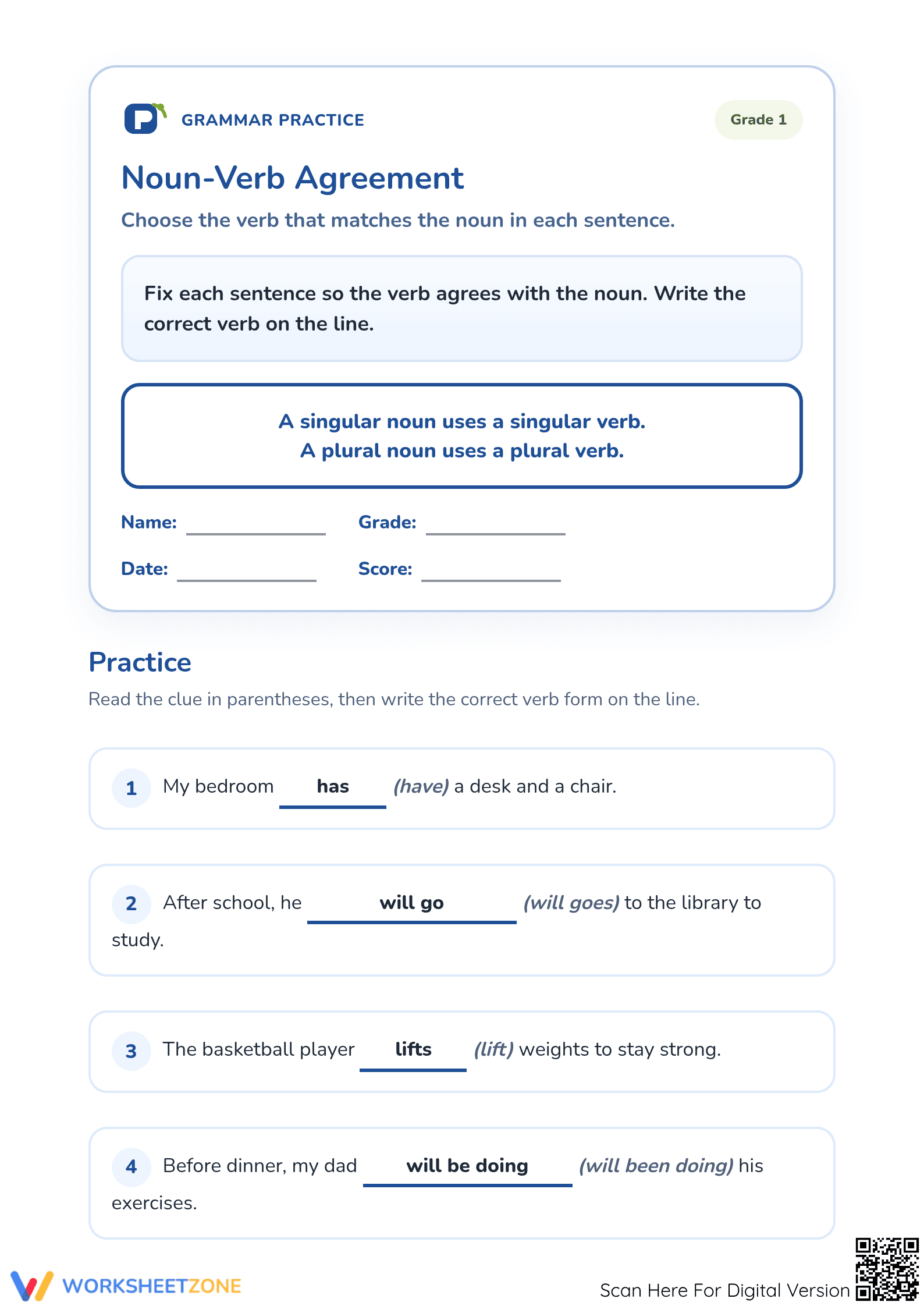
Mastering subject-verb consistency is a foundational milestone for early writers. This printable Grade 1 noun-verb agreement worksheet provides immediate practice to ensure students match singular and plural subjects with their correct verb forms. By completing these structured exercises, learners develop the grammatical intuition necessary for constructing clear, fluent sentences in both their speaking and writing.
At a Glance
- Grade: 1 · Subject: English Language Arts (ELA)
- Standard:
CCSS.ELA-LITERACY.L.1.1.C— Use singular and plural nouns with matching verbs in basic sentences- Skill Focus: Noun-verb (subject-verb) agreement
- Format: 3 pages · 10 problems · Answer key included · PDF
- Best For: Independent grammar practice or homework
- Time: 10–15 minutes
What's Inside: This PDF features 10 sentence completion tasks. Each item provides a sentence with a missing verb and a prompt in parentheses offering two options. The layout includes a concise rule reminder at the top. A comprehensive Answer Check section provides the correct responses and brief linguistic explanations for why each specific verb form is required, supporting student self-correction.
Zero-Prep Workflow: This resource is designed for immediate classroom implementation with teacher prep time under two minutes. First, print the practice sheet for your students. Second, distribute materials during your grammar block or as a transition activity. Finally, review the answers using the provided key, which can be projected for a quick group check. It is an ideal choice for emergency sub plans.
Standards Alignment: This worksheet aligns with `CCSS.ELA-LITERACY.L.1.1.C`, requiring Grade 1 students to use singular and plural nouns with matching verbs. It targets the internalizing of verb endings based on the subject's number. This standard code can be copied directly into lesson plans, IEP goals, or district curriculum mapping tools to demonstrate adherence to national ELA frameworks.
How to Use It: Deploy this worksheet as a formative assessment after a direct instruction lesson. Observe students as they work on the first three problems; if they struggle, provide a quick scaffold by underlining the noun. Alternatively, use it as morning work to reinforce grammar rules. Most students will complete the ten items within 15 minutes, allowing for a swift wrap-up discussion.
Who It's For: This resource is tailored for Grade 1 but serves as an effective intervention for Grade 2 learners. It is particularly helpful for English Language Learners navigating the nuances of English verb conjugation. Pair this practice sheet with a mentor text to help students see these grammatical rules applied in a broader literary context during direct instruction or independent reading sessions.
The mastery of CCSS.ELA-LITERACY.L.1.1.C is essential for developing syntactical accuracy in early elementary education. This worksheet focuses on the plain-English skill of matching singular and plural nouns with their appropriate verb forms, a core component of sentence-level fluency. According to the RAND AIRS 2024 study on instructional materials, structured grammar practice that combines clear rule exposition with immediate application significantly improves long-term retention of language conventions. By engaging with these 10 targeted problems, students move beyond rote memorization to a functional understanding of how subjects and actions interact within a sentence. This specific pedagogical approach reduces the cognitive load on young writers, allowing them to focus more on their ideas and less on mechanics during independent composition. Educators can reliably use this tool to gather evidence of student mastery for progress monitoring and report cards. The inclusion of a detailed answer key further supports self-correction and metacognitive growth in early learners.


