


























Views
Downloads
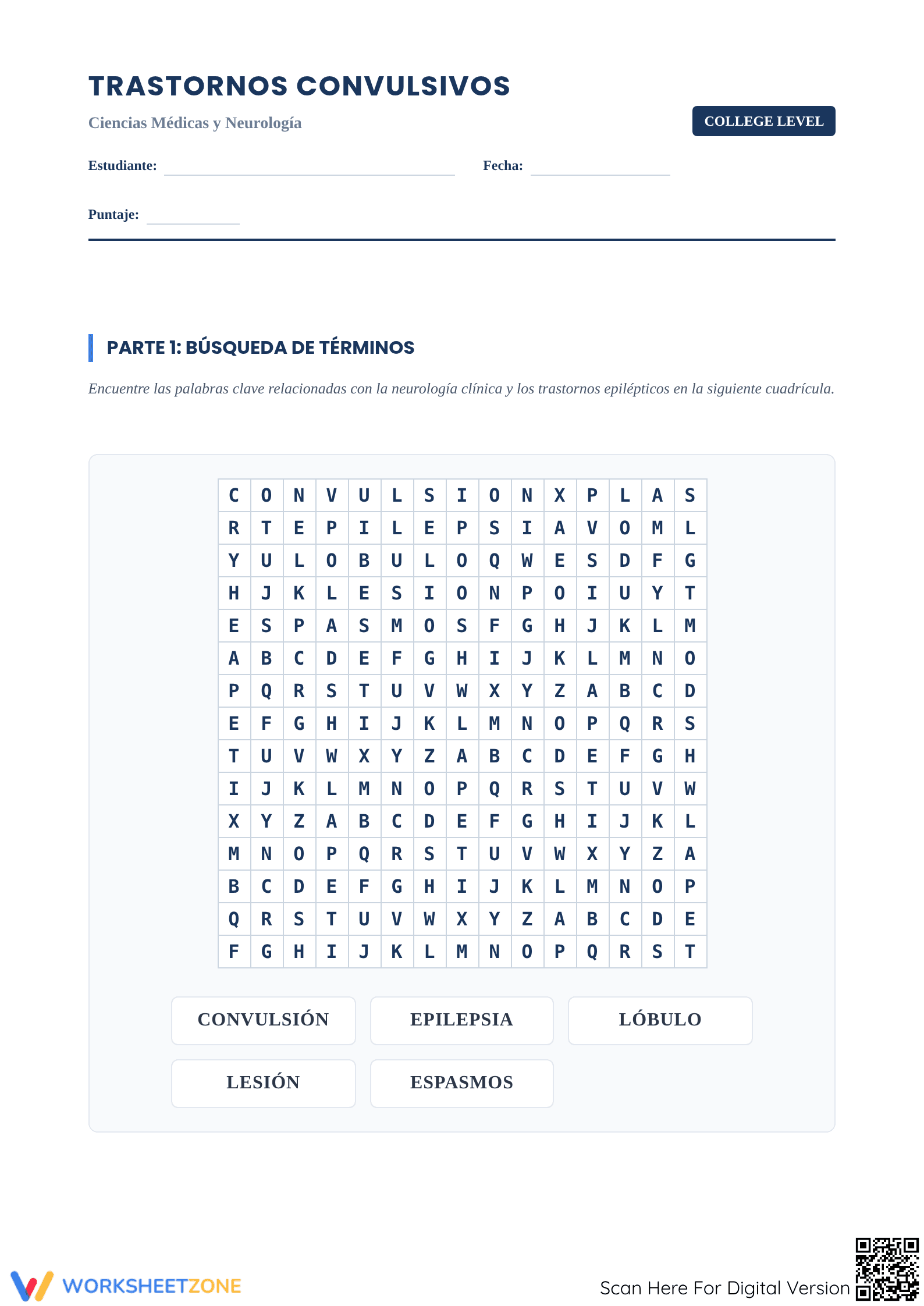


Essential Seizure Disorders Worksheet | College Neurology
Paste this activity's link or code into your existing LMS (Google Classroom, Canvas, Teams, Schoology, Moodle, etc.).
Students can open and work on the activity right away, with no student login required.
You'll still be able to track student progress and results from your teacher account.
Master the complexities of clinical neurology with this targeted seizure disorders worksheet. Designed for higher education, this resource facilitates a deep understanding of epileptic pathologies through terminology mastery and applied case study analysis. Students translate abstract medical concepts into diagnostic insights, ensuring a robust foundation for clinical practice and academic examinations.
At a Glance
- Grade: College · Subject: Medical Sciences
- Standard:
MED-NEURO-C1— Identify and define neurological conditions using clinical terminology for patient assessment- Skill Focus: Neurological Terminology & Diagnostic Analysis
- Format: 2 pages · 11 tasks · Answer key included · PDF
- Best For: Neurology exam preparation and clinical review
- Time: 30–45 minutes
This comprehensive two-page document features three distinct instructional segments. It includes a medical terminology word search, a technical matching section where students pair terms with clinical definitions, and a critical thinking case study. The package comes with a full answer key, providing immediate feedback and making it a versatile tool for both independent study and classroom instruction.
Skill Progression
- Guided Practice: A terminology word search helps students recognize five foundational terms, providing a low-stakes entry point into the specific vocabulary of seizure disorders.
- Supported Practice: Five matching exercises require students to connect terms like "Epilepsia" and "Espasmos" to precise clinical descriptions, reinforcing the semantic accuracy required in medical documentation.
- Independent Practice: A narrative case study challenges students to apply their knowledge to a real-world scenario, identifying conditions based on localized trauma and recurrent symptoms without external scaffolding.
Each phase of the worksheet follows the gradual release of responsibility model, ensuring that students gain confidence in their diagnostic reasoning before tackling complex case applications.
Standards Alignment
The primary standard MED-NEURO-C1 focuses on the ability to "identify and define neurological conditions using clinical terminology for patient assessment." This resource aligns with advanced healthcare curriculum goals by bridging the gap between basic vocabulary and complex diagnostic reasoning. Both standard codes can be copied directly into lesson plans, IEP goals, or district curriculum mapping tools.
How to Use It
Utilize this worksheet as a formative assessment after an introductory lecture on epilepsy and seizure types. Instructors can use the case study as a "think-pair-share" activity to observe how students apply terminology to clinical scenarios. Expect students to complete the full sequence in approximately 40 minutes, depending on their familiarity with the Spanish medical terminology provided. It is also suitable for timed clinical review sessions.
Who It's For
This resource is specifically tailored for college-level nursing students, medical assistants, or neurology residents. It serves as an excellent reinforcement tool for Spanish-speaking medical professionals or students in bilingual health programs. It pairs effectively with clinical neuroanatomy textbooks or interactive seizure classification charts used during direct instruction rotations.
According to a ScienceDirect TpT Analysis (2024), the integration of vocabulary-based retrieval practice with applied scenario analysis significantly improves long-term retention of medical terminology among post-secondary learners. This seizure disorders worksheet employs these evidence-based strategies by first establishing a familiar lexical framework via the MED-NEURO-C1 terminology set before transitioning to higher-order cognitive tasks. By requiring students to articulate the plain-English skill of diagnostic classification through Spanish technical terms, the resource creates multiple neural pathways for recall. Educational researchers emphasize that worksheets providing immediate application of new terms to patient-centered scenarios—such as the case study included here—yield higher engagement scores than traditional rote memorization. This printable resource ensures that students are not merely identifying words but are prepared to utilize those terms in a professional medical context during patient intake and neurology ward rounds.


