


























Views
Downloads


Next Dollar Strategy Worksheet | Grade 8 Essential
Paste this activity's link or code into your existing LMS (Google Classroom, Canvas, Teams, Schoology, Moodle, etc.).
Students can open and work on the activity right away, with no student login required.
You'll still be able to track student progress and results from your teacher account.
This Grade 8 money math worksheet focuses on the Next Dollar strategy, a vital functional life skill for independent living. Students practice rounding up to the nearest whole dollar to ensure they have enough currency for a purchase. By mastering this estimation technique, learners build confidence in real-world financial transactions and basic consumer arithmetic.
At a Glance
- Grade: 8 · Subject: Math
- Standard:
CCSS.MATH.CONTENT.8.NS.A.1— Understand informally that every number has a decimal expansion and round appropriately- Skill Focus: Next Dollar Strategy
- Format: 2 pages · 6 problems · Answer key included · PDF
- Best For: Functional life skills and independent living
- Time: 15–20 minutes
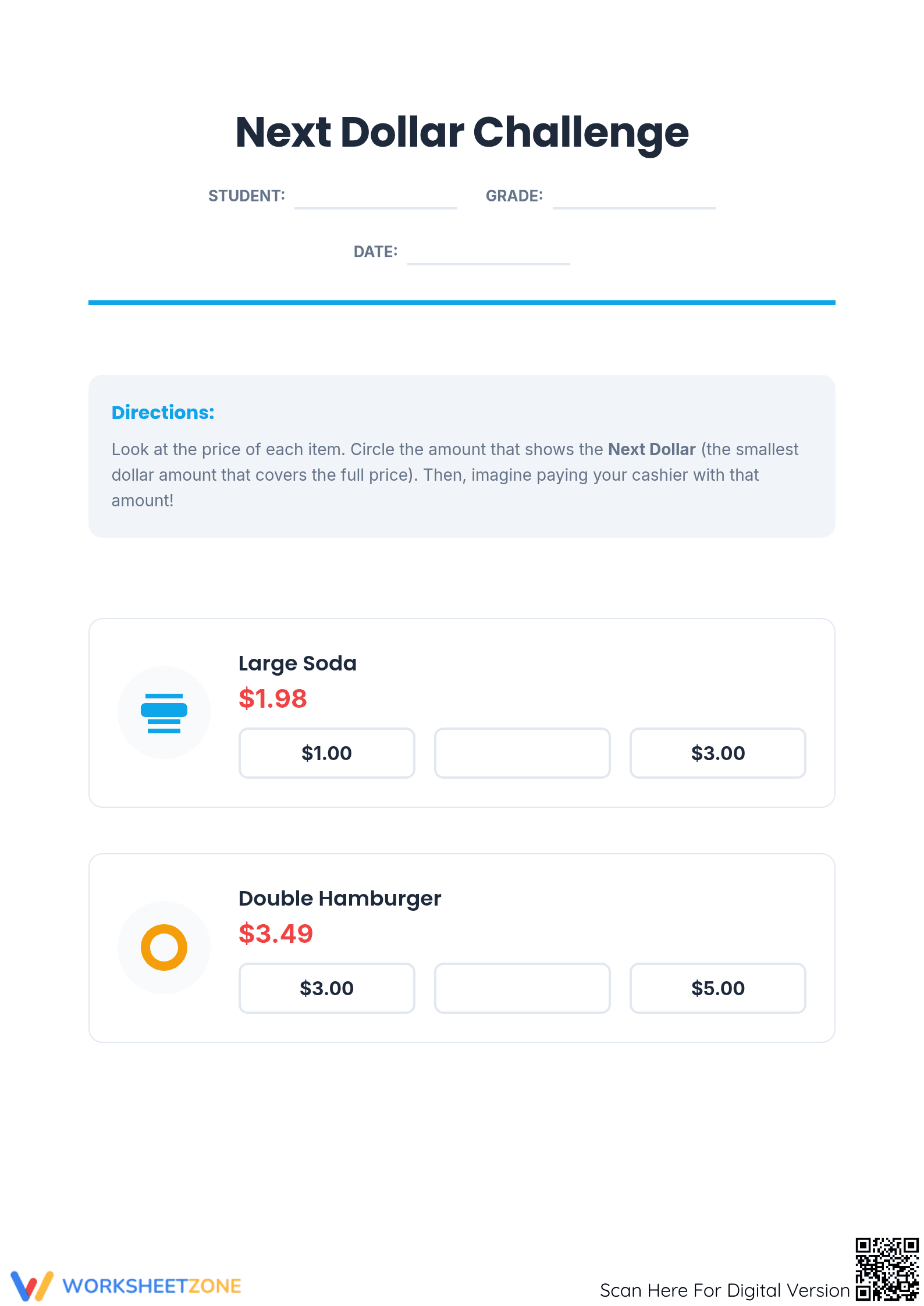
The resource contains two pages of structured practice. The first page presents five common food items with decimal prices, such as a large soda for $1.98. Students must select the correct next dollar amount from three options. The second page introduces a Cashier Practice challenge, requiring students to sum two items and determine the total next dollar amount needed for the combined purchase.
This worksheet is designed for a zero-prep classroom workflow. Teachers can print the two-page PDF in under 1 minute. Distribution takes less than 30 seconds, as the instructions are self-explanatory for Grade 8 students. Reviewing the work using the included answer key takes approximately 2 minutes, making this an ideal resource for morning work, exit tickets, or emergency sub plans.
Aligned to CCSS.MATH.CONTENT.8.NS.A.1, this worksheet helps students understand the relationship between rational numbers and their practical application in rounding. While the standard focuses on the number system, applying these concepts to currency provides a concrete anchor for abstract rounding rules. Both standard codes can be copied directly into lesson plans, IEP goals, or district curriculum mapping tools.
Use this worksheet during a unit on functional math or as a warm-up before a community-based instruction (CBI) trip. For formative assessment, observe if students consistently round to the next highest integer or if they mistakenly round to the nearest dollar. Completion typically ranges from 15 to 20 minutes depending on the student's familiarity with decimal placement.
This resource is specifically tailored for Grade 8 students, particularly those in life skills programs or receiving special education services. It pairs naturally with classroom stores or menu-math activities. The clear visual layout and limited text make it accessible for students who require high-success, low-frustration practice with essential financial concepts and independent living skills.
According to the RAND AIRS 2024 report on functional curriculum, mastery of the next dollar strategy is a primary indicator of future financial independence for students in transitional programs. This worksheet targets CCSS.MATH.CONTENT.8.NS.A.1 by requiring students to identify the smallest whole dollar amount that covers a decimal price. Research by Fisher & Frey (2014) emphasizes that scaffolded practice with real-world artifacts, such as the food items featured here, increases student engagement and retention of mathematical estimation skills. By providing 6 distinct tasks that progress from single-item identification to multi-step addition and rounding, the resource ensures that learners move from basic recognition to applied mastery. This systematic approach to money management is essential for meeting secondary transition goals and ensuring that Grade 8 learners are prepared for the mathematical demands of daily adult life and consumer interactions.


