


























Views
Downloads

Essential Grade 2 Animal Needs Worksheet | Cats vs Lions
Paste this activity's link or code into your existing LMS (Google Classroom, Canvas, Teams, Schoology, Moodle, etc.).
Students can open and work on the activity right away, with no student login required.
You'll still be able to track student progress and results from your teacher account.
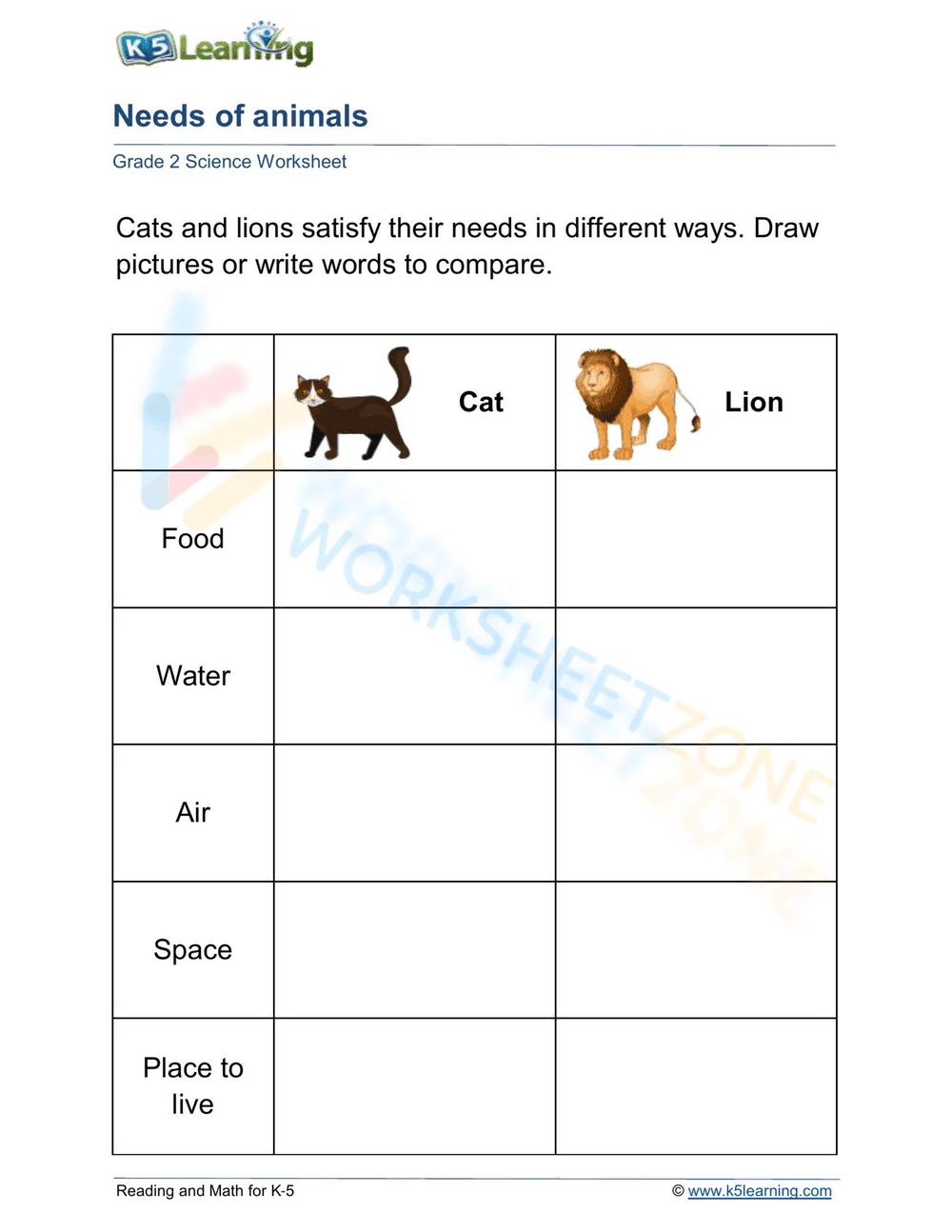
This essential Grade 2 science worksheet helps students compare the basic survival needs of domestic cats and wild lions. By identifying how different animals satisfy their requirements for food, water, air, and shelter, learners develop a foundational understanding of biological patterns. This activity facilitates critical thinking as students observe similarities in animal behaviors.
At a Glance
- Grade: 2 · Subject: Living Things
- Standard:
K-LS1-1— Describe patterns of what animals need to survive in different environments- Skill Focus: Survival needs and habitat comparison
- Format: 2 pages · 5 tasks · Answer key included · PDF
- Best For: Independent practice or science center activity
- Time: 15–20 minutes
What's Inside
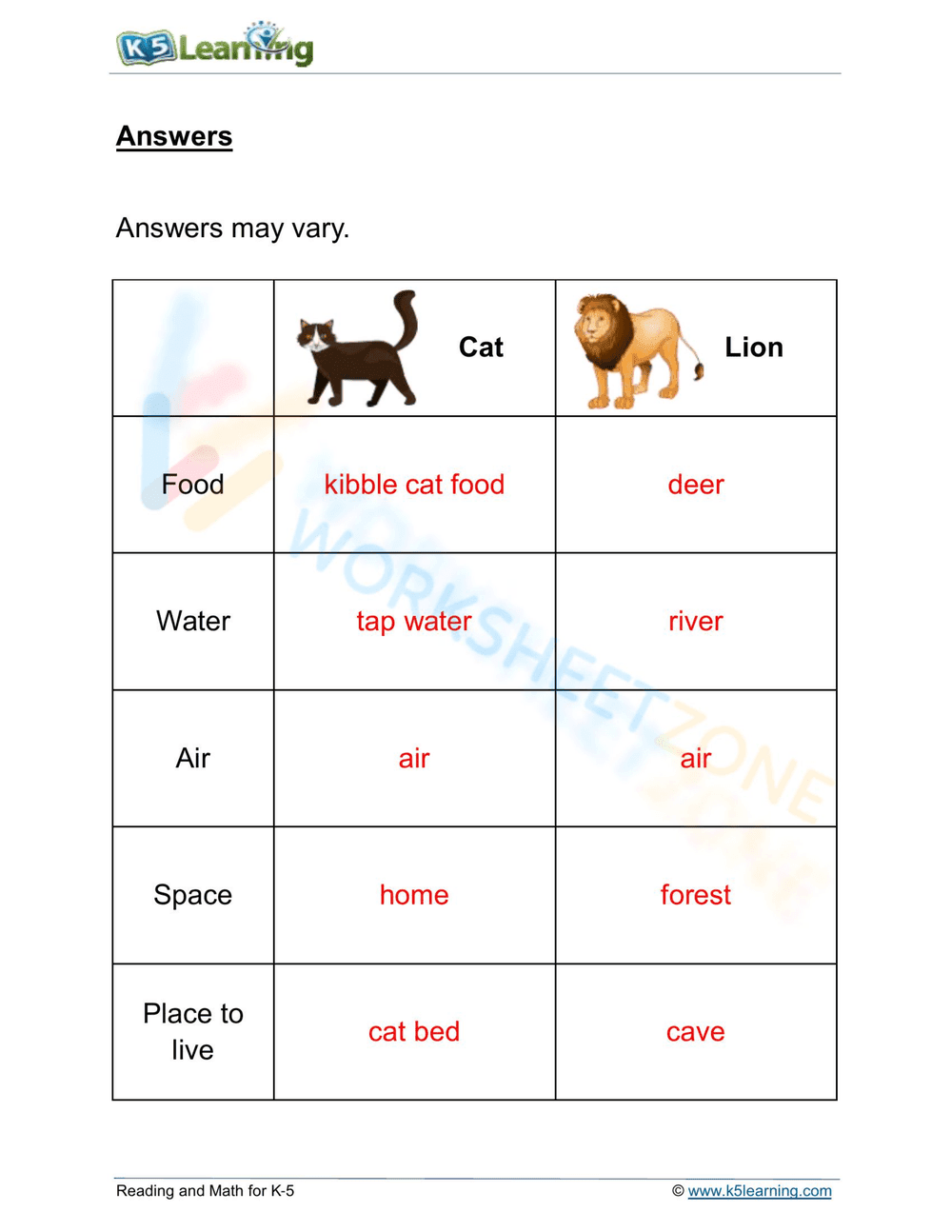
This two-page PDF includes a focused comparison chart featuring five specific survival categories: food, water, air, space, and a place to live. The first page provides the student worksheet where children can draw pictures or write words to differentiate between a house cat and a lion. The second page contains a full answer key with sample responses like "kibble" versus "deer" to guide instruction and self-correction.
Zero-Prep Workflow
This resource is designed for maximum efficiency in busy classrooms:
- Step 1: Print (15 seconds) — Download the PDF and send the student worksheet to your printer.
- Step 2: Distribute (30 seconds) — Hand out the copies along with pencils or coloring supplies.
- Step 3: Review (45 seconds) — Use the sample answer key to verify student understanding.
Total teacher preparation time is under 2 minutes. This worksheet is perfect for morning work, science centers, or emergency substitute lesson plans where zero setup is required.
Standards Alignment
This resource is aligned to `K-LS1-1`: "Use observations to describe patterns of what plants and animals (including humans) need to survive." While introduced in kindergarten, these core concepts are reinforced in Grade 2 as students explore broader biodiversity and habitat relationships. This standard code can be copied directly into lesson plans, IEP goals, or district curriculum mapping tools.
How to Use It
Use this worksheet as a formative assessment after a direct instruction lesson on animal needs. Have students work independently to fill in the chart, then pair-share their drawings to compare their thinking. Teachers should observe whether students distinguish between "man-made" versus "natural" sources of food and water. This task typically takes 15 to 20 minutes to complete.
Who It's For
This activity is designed for second-grade students but is highly accessible for English Language Learners due to the option to draw responses. It pairs naturally with a non-fiction reading passage about African savannas or a classroom discussion about pet care responsibilities during a biological science unit.
The "Needs of Animals: Cats vs. Lions" worksheet leverages the standard `K-LS1-1` to help Grade 2 students identify survival patterns through comparative observation. Research from `Fisher & Frey (2014)` emphasizes that using graphic organizers like comparison charts helps young learners organize complex biological information and move toward independent mastery of scientific concepts. By contrasting a domestic animal with a wild counterpart, students practice applying their knowledge of food, water, and shelter to various contexts, which is a key component of the Science and Engineering Practices. This worksheet provides a structured environment for students to record observable data, bridging the gap between simple identification and higher-order analysis of animal survival strategies. Educators can use these results to gauge student readiness for more complex ecosystem studies, ensuring that the fundamental requirements of life are clearly understood before progressing to food webs or adaptations.


