




























Views
Downloads
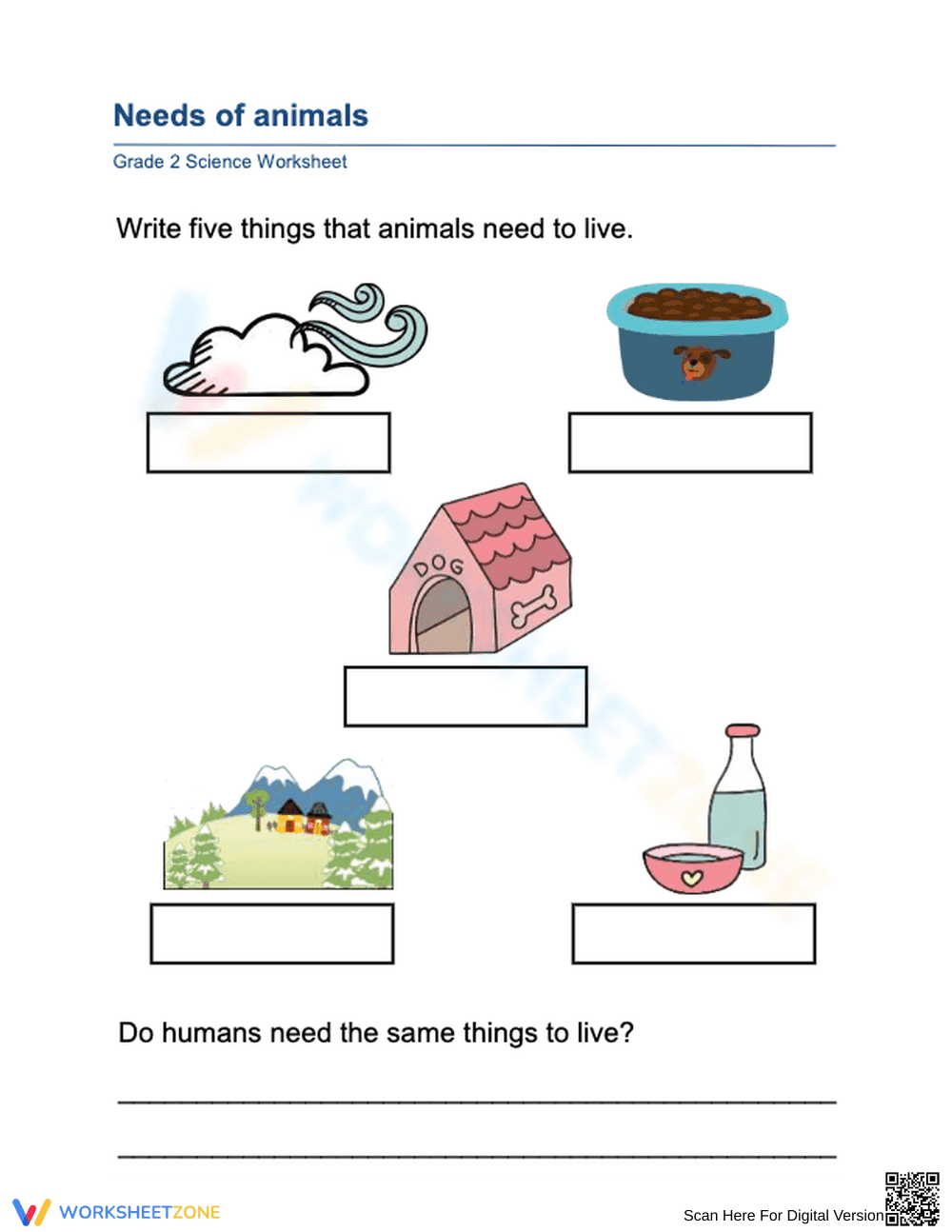

Essential Needs of Animals Worksheet | Grade 1 Science

Paste this activity's link or code into your existing LMS (Google Classroom, Canvas, Teams, Schoology, Moodle, etc.).
Students can open and work on the activity right away, with no student login required.
You'll still be able to track student progress and results from your teacher account.
This Grade 1 Science worksheet focuses on the fundamental survival needs of animals, guiding students to recognize what every living creature requires to thrive. By labeling visual prompts and connecting animal needs to human survival, learners develop a concrete understanding of biological requirements. It serves as a foundational step toward exploring habitats and ecosystems.
At a Glance
- Grade: 1 · Subject: Science
- Standard:
1-LS1-1— Use materials to design solutions mimicking how animals meet their survival needs- Skill Focus: Survival requirements (food, water, air, shelter, space)
- Format: 2 pages · 6 problems · Answer key included · PDF
- Best For: Introduction to life science and habitats
- Time: 15–20 minutes
The resource includes a visually clear worksheet and a matching answer key. Students are presented with five distinct illustrations representing air, food, shelter, space, and water. A final critical thinking prompt asks students to compare animal needs to human requirements, reinforcing the universality of survival basics across two comprehensive pages.
Zero-Prep Workflow: 1. Print: Simply print the two-page PDF directly from your browser. 2. Distribute: Hand out the worksheet during your life science unit. 3. Review: Use the included answer key for immediate student feedback or a quick whole-class check. Total teacher prep time is under 2 minutes, making this an ideal resource for busy mornings or unexpected substitute plans.
Standards Alignment: This resource aligns with `1-LS1-1`: "Use materials to design a solution to a human problem by mimicking how plants and/or animals use their external parts to help them survive, grow, and meet their needs." Both standard codes can be copied directly into lesson plans, IEP goals, or district curriculum mapping tools.
How to Use It: Use this as an exit ticket after a lesson on living things to see if students can recall all five survival elements as a formative check. Alternatively, place this in a self-directed science center where students can work independently and check their own work using the provided key. Expected completion time is 15-20 minutes.
Who It's For: This activity is designed for first-grade students, ELL learners requiring visual support, and home-school parents looking for structured science practice. It pairs naturally with an introductory video on animal habitats or a classroom pet observation activity to provide hands-on context for theoretical concepts.
The `1-LS1-1` standard requires students to understand how organisms meet their needs to survive. This worksheet provides the essential vocabulary and conceptual scaffolding for that mastery. Research from the `ScienceDirect TpT Analysis` indicates that visual-verbal association tasks significantly improve retention of scientific concepts in early elementary learners. By identifying air, food, water, space, and shelter through illustrations, students build a robust mental model of biological necessity. This foundational knowledge is critical for later grades where students analyze complex ecosystem interactions and environmental adaptations. The inclusion of a comparative question about human needs further cements the concept by applying scientific observation to the students' own lived experience, a key strategy for developing scientific literacy as defined by the NGSS framework for early childhood education.


