


























Views
Downloads
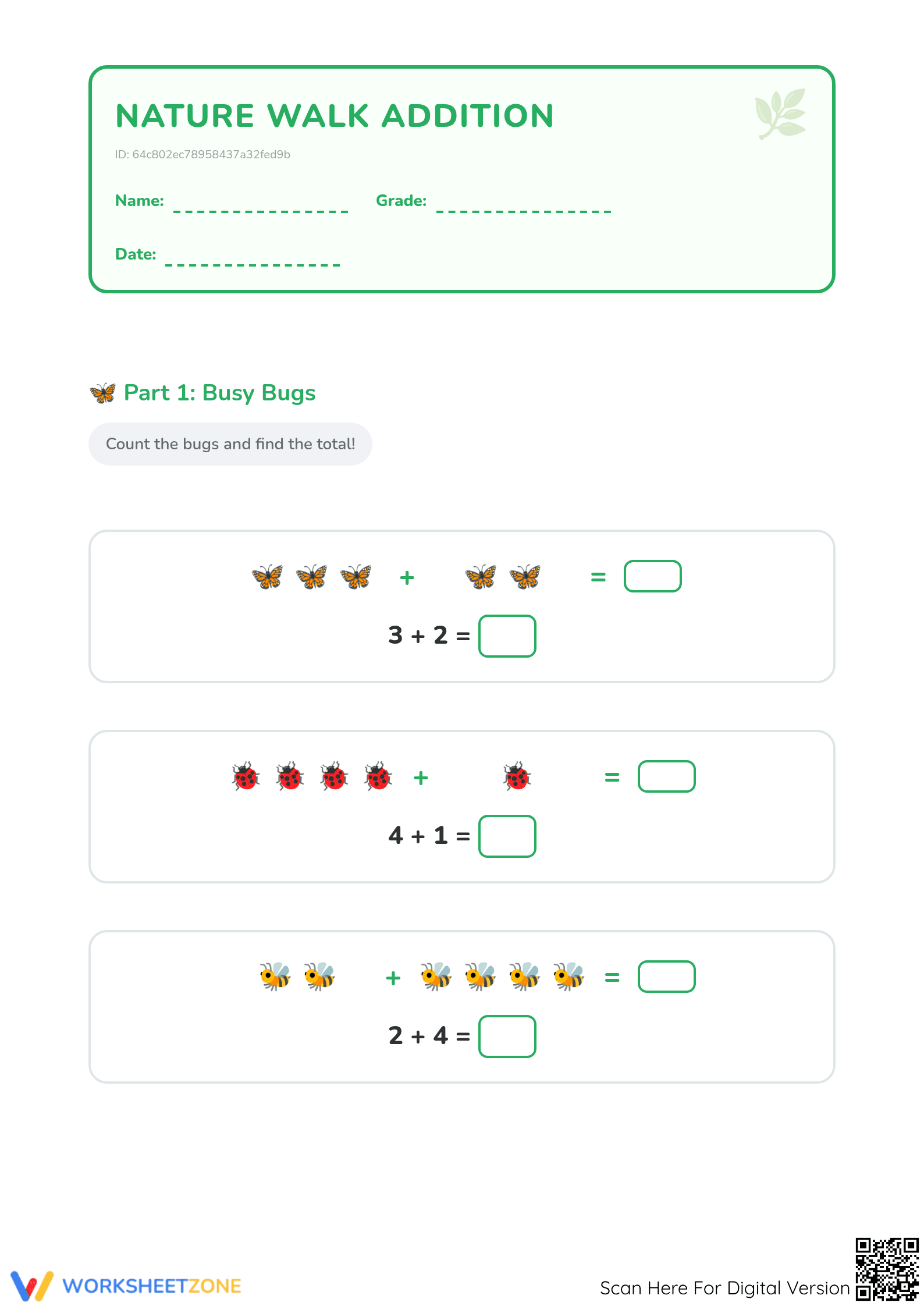


Grade 1 Nature Addition — Printable No-Prep Worksheet
Paste this activity's link or code into your existing LMS (Google Classroom, Canvas, Teams, Schoology, Moodle, etc.).
Students can open and work on the activity right away, with no student login required.
You'll still be able to track student progress and results from your teacher account.
This Grade 1 Nature Walk addition worksheet provides young learners with a vibrant, engaging way to master sums within 10. By combining visual counting with introductory word problems, students build the foundational number sense required for mathematical fluency. It transforms abstract arithmetic into a concrete exploration of the natural world.
At a Glance
- Grade: 1 · Subject: Math
- Standard:
1.OA.A.1— Use addition within 20 to solve word problems and equations- Skill Focus: Addition within 10 with visual support
- Format: 3 pages · 9 problems · Answer key included · PDF
- Best For: Early finishers or morning work packets
- Time: 15–20 minutes
What's Inside
This comprehensive three-page PDF packet features four distinct learning sections designed to scaffold student understanding. Students begin by counting "Busy Bugs" and "Garden Growth" to solve visual equations, then transition to "Nature Stories" word problems involving birds, acorns, and frogs. The final section, "Draw Your Own," encourages creative application by asking students to design their own nature-themed addition problem.
Zero-Prep Workflow
The zero-prep design ensures this resource is classroom-ready in seconds. **Step 1: Print** — Send the three-page PDF to your printer in under 30 seconds. **Step 2: Distribute** — Hand out the packets to students for independent practice or centers (1 minute). **Step 3: Review** — Use the provided answer key to grade or lead a whole-class review in under 1 minute. Total teacher preparation time is less than two minutes, making it an ideal choice for sub-plans or emergency morning work.
Standards Alignment
This resource is primarily aligned to `1.OA.A.1`, which requires students to use addition within 20 to solve word problems involving situations of adding to and putting together. By representing these problems with objects and drawings, the worksheet also supports `1.OA.C.6` for mental math fluency within 10. Both standard codes can be copied directly into lesson plans, IEP goals, or district curriculum mapping tools.
How to Use It
Deploy this worksheet during the independent practice phase of a lesson on basic addition to reinforce counting strategies. It is also an excellent formative assessment tool; observe if students rely on counting individual bug images or if they can identify the written numerals to solve the equation. Expect a completion time of 20 minutes for most first graders.
Who It's For
This packet is designed for Grade 1 students requiring focused practice on single-digit addition. The visual scaffolds make it highly effective for English Language Learners (ELL) and students with IEP accommodations. It pairs naturally with a hands-on math manipulative set or a classroom nature-themed anchor chart to provide a cohesive learning experience.
Research by Fisher & Frey (2014) highlights that gradual release of responsibility—moving from visual scaffolds to abstract word problems—is critical for early numeracy development. This Nature Walk worksheet implements this evidence-based strategy by starting with object-based counting before introducing text-based scenarios. By integrating standard 1.OA.A.1 within a familiar environmental context, the resource reduces cognitive load and increases student engagement with mathematical concepts. The NAEP emphasizes that connecting math to real-world objects, such as bugs and acorns, helps solidify the part-part-whole relationship necessary for later operations. Educators can be confident that this printable supports both rigorous alignment and developmentally appropriate instructional design for six-to-seven-year-olds. This resource effectively bridges the gap between concrete counting and symbolic arithmetic through structured, repetitive practice. Standardized assessments often require students to interpret visual models, and this worksheet provides the exact repetition needed for mastery.


