


























Views
Downloads

Essential Natural Resources Worksheet | Grade 3 Science
Paste this activity's link or code into your existing LMS (Google Classroom, Canvas, Teams, Schoology, Moodle, etc.).
Students can open and work on the activity right away, with no student login required.
You'll still be able to track student progress and results from your teacher account.
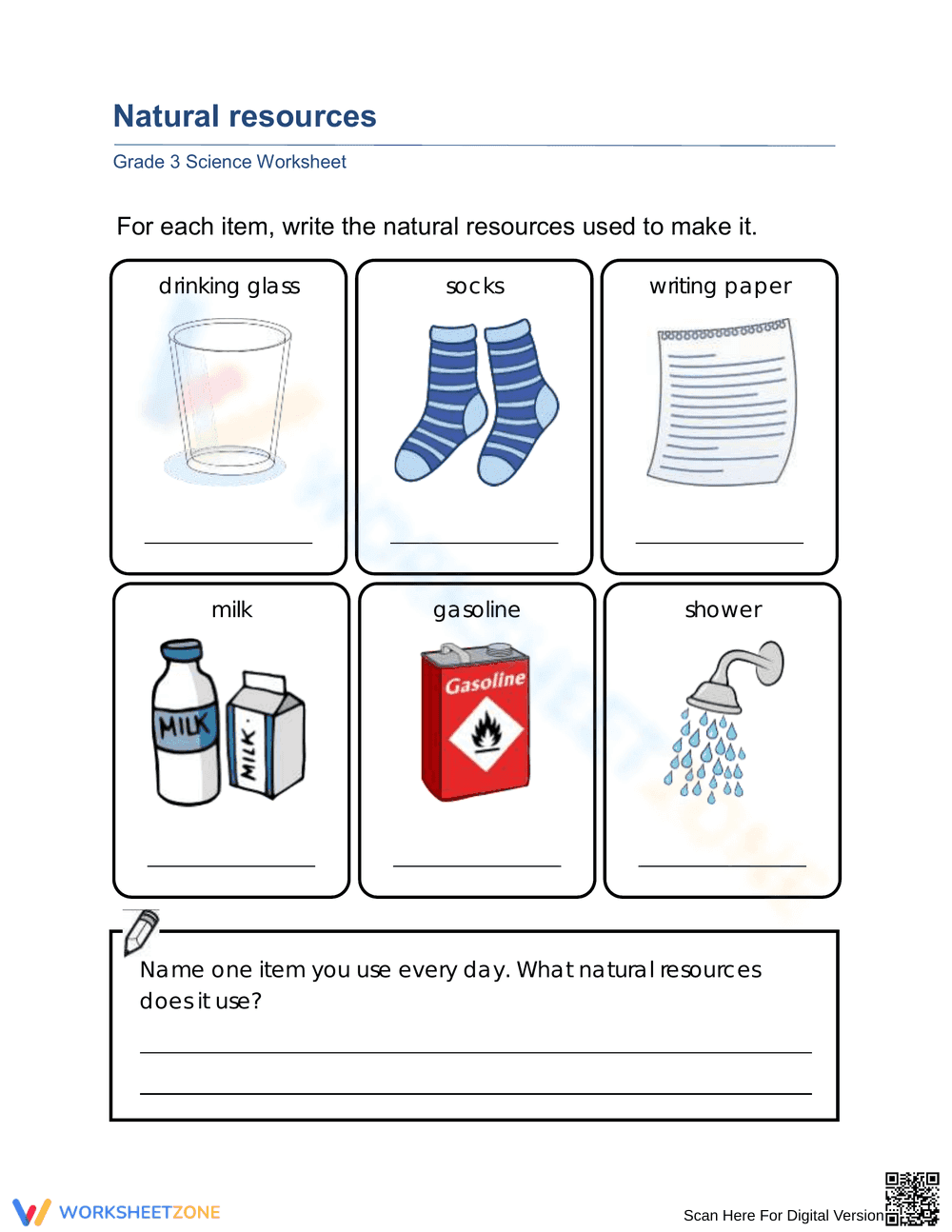
This Grade 3 science worksheet helps students bridge the gap between everyday items and their raw environmental origins. By identifying the natural resources used to manufacture products like glass, socks, and paper, learners develop a concrete understanding of human-environment interaction. This activity effectively builds critical thinking skills through scientific relationship mapping and evidence-based identification.
At a Glance
- Grade: 3 · Subject: Science & Environment
- Standard:
CCSS.ELA-LITERACY.RI.3.3— Describe the relationship between scientific ideas or concepts in a text- Skill Focus: Identifying origins of manufactured products
- Format: 1 page · 7 problems · Answer key included · PDF
- Best For: Introduction to Earth resources and manufacturing
- Time: 15–20 minutes
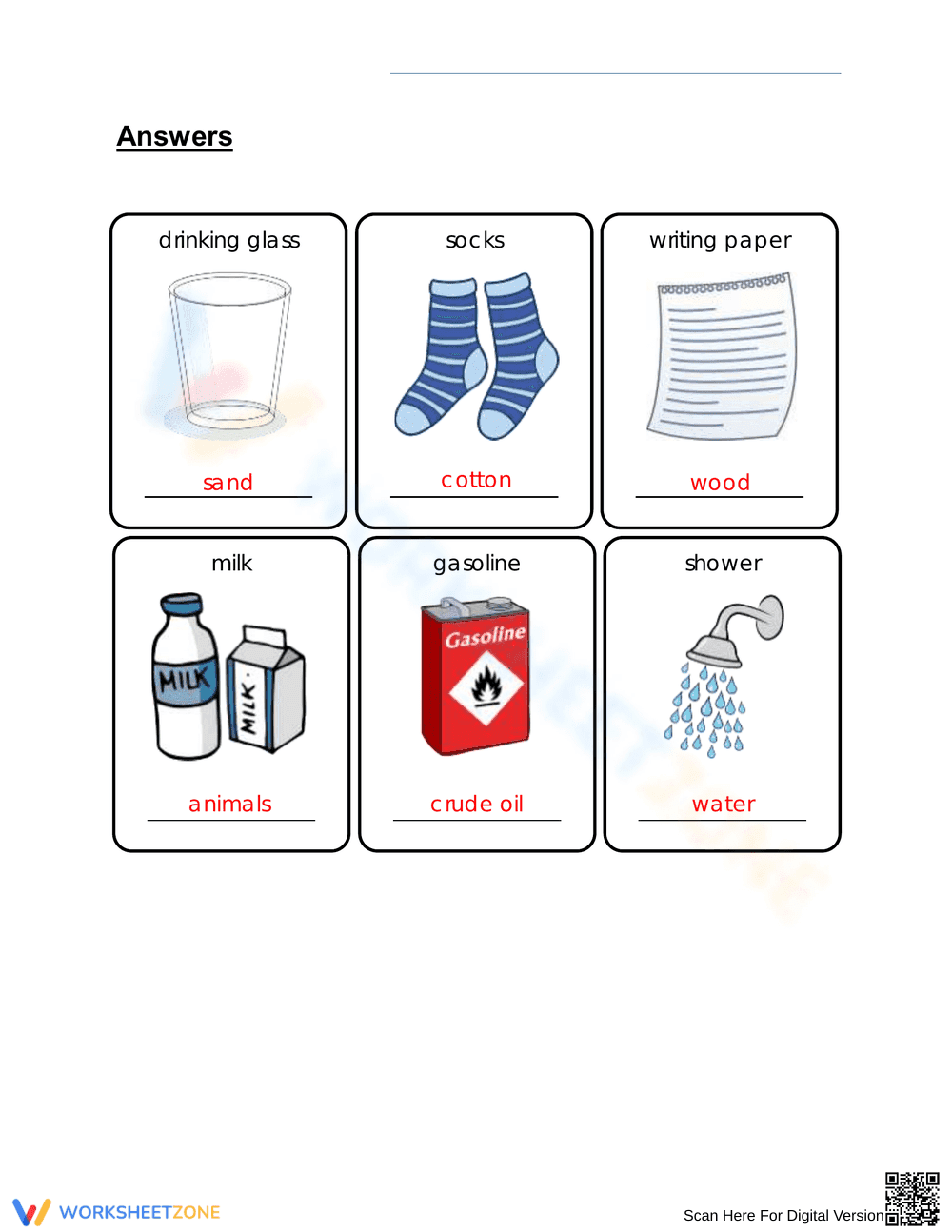
This single-page PDF features six visual prompts paired with identification lines, requiring students to match products like drinking glasses and gasoline to resources such as sand and crude oil. The layout includes clear, engaging illustrations that support visual learners. A final open-ended reflection question prompts students to apply their knowledge to a personally relevant everyday item, while the included answer key ensures immediate feedback.
Zero-Prep Workflow
Teachers can integrate this resource with under 2 minutes of prep. The workflow is streamlined: print copies, distribute at the start of a lesson, and use the included answer key for quick review. This print-and-go design is ideal for emergency substitute plans or independent morning work.
Standards Alignment
Aligned to CCSS.ELA-LITERACY.RI.3.3, this worksheet requires students to describe scientific relationships—specifically the connection between raw materials and finished goods. This standard code can be copied directly into lesson plans, IEP goals, or district curriculum mapping tools.
How to Use It
Assign this worksheet during the "Explain" phase of a 5E lesson on Earth's resources to solidify students' understanding of raw materials. It serves as an excellent formative assessment tool; as students work, observe their ability to connect complex items like gasoline to crude oil to gauge their grasp of non-renewable resources. Expected completion time is approximately 15 to 20 minutes.
Who It's For
This resource is designed for Grade 3 students, particularly those beginning a unit on environmental science or sustainability. It provides visual scaffolding for English Language Learners and can be naturally paired with an anchor chart depicting renewable versus non-renewable resources for additional support.
The CCSS.ELA-LITERACY.RI.3.3 standard emphasizes the importance of understanding relationships between scientific ideas, a foundational skill for elementary environmental literacy. This worksheet facilitates this by prompting students to trace the lifecycle of common products back to their environmental roots. According to Fisher & Frey (2014), visual scaffolds and structured practice are essential for helping younger learners internalize complex scientific relationships and vocabulary. By connecting abstract concepts like "crude oil" to the familiar sight of a "gasoline" can, students build lasting schema that supports higher-order thinking in later grades. This alignment with evidence-based instructional design ensures that students are not merely memorizing facts but are actively constructing a mental model of the world's resource systems. This 7-task resource provides the necessary repetition to ensure mastery of the core concept while maintaining high student engagement through clear, recognizable imagery.


