


























Views
Downloads

Essential Standard Deviation Worksheet | High School Math
Paste this activity's link or code into your existing LMS (Google Classroom, Canvas, Teams, Schoology, Moodle, etc.).
Students can open and work on the activity right away, with no student login required.
You'll still be able to track student progress and results from your teacher account.
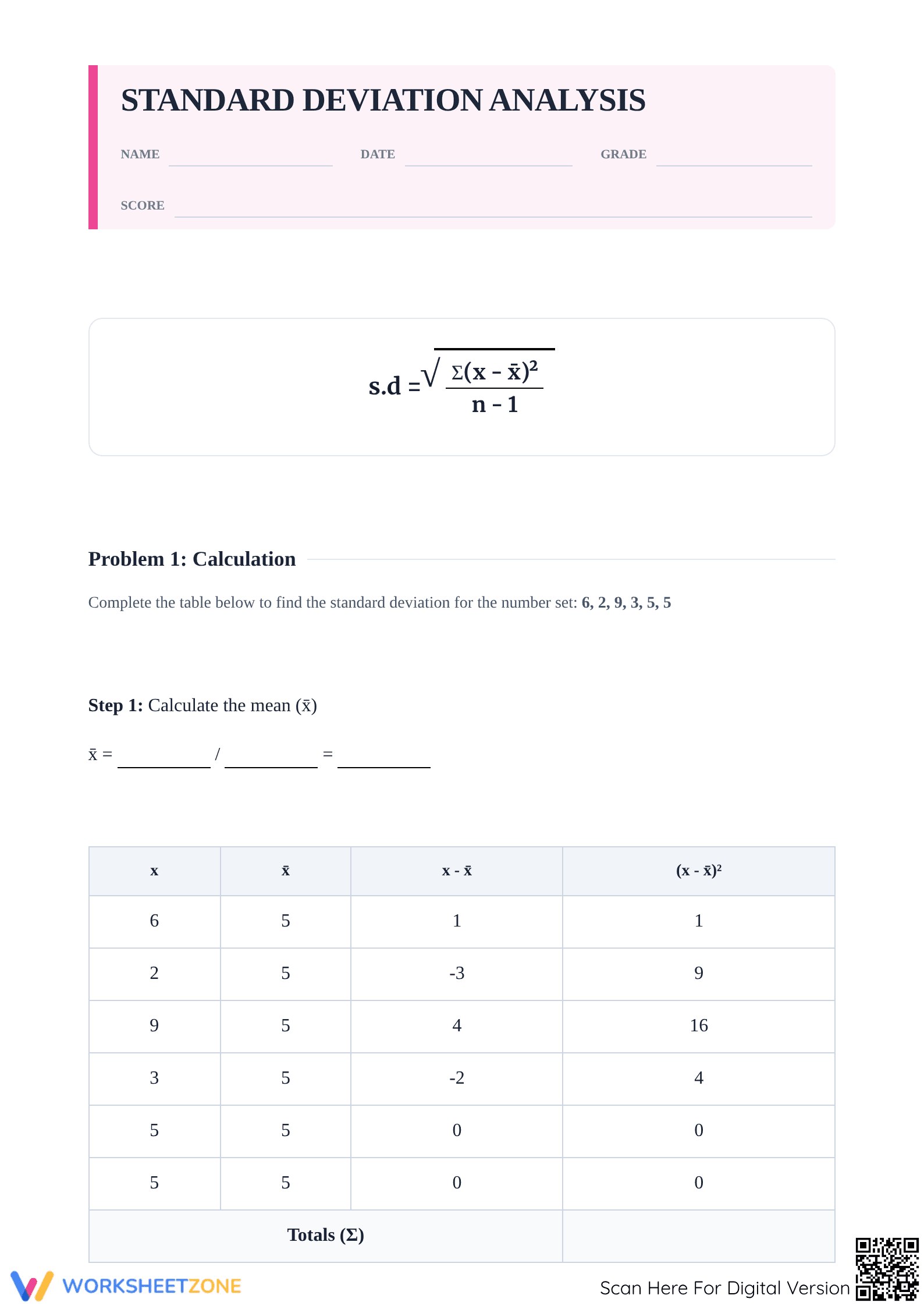
This comprehensive standard deviation worksheet empowers high school students to master complex statistical calculations through structured practice. By working through 14 progressively challenging data sets, learners develop a deep understanding of variance and data spread. Students successfully transition from basic formula application to interpreting real-world statistical consistency in various academic and practical contexts.
At a Glance
- Grade: 9–12 · Subject: Math (Statistics)
- Standard:
HSS.ID.A.2— Use statistics to compare center and spread of different data sets- Skill Focus: Standard Deviation Calculation
- Format: 4 pages · 14 problems · Answer key included · PDF
- Best For: High school statistics practice and assessment
- Time: 45–60 minutes
What's Inside
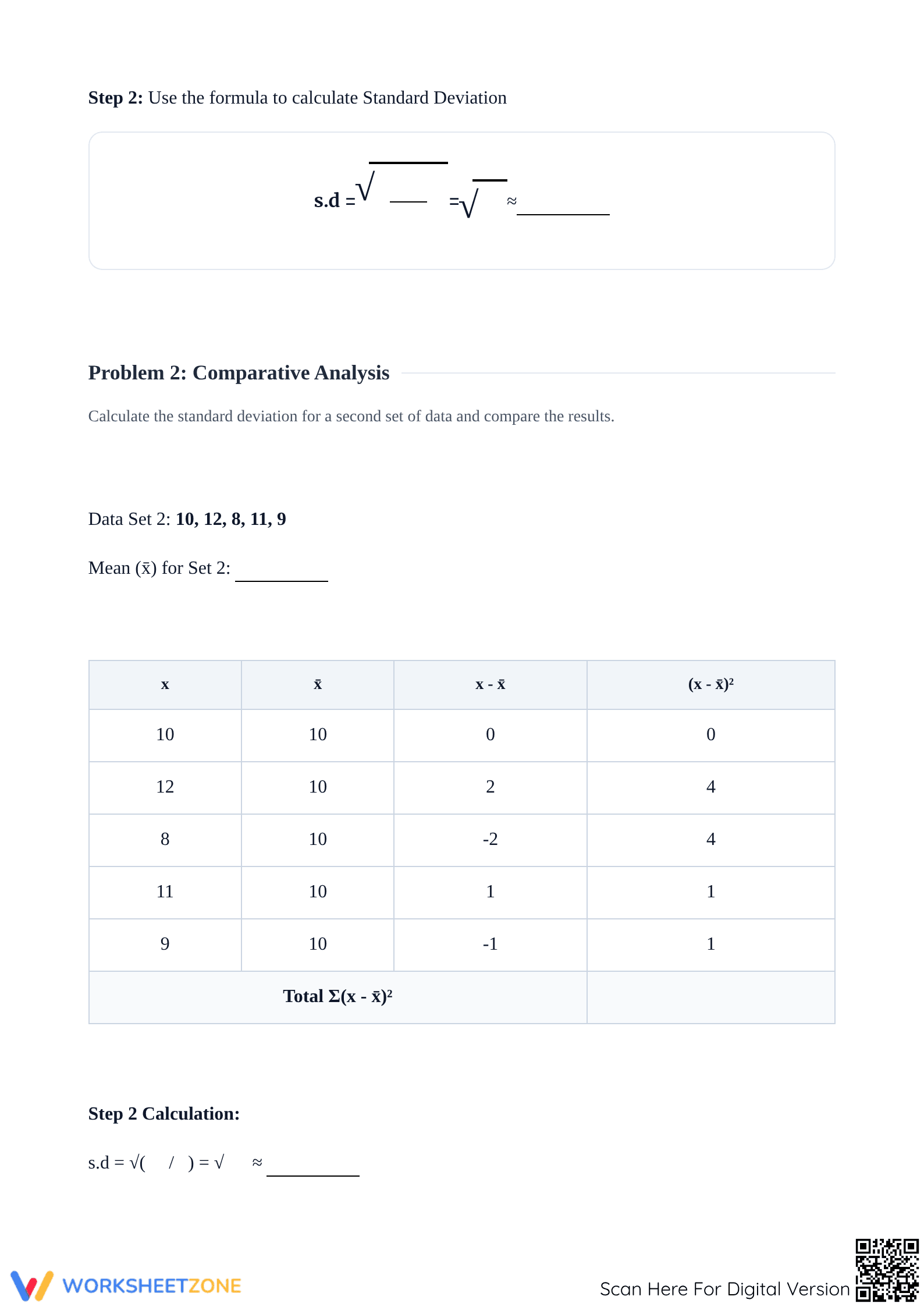
This 4-page instructional resource features 14 primary tasks designed to build computational fluency with standard deviation. The first page provides the essential formula and immediate application opportunities. Throughout the packet, students encounter diverse data sets including exam scores and agricultural yields. The resource includes a full answer key and ample workspace for multi-step calculations.
Skill Progression
- Guided practice: The initial section provides the formula and scaffolded steps for calculating the mean and squares of differences for small data sets.
- Supported practice: Middle tasks increase data set size and introduce varied contexts, requiring students to organize their work independently.
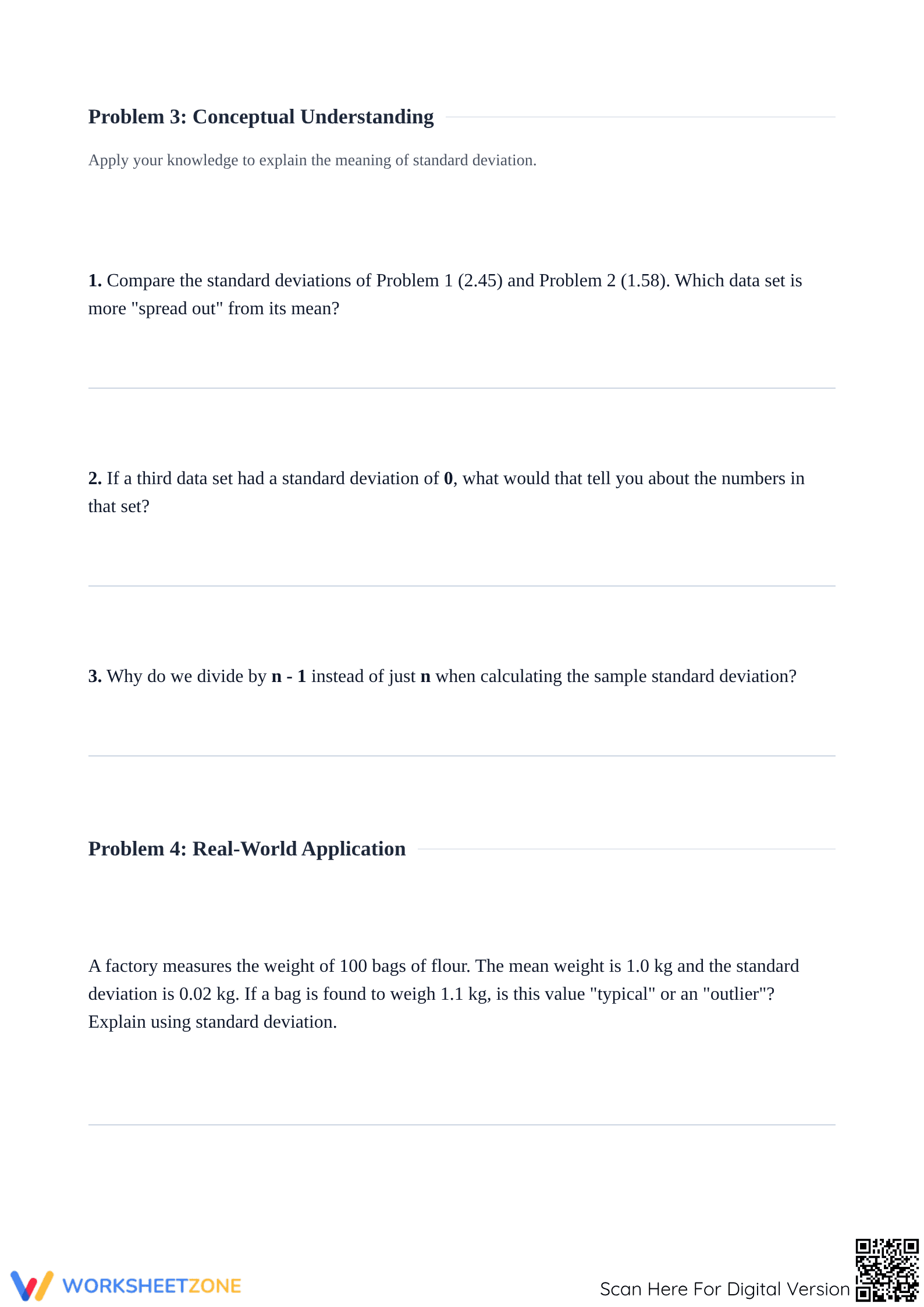
- Independent practice: Final tasks present larger numerical values and complex scenarios, challenging students to maintain precision without structural prompts.
This progression follows the I Do, We Do, You Do framework, allowing teachers to model the first calculation before students proceed to independent mastery.
Standards Alignment
The worksheet is strictly aligned to HSS.ID.A.2: "Use statistics appropriate to the shape of the data distribution to compare center (median, mean) and spread (interquartile range, standard deviation) of two or more different data sets." It specifically addresses the computational requirements for determining spread within statistical distributions. Standard codes can be copied directly into lesson plans, IEP goals, or district curriculum mapping tools.
How to Use It
This resource is ideal for use during the independent practice phase of a statistics unit. Assign the first two pages as in-class practice following direct instruction on the standard deviation formula. Use the remaining pages as a summative assessment or homework to verify student accuracy in multi-step processing. Teachers should observe whether students are correctly squaring the differences or forgetting to take the square root at the final step.
Who It's For
This worksheet is designed for Grade 9 through 12 students enrolled in Algebra 2, Pre-Calculus, or AP Statistics. It is particularly effective for learners who benefit from repetitive, structured calculation to internalize statistical concepts. Pair this resource with a standard deviation anchor chart or a digital graphing calculator lesson for a comprehensive learning experience.
Aligned with the Common Core State Standard HSS.ID.A.2, this worksheet focuses on the fundamental skill of calculating standard deviation to measure data spread. Educational research highlighted by Fisher & Frey (2014) emphasizes that the gradual release of responsibility, as mirrored in this 14-task progression, is essential for mastering high-order mathematical procedures. By moving from scaffolded formula application to independent calculation across four pages, students develop the procedural fluency required for more advanced data analysis. This resource provides the rigorous practice needed to meet National 5 and high school statistics benchmarks, ensuring that learners can accurately quantify variance within diverse data sets. Such structured practice is identified by EdReports (2024) as a key component of effective high school mathematics curricula, bridging the gap between basic arithmetic and the interpretive demands of modern data science and statistical reasoning in college-level coursework.


