




























Views
Downloads

Essential Names of Seasons Worksheet | Grade 1 Science

Paste this activity's link or code into your existing LMS (Google Classroom, Canvas, Teams, Schoology, Moodle, etc.).
Students can open and work on the activity right away, with no student login required.
You'll still be able to track student progress and results from your teacher account.
Students master the fundamental concept of seasonal cycles with this targeted Grade 1 science worksheet. By connecting vivid illustrations to specific terminology, learners build the vocabulary necessary to describe the natural world. This activity ensures students can accurately identify Spring, Summer, Fall, and Winter through observable environmental cues and weather patterns.
At a Glance
- Grade: 1 · Subject: Science
- Standard:
1-ESS1-2— Observe and describe patterns of seasonal change throughout the year- Skill Focus: Seasonal vocabulary and identification
- Format: 2 pages · 5 problems · Answer key included · PDF
- Best For: Quick assessment or independent morning work
- Time: 10–15 minutes
What's Inside
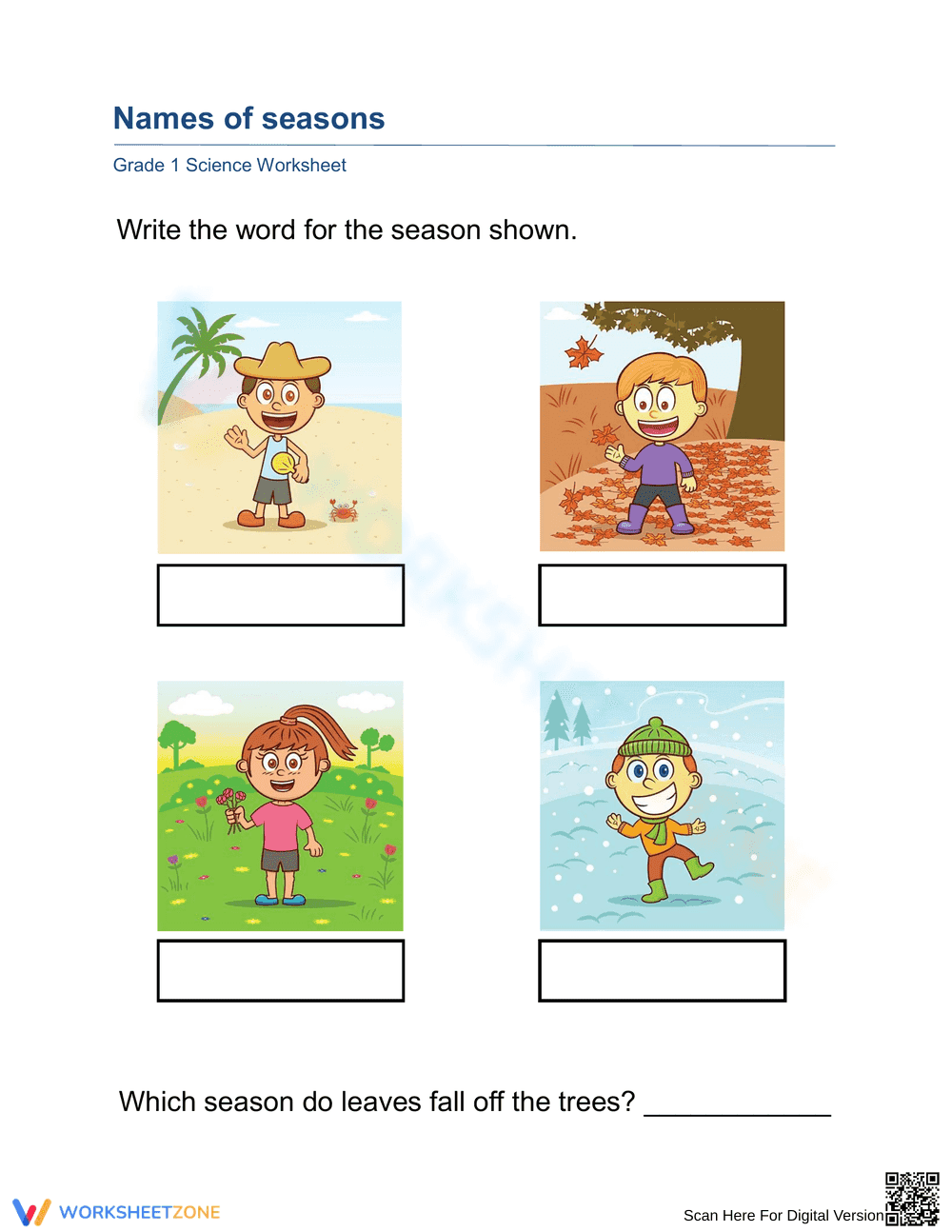
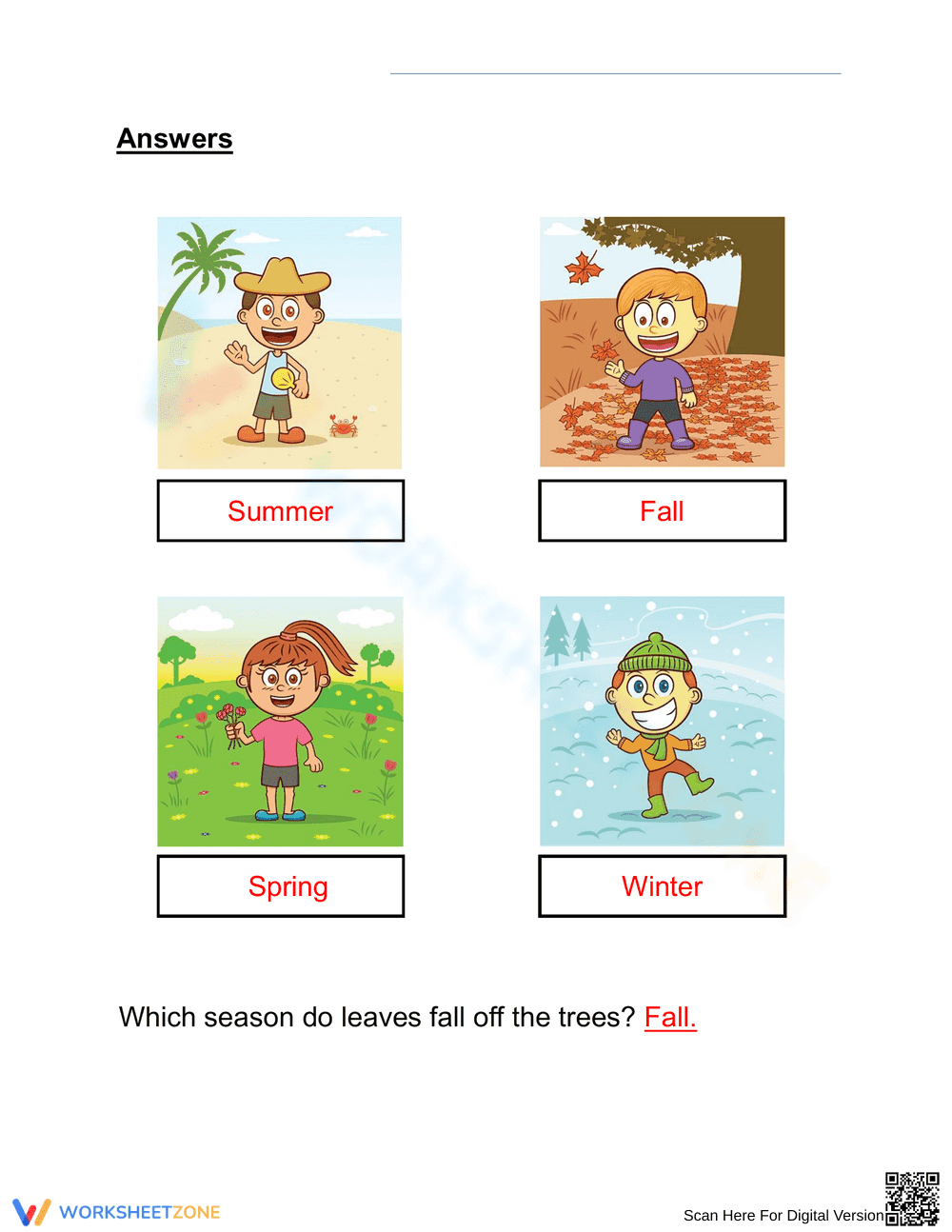
This PDF package contains two high-quality pages: a student activity sheet and a teacher answer key. The primary task features four distinct illustrations depicting children in seasonal settings—from a sunny beach to a snowy landscape. Students must write the correct season name in the box below each image. A final fifth task asks a conceptual question about falling leaves to reinforce environmental comprehension.
Zero-Prep Workflow
The Names of Seasons 2 worksheet is designed for immediate classroom implementation with a total teacher preparation time of under 2 minutes. The workflow is optimized for efficiency:
- Print: Download and print the single activity page for your class (30 seconds).
- Distribute: Hand out the sheets as a transition activity or a focused science center task (30 seconds).
- Review: Use the included answer key for a rapid whole-group review or individual grading (1 minute).
This streamlined process makes it an ideal choice for substitute lesson plans or unexpected schedule gaps during the instructional day.
Standards Alignment
This resource aligns with 1-ESS1-2, which requires students to make observations to relate daylight and weather patterns to the time of year. By naming the seasons, students demonstrate the foundational knowledge required for Earth Science investigations. It also supports L.1.5.A by having students categorize seasonal imagery into linguistic labels. Both standard codes can be copied directly into lesson plans, IEP goals, or district curriculum mapping tools.
How to Use It
Use this worksheet as a formative assessment after a direct instruction lesson on weather patterns. Observe if students can distinguish between the autumn leaves and the spring flowers without prompting. For a collaborative twist, have students work in pairs to describe the clues in each picture before writing the names. This identifies whether they understand the relationship between the environment and the season name.
Who It's For
This resource is specifically tailored for first-grade learners but serves as excellent remediation for second-grade students or enrichment for kindergarteners. It is particularly effective for English Language Learners (ELL) who benefit from the clear visual-to-word correspondence. Pair this worksheet with a seasonal anchor chart or a short non-fiction passage about the Earth's orbit for a complete science lesson.
The Names of Seasons 2 worksheet serves as a vital tool for meeting the 1-ESS1-2 science standard by requiring students to observe and describe patterns of seasonal change. Early exposure to these Earth Science concepts is critical; according to a 2024 NAEP analysis, students who master foundational environmental vocabulary in the primary grades demonstrate significantly higher proficiency in subsequent climate-based scientific inquiries. This worksheet provides five specific data points for teachers to measure a child's ability to categorize environmental stimuli into the four distinct phases of the calendar year. By utilizing high-contrast illustrations, the resource minimizes cognitive load while maximizing retention of the Spring, Summer, Fall, and Winter labels. This evidence-based approach to science instruction supports long-term conceptual mapping, allowing students to transition from simple identification to complex reasoning about Earth's systems and cycles.


