


























Views
Downloads

Essential Severe Weather Worksheet | Grade 1 Science
Paste this activity's link or code into your existing LMS (Google Classroom, Canvas, Teams, Schoology, Moodle, etc.).
Students can open and work on the activity right away, with no student login required.
You'll still be able to track student progress and results from your teacher account.
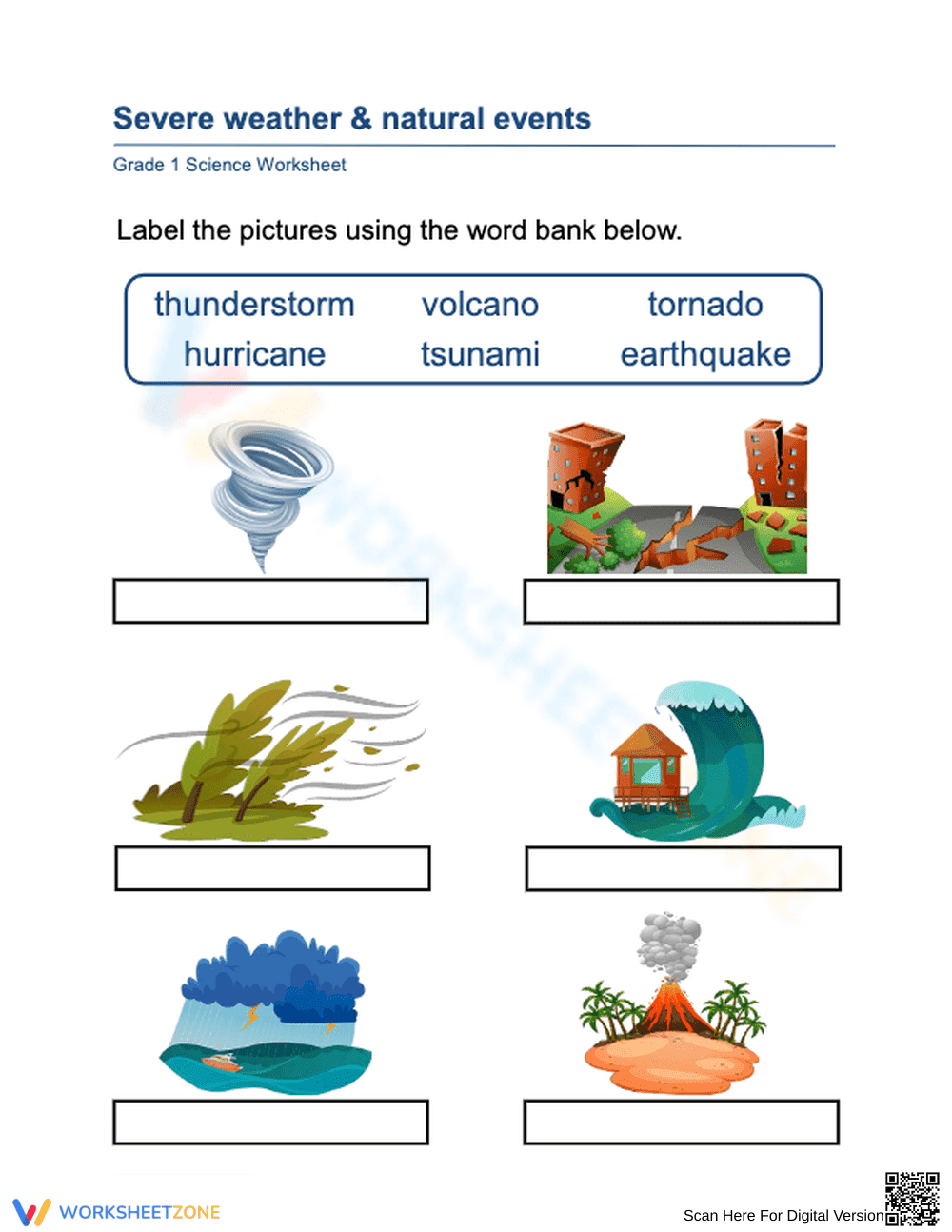
Students identify and categorize various severe weather and natural phenomena using this Grade 1 science worksheet. By matching visual representations with descriptive terms from a word bank, learners build foundational vocabulary for understanding Earth's systems. This resource ensures students can distinguish between atmospheric and geological events effectively.
At a Glance
- Grade: 1 · Subject: Science
- Standard:
K-ESS3-2— Identify and describe different types of severe weather and natural events- Skill Focus: Scientific vocabulary and visual identification
- Format: 2 pages · 6 problems · Answer key included · PDF
- Best For: Introduction to weather safety and identification
- Time: 10–15 minutes
What's Inside
This two-page PDF includes a student worksheet and a comprehensive answer key for immediate feedback. The primary task features six illustrations representing natural events, including hurricanes, volcanoes, and tsunamis. A structured word bank provides all necessary terms—thunderstorm, volcano, tornado, hurricane, tsunami, and earthquake—to support emerging readers and help them connect text to visual data.
Zero-Prep Workflow
This zero-prep design allows implementation in under two minutes of preparation time. Simply print the worksheet and distribute it immediately; no additional materials are required. Following the activity, the included answer key enables a rapid review session where students can self-correct or participate in a group discussion about each weather type, making it ideal for substitute plans.
Standards Alignment
This resource aligns with `K-ESS3-2`, focusing on observing and preparing for severe weather. It addresses the need to recognize environmental hazards as outlined in Earth Science frameworks. The worksheet targets the use of scientific language to describe the natural world. This standard code can be copied directly into lesson plans or curriculum mapping tools.
How to Use It
Use this as a formative assessment after a lesson on weather patterns. It works well during the "elaborate" phase of a 5E cycle or as morning work. Teachers should observe whether students distinguish between the wind of a tornado versus a tsunami, providing a window into their visual processing and vocabulary mastery. Completion typically takes fifteen minutes.
Who It's For
This activity is for first-grade students, Kindergarten enrichment, or second-grade review. The visual tasks make it excellent for English Language Learners developing science vocabulary. It pairs naturally with a classroom anchor chart or a short video on storm safety. The worksheet supports students who need clear visual cues to grasp abstract concepts.
The use of visual labeling in early science education is supported by the research of Fisher & Frey (2014) regarding the gradual release of responsibility and the importance of vocabulary-rich environments. By providing a structured word bank and clear illustrations, this worksheet reduces cognitive load while increasing the retention of the K-ESS3-2 standard concepts. Students who can accurately label and identify severe weather events are better prepared to engage in higher-order discussions about weather safety and environmental impact. This Grade 1 Science resource provides six distinct tasks that bridge the gap between simple observation and formal scientific classification. The inclusion of geological events like volcanoes and earthquakes alongside atmospheric phenomena like hurricanes ensures a comprehensive overview of natural hazards. This evidence-based approach to science literacy facilitates the development of mental models that students will utilize throughout their primary education and beyond.


