




























Views
Downloads
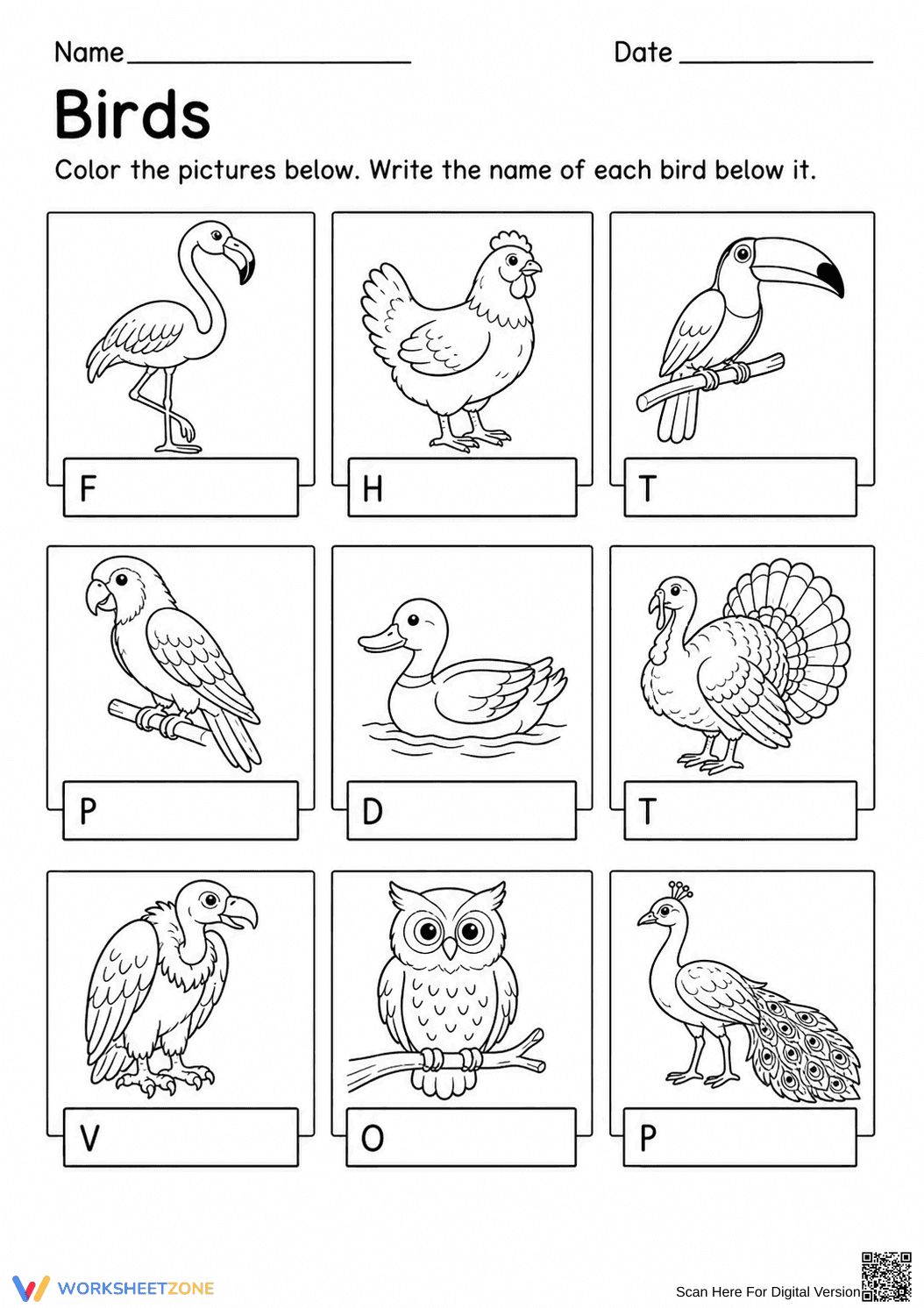

Grade K-1 Bird Naming — Printable No-Prep Worksheet

Paste this activity's link or code into your existing LMS (Google Classroom, Canvas, Teams, Schoology, Moodle, etc.).
Students can open and work on the activity right away, with no student login required.
You'll still be able to track student progress and results from your teacher account.
This Grade K-1 science worksheet helps early learners identify and name nine distinct bird species while practicing essential vocabulary. By combining coloring with initial-letter spelling scaffolds, students build critical observation skills and reinforce fine motor development in a structured, engaging format.
At a Glance
- Grade: PK–1 · Subject: Science
- Standard:
K-LS1-1— Observe and identify diverse bird species- Skill Focus: Bird identification and vocabulary
- Format: 1 page · 9 problems · Answer key included · PDF
- Best For: Early science centers and vocabulary building
- Time: 15–20 minutes
This one-page resource features a clean layout containing nine bird illustrations, ranging from common ducks to exotic toucans. Each task provides the initial letter of the bird's name as a scaffold, paired with a box for students to complete the spelling. The black-and-white line art is designed for coloring, extending engagement and allowing for fine motor development. A comprehensive answer key is provided for quick verification.
Zero-Prep Workflow
This worksheet is designed for maximum efficiency in the classroom. Follow these three simple steps:
- Print (30 seconds): Simply open the PDF and send it to your printer.
- Distribute (1 minute): Pass out the sheets with crayons and pencils.
- Review (1 minute): Use the included answer key to check for accuracy as students finish.
Total teacher preparation time is under two minutes, making it ideal for sub plans or morning work.
Standards Alignment
This activity aligns primarily with K-LS1-1, which requires students to use observations to describe patterns of what animals need to survive. By identifying diverse birds—from ducks to owls—students begin to categorize animal traits and recognize biological diversity. It also supports early literacy and vocabulary acquisition. Both standard codes can be copied directly into lesson plans, IEP goals, or district curriculum mapping tools.
How to Use It
Introduce this worksheet during the explain phase of a science unit. It works perfectly as a guided practice activity following a read-aloud about bird characteristics or animal classification. For formative assessment, observe students as they complete the naming boxes; look for their ability to distinguish between species using visual cues. The activity typically takes 15 to 20 minutes to complete.
Who It's For
Designed for Preschool, Kindergarten, and Grade 1, this worksheet is highly effective for English Language Learners who benefit from visual-to-text connections. The initial letter scaffolds provide crucial support for emerging writers, while the coloring component keeps younger students focused. It pairs naturally with an anchor chart depicting bird parts like beaks and feathers to reinforce the core science concepts.
According to the RAND AIRS 2024 report on early childhood science, integrating visual identification tasks with vocabulary reinforcement significantly improves long-term retention of biological concepts in students aged 4 to 7. This worksheet utilizes observation-based learning to meet the K-LS1-1 standard, requiring students to observe and identify diverse bird species through specific anatomical features shown in the illustrations. By engaging with nine diverse species, learners develop a broader understanding of animal diversity while practicing essential literacy skills. This evidence-based approach aligns with findings that multi-modal activities—combining coloring, reading, and writing—are highly effective at sustaining engagement in Tier 1 classroom environments compared to single-mode tasks. This resource provides the high-quality, aligned practice necessary for early mastery of life science topics, ensuring students remain focused while achieving measurable learning outcomes. The combination of identification and motor skill practice makes this an essential tool for early elementary educators.


